

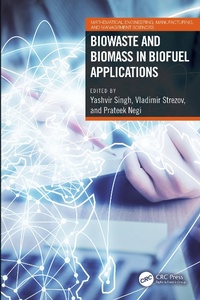
Biowaste and Biomass in Biofuel Applications
1st Edition
Published on 27. February 2023
312 pages
978-1-000-84014-8 (ISBN)
Description

This book reflects the new dimension of biofuel production from its introductory principles to the advancements from a future prospective. It summarizes the rationale for changes in liquid fuel utilization and the selection of new technologies to make biofuel cost-effective and move toward a carbon-neutral approach. It provides an evidence-based outline of how additives and nanotechnology chemically change biofuels' quality and effectiveness, including new and innovative approaches, such as nanomaterials and various nano-additives.
Features:
It provides an overview of biowaste as a sustainable source in the field of biofuel production
It includes effective conversion parameters of the biowaste feedstocks and their classification
It summarizes current research into the development and exploitation of new biofuel sources
It discusses the improvement of pilot scale scalability, chemical processing, and design flow
It presents relevant and realistic global explanations of biowaste management techniques for biofuels
This book is aimed at senior undergraduate and graduate students, and researchers in bioprocessing, chemical engineering, and biotechnology.
Features:
It provides an overview of biowaste as a sustainable source in the field of biofuel production
It includes effective conversion parameters of the biowaste feedstocks and their classification
It summarizes current research into the development and exploitation of new biofuel sources
It discusses the improvement of pilot scale scalability, chemical processing, and design flow
It presents relevant and realistic global explanations of biowaste management techniques for biofuels
This book is aimed at senior undergraduate and graduate students, and researchers in bioprocessing, chemical engineering, and biotechnology.
More details
Series
Edition
1. Auflage
Language
English
Place of publication
London
United Kingdom
Publishing group
Taylor & Francis Ltd
Target group
Professional and scholarly
Product notice
Reflowable
Illustrations
34 Tables, black and white; 38 Line drawings, black and white; 8 Halftones, black and white; 46 Illustrations, black and white
ISBN-13
978-1-000-84014-8 (9781000840148)
Copyright in bibliographic data and cover images is held by Nielsen Book Services Limited or by the publishers or by their respective licensors: all rights reserved.
Schweitzer Classification
Other editions
Additional editions
Yashvir Singh | Vladimir Strezov | Prateek Negi
Biowaste and Biomass in Biofuel Applications
Book
10/2024
1st Edition
CRC Press
€73.90
Shipment within 10-20 days
Yashvir Singh | Vladimir Strezov | Prateek Negi
Biowaste and Biomass in Biofuel Applications
Book
02/2023
1st Edition
CRC Press
€185.90
Shipment within 10-20 days
Persons
Dr. Yashvir Singh is presently working as post-doctoral fellow in Faculty of Mechanical and Manufacturing Engineering, Universiti Tun Hussein Onn Malaysia, Parit Raja, Batu Pahat, Johor, Malaysia. He is also an associate professor in the Department of Mechanical Engineering, Graphic Era Deemed to be University, Dehradun, Uttarakhand, India. He has more than 15 years of teaching experience. He has written more than 100 research articles and published them in various peer-reviewed journals. He is also a reviewer and editorial board member of various journals. His specialization includes areas like tribology, biofuels, lubrication, manufacturing, Additive Manufacturing etc. He has taught various subjects at UG and PG level, such as non-conventional machining processes, advanced manufacturing processes and additive manufacturing. He published various research papers in reputed journals and also reviewed various articles in the journals.
Prof. Vladimir Strezov is a professor at the Department of Earth and Environmental Sciences, Faculty of Science and Engineering, Macquarie University, Australia. He holds a Ph.D. degree in chemical engineering and a B.E. degree in mechanical engineering. Before commencing academic work at Macquarie University in 2003, he was a researcher at the Department of Chemical Engineering, the University of Newcastle and at BHP Research in Newcastle, Australia. Professor Strezov leads a research group at Macquarie University working on renewable and sustainable energy, industrial ecology, control of environmental pollution, and design of sustainability metrics of industrial operations. Professor Strezov was an advisory panel member for the Australian Renewable Energy Agency (ARENA) (2015-2020). He is a Fellow of the Institution of Engineers Australia and a Fellow of the Australian Institute of Energy. He is an editorial member for the journals Sustainability, Environmental Progress & Sustainable Energy, International Journal of Sustainable Engineering, and International Journal of Chemical Engineering and Applications. He is the author of ~300 publications and editor of four books: Biomass Processing Technologies, with T. J. Evans (2014), Antibiotics and Antibiotics Resistance Genes in Soils, with M. Z. Hashmi and A. Varma (2017), Renewable Energy Systems from Biomass: Efficiency, Innovation, and Sustainability with H.M. Anawar (2019) and Sustainable and Economic Waste Management: Resource Recovery Techniques with H.M. Anawar and Abhilash (2020).
Mr. Prateek Negi is presently working as an assistant professor at the Department of Mechanical Engineering, Graphic Era Deemed to be University, Dehradun, Uttarakhand, India. His areas of specialization include thermal energy storage, energy technologies, and alternate fuels, and is currently working on the tribological analysis of bio-lubricants. Being a reviewer of some peer-reviewed journals, he has more than 20 journal and conference papers to his credit. Has taught various subjects at UG level, including heat and mass transfer, thermodynamics, non-conventional energy resources, computer-aided design, and manufacturing and operations research.
Prof. Vladimir Strezov is a professor at the Department of Earth and Environmental Sciences, Faculty of Science and Engineering, Macquarie University, Australia. He holds a Ph.D. degree in chemical engineering and a B.E. degree in mechanical engineering. Before commencing academic work at Macquarie University in 2003, he was a researcher at the Department of Chemical Engineering, the University of Newcastle and at BHP Research in Newcastle, Australia. Professor Strezov leads a research group at Macquarie University working on renewable and sustainable energy, industrial ecology, control of environmental pollution, and design of sustainability metrics of industrial operations. Professor Strezov was an advisory panel member for the Australian Renewable Energy Agency (ARENA) (2015-2020). He is a Fellow of the Institution of Engineers Australia and a Fellow of the Australian Institute of Energy. He is an editorial member for the journals Sustainability, Environmental Progress & Sustainable Energy, International Journal of Sustainable Engineering, and International Journal of Chemical Engineering and Applications. He is the author of ~300 publications and editor of four books: Biomass Processing Technologies, with T. J. Evans (2014), Antibiotics and Antibiotics Resistance Genes in Soils, with M. Z. Hashmi and A. Varma (2017), Renewable Energy Systems from Biomass: Efficiency, Innovation, and Sustainability with H.M. Anawar (2019) and Sustainable and Economic Waste Management: Resource Recovery Techniques with H.M. Anawar and Abhilash (2020).
Mr. Prateek Negi is presently working as an assistant professor at the Department of Mechanical Engineering, Graphic Era Deemed to be University, Dehradun, Uttarakhand, India. His areas of specialization include thermal energy storage, energy technologies, and alternate fuels, and is currently working on the tribological analysis of bio-lubricants. Being a reviewer of some peer-reviewed journals, he has more than 20 journal and conference papers to his credit. Has taught various subjects at UG level, including heat and mass transfer, thermodynamics, non-conventional energy resources, computer-aided design, and manufacturing and operations research.
Content
Chapter 1. Sustainability of Waste Cooking Oil for the Production of Biodiesel and Its Tribological Applications: A Review. Chapter 2. Application of Nanofluids in Solar Desalination Process: A Review. Chapter 3. Nanomaterials as Additives in Biodiesel. Chapter 4. Challenges and Future Prospects of Biofuel Generations: An Overview. Chapter 5. A Comparative Study of Physicochemical Properties and Performance Characteristics of Various Biodiesel Feedstock: An Overview. Chapter 6. Chemical Processing Techniques Related to Bio-Waste for Their Conversion to Biofuel. Chapter 7. The Effectiveness of Balanites aegyptiaca Oil Nanofluid Augmented with Nanoparticles as Cutting Fluids during the Turning Process. Chapter 8. Lignocellulose Biomass Pyrolysis for Bio-Oil Production: Biomass Pre-treatment Methods for Production of Drop-In Fuels. Chapter 9. Thermochemical Production of Bio-Oil: Downstream Processing Technologies for Bio-Oil Upgrading, Production of Hydrogen, and High Value-Added Products. Chapter 10. Free Fatty Acids and Their Role in CI Engines
