

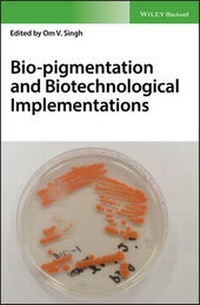
Bio-pigmentation and Biotechnological Implementations
Description

More details
Other editions
Additional editions
Person
Content
List of Contributors xv
Introduction xvii
1 Introduction of Natural Pigments From Microorganisms 1
Siyuan Wang, Fuchao Xu, and Jixun Zhan
1.1 Introduction 1
1.2 Microbial Pigments from Eukaryotic Sources 2
1.2.1 Pigments from Algae 2
1.2.2 Pigments from Fungi 4
1.2.3 Pigments from Yeasts 7
1.3 Natural Pigments from Prokaryotes 9
1.3.1 Natural Pigments from Cyanobacteria 9
1.3.2 Natural Pigments from Bacteria 10
1.4 Conclusion 16
References 16
2 Establishing Novel Cell Factories Producing Natural Pigments In Europe 23
Gerit Tolborg, Thomas Isbrandt, Thomas Ostenfeld Larsen, and Mhairi Workman
2.1 Introduction 23
2.2 Colorants 25
2.2.1 Classification of Colorants 25
2.2.2 Monascus Pigments 26
2.2.3 Biosynthesis of Monascus Pigments 29
2.2.4 Derivatives of Monascus Pigments 31
2.3 Screening for Monascus Pigment-Producing Cell Factories for the European Market 32
2.3.1 Cell Factory Selection and Identification 32
2.3.2 From Single Pigment Producers to High-Performance Cell Factories 33
2.4 Assessment of the Color Yield 34
2.4.1 Pigment Purification and Quantification 34
2.4.2 Detection and Identification 37
2.4.3 Quantification 38
2.4.4 CIELAB 41
2.5 Optimizing Cellular Performance: Growth and Pigment Production 41
2.5.1 Assessment of Classical Physiological Parameters 42
2.5.2 Media Composition 42
2.5.3 Cultivation Parameters 44
2.5.4 Type of Cultivation 46
2.5.5 Metabolic Engineering 48
2.6 Pigment Properties 50
2.7 Conclusion 51
References 51
3 Color-Producing Extremophiles 61
Eva García-López, Alberto Alcázar, Ana María Moreno, and Cristina Cid
3.1 Introduction 61
3.2 Color-Producing Extremophiles 62
3.2.1 Thermophiles and Hyperthermophiles 63
3.2.2 Psychrophiles and Psychrotolerants 63
3.2.3 Alkaliphiles 66
3.2.4 Acidophiles 66
3.2.5 Piezophiles and Piezotolerants 66
3.2.6 Halophiles and Halotolerants 67
3.2.7 Radiophiles 67
3.3 Microbial Pigments 68
3.3.1 Chlorophylls and Bacteriochlorophylls 68
3.3.2 Carotenoids and Phycobilins 69
3.3.3 Violacein 70
3.3.4 Prodigiosin 70
3.3.5 Pyocyanin 70
3.3.6 Azaphilones 70
3.3.7 Bacteriorhodopsin 71
3.3.8 Cytochromes 71
3.3.9 Other 72
3.4 Biotechnological Applications of Microbial Pigments from Extremophiles 73
3.4.1 Applications in the Food Industry 74
3.4.2 Applications in the Pharmaceutical Industry 77
3.4.3 Applications in the Textile Industry 78
3.4.4 Applications as Laboratory Tools 78
3.4.5 Applications in Bioremediation 79
3.4.6 Development of Microbial Fuel Cells 79
3.4.7 Biotechnological Production of Natural Pigments 80
3.5 Conclusion 80
Acknowledgments 80
References 80
4 Current Carotenoid Production Using Microorganisms 87
Laurent Dufossé
4.1 Introduction 87
4.2 ß-carotene 88
4.2.1 B. trispora 88
4.2.2 Phycomyces blakesleeanus 90
4.2.3 Mucor circinelloides 91
4.2.4 Applications 91
4.3 Lycopene 91
4.3.1 B. trispora 92
4.3.2 Fusarium sporotrichioides 93
4.4 Astaxanthin 93
4.4.1 X. dendrorhous, Formerly Phaffia rhodozyma 94
4.4.2 Agrobacterium aurantiacum and Other Bacteria 95
4.4.3 Advantages over Other Carotenoids 95
4.4.4 Astaxanthin for Salmon and Trout Feeds 96
4.4.5 Astaxanthin for Humans 97
4.5 Zeaxanthin 97
4.6 Canthaxanthin 98
4.7 Torulene and Thorularhodin 99
4.8 Prospects for Carotenoid Production by Genetically Modified Microorganisms 99
4.8.1 Escherichia coli and Other Hosts 99
4.8.2 Directed Evolution and Combinatorial Biosynthesis 101
4.9 Conclusion 102
References 104
5 C50 Carotenoids: Occurrence, Biosynthesis, Glycosylation, and Metabolic Engineering For Their Overproduction 107
Nadja A. Henke, Petra Peters-Wendisch, Volker F. Wendisch, and Sabine A.E. Heider
5.1 Introduction 107
5.2 Occurrence and Biological Function of C50 Carotenoids 108
5.3 Biosynthesis of C50 Carotenoids 110
5.4 Glycosylation of C50 Carotenoids 114
5.5 Overproduction of C50 Carotenoids by Metabolic Engineering 115
5.6 Conclusion 118
Acknowledgments 119
References 119
6 Biopigments and Microbial Biosynthesis of ¿¿¿¿-Carotenoids 127
Rosemary C. Nwabuogu, Jennifer Lau, and Om V. Singh
6.1 Introduction 127
6.2 Characterization of Biological Pigments 129
6.2.1 Tetrapyrrole Derivatives 129
6.2.2 N-heterocyclic Derivatives 130
6.2.3 Isoprenoid Derivatives 131
6.2.4 Benzopran Derivatives 132
6.2.5 Quinones 132
6.2.6 Melanins 133
6.3 Biosynthetic Routes of ß-carotene 133
6.3.1 Fermentation of ß-carotene 138
6.4 Molecular Regulation of ß-carotene Biosynthesis 146
6.5 Commercialization of ß-carotene 147
6.6 Conclusion 151
References 151
7 Biotechnological Production of Melanins With Microorganisms 161
Guillermo Gosset
7.1 Introduction 161
7.2 Microbial Production of Melanins 163
7.3 Production of Melanins with Engineered Microorganisms 165
7.4 Conclusion 169
References 170
8 Biochemistry and Molecular Mechanisms of Monascus Pigments 173
Changlu Wang, Di Chen, and Jiancheng Qi
8.1 Introduction 173
8.2 Monascus Pigments 174
8.3 The Properties of Monascus Pigments 176
8.3.1 Solubility 176
8.3.2 Stability 177
8.3.3 Safety 177
8.4 Functional Properties of Monascus Pigments 177
8.4.1 Antimicrobial Activities 178
8.4.2 Anti-inflammatory Activities 178
8.4.3 Anti-obesity Activities 178
8.4.4 Anticancer Activities 178
8.5 Biosynthetic Pathway of Monascus Pigments 179
8.6 Biosynthetic Pathway of Related Genes 181
8.7 Factors Affecting Monascus Pigment Production 184
8.7.1 Solid-State Fermentation 185
8.7.2 Submerged Fermentation 186
8.7.3 Carbon Source 186
8.7.4 Nitrogen Source 187
8.7.5 Temperature 187
8.7.6 Light 187
References 187
9 Diversity and Applications of Versatile Pigments Produced By Monascus Sp 193
Sunil H. Koli, Rahul K. Suryawanshi, Chandrashekhar D. Patil, and Satish V. Patil
9.1 Introduction 193
9.2 Pigment-Producing Monascus Strains 195
9.3 Various Types of Monascus Pigments 199
9.4 Extraction and Purification of Monascus Pigments 203
9.5 Detection and Purification 204
9.5.1 UV-Vis Spectrophotometric Methods 204
9.5.2 Column Chromatography 204
9.5.3 Thin-Layer Chromatography 205
9.5.4 High-Performance Liquid Chromatography 205
9.6 Applications 206
9.6.1 Food Colorants 206
9.6.2 Biological Role 206
9.7 Conclusion 209
Acknowledgments 209
References 209
10 Microbial Pigment Production Utilizing Agro-Industrial Waste and Its Applications 215
Chidambaram Kulandaisamy Venil, Nur Zulaikha Binti Yusof, Claira Arul Aruldass, and Wan Azlina Ahmad
10.1 Introduction 215
10.2 Agro-industrial Waste Generation: A Scenario 216
10.3 Microbial Pigments 216
10.4 Production of Microbial Pigments Utilizing Agro-industrial Waste from Different Industries 223
10.5 Case Study: Production of Violacein by Chromobacterium violaceum Grown in Agricultural Wastes 225
10.5.1 Introduction 225
10.5.2 Materials and Methods 226
10.5.3 Results and Discussion 229
10.6 Conclusion 235
Acknowledgments 235
References 235
11 Microbial Pigments: Potential Functions and Prospects 241
P. Akilandeswari and B.V. Pradeep
11.1 Introduction 241
11.1.1 Pigments 242
11.1.2 Types of Pigments 242
11.1.3 Microbial Pigments 242
11.1.4 Use of Pigments 243
11.1.5 Advantages of Natural Pigments 243
11.1.6 Disadvantages of Synthetic Dyes 243
11.2 Potential Sources of Microbial Pigments 244
11.2.1 Actinomycetes 244
11.2.2 Bacteria 245
11.2.3 Fungi 245
11.3 Physical Factors Influencing Microbial Pigments 246
11.4 Chemical Factors Influencing Microbial Pigments 247
11.5 Fermentation Practices in Pigment Production 248
11.5.1 Solid-State Fermentation 248
11.5.2 Submerged Fermentation 248
11.6 Characterization and Purification Analysis 249
11.7 Biocolors from Microbes and their Potential Functions 250
11.7.1 Pharmaceutical Industry 250
11.7.2 Food Colorants 255
11.7.3 Textile Dyeing 256
References 257
12 The Microbial World of Biocolor Production 263
Roshan Gul, Raman Kumar, and Anil K. Sharma
12.1 Introduction 263
12.2 Pigments Produced by Microorganisms 265
12.3 Classification of Pigments 265
12.3.1 Riboflavin 265
12.3.2 ß-carotene 265
12.3.3 Canthaxanthin 268
12.3.4 Carotenoids 268
12.3.5 Prodigiosin 268
12.3.6 Phycocyanin 268
12.3.7 Violacein 268
12.3.8 Astaxanthin 268
12.4 Benefits and Applications of Microbial Pigments 269
12.5 Conclusion 272
References 273
Index 279
Chapter 1
Introduction of Natural Pigments from Microorganisms
Siyuan Wang, Fuchao Xu and Jixun Zhan
Department of Biological Engineering, Utah State University, Logan, UT, USA
1.1 Introduction
Pigments are widely used in a variety of industries. In the food industry, one of the most important goals is to develop foods that have an attractive flavor and appearance. Artificial food coloring using synthetic dyes can make foods more appealing and desirable. However, the safety of these dyes has been questioned. Recent research has linked synthetic food dyes to a number of potential health problems, such as cancer in animals and attention-deficit disorder in children (Potera 2010). Synthetic colorants are criticized for having these problems, and consumers are showing more and more interest in products that do not include artificial coloring agents. Therefore, various natural sources of food-grade colorants are in high demand. The textile industry also uses millions of tons of dyes, pigments, and dye precursors every year, and almost all of them are manufactured synthetically (Chequer et al. 2013). Synthetic dyes have serious limitations in that their production involves the use of toxic chemicals and can generate hazardous wastes, which is unfriendly to the environment and to human health (Khan et al. 2013).
Biological pigments are substances from biological sources that have a particular color, corresponding to their structure. They are found in plants, animals, and microbial organisms. Natural pigments have been long studied, but they are receiving increasing attention from industry because of the potential health and environmental concerns around synthetic dyes. Biological pigments from microbial cells are termed "microbial pigments." In addition to their function as colorants, some microbial pigments are also used to promote human health, providing key nutrients or compounds required by the body. Some also have particular biological activities, such as anti-inflammatory, antibiotic, anticancer, and immunosuppressive properties (Soliev et al. 2011). Microbial pigments with fluorescence are used in laboratories to label antibodies (Mahmoudian et al. 2010). Some pigments can also be used to indicate the progress of specific reactions or to track pH changes through changes in their color (Venil et al. 2014). A large number of pigments are produced by various species of bacteria, yeasts, fungi, and algae, with colors including brown, black, red, orange, yellow, green, blue, and purple, and structures such as carotenoids, anthraquinones, flavonoids, and tetrapirroles. Different biosynthetic enzymes are involved in the biosynthesis of microbial pigments. For example, carotenoids are typically synthesized by terpene synthases, flavonoids are assembled by polyketide synthases (PKSs), and indigoidine - a bacterial blue pigment - is synthesized by a nonribosomal peptide synthetase. Microbial pigments are used for different purposes depending on their color property and biological function. This chapter covers a variety of microbial pigments from eukaryotic and prokaryotic sources and discusses their properties and applications.
1.2 Microbial Pigments from Eukaryotic Sources
The cells of eukaryotes such as plants, animals, and fungi contain a nucleus and other organelles. Eukaryotic microorganisms produce a lot of different pigments. Some representative pigments from these organisms are described in this section, categorized according to their source: algae, fungi, and yeasts.
1.2.1 Pigments from Algae
Algae produce a variety of pigments. The most commonly used in the industry is the carotenoid ß-carotene (Figure 1.1). Carotenoids belong to the family of tetraterpenoids and are found in the chloroplasts and chromoplasts of plants, algae, fungi, and some bacteria (Asker et al. 2007). They are yellow, orange, and red pigments that can be used for coloration. ß-carotene is a red-orange nonpolar pigment that can be obtained from Dunaliella salina, a kind of marine green microalga. The production of ß-carotene in D. salina is affected by high salinity, temperature, and light intensity. A high ß-carotene content in D. salina can help it protect itself from intense light and osmotic pressure in the ocean (Oren 2005). ß-carotene is well known for its antioxidant activity and for its use as food supplement (Stargrove et al. 2008). It is commercially produced across the world, due to its widespread use (Oren 2005). The first company to manufacture and sell natural ß-carotene, Betatene Ltd., was established in 1985 (Nelis and Deleenheer 1991). Production of ß-carotene from D. salina is often seen in large open ponds located in or near salt lakes in Australia, the United States, and China.
Figure 1.1 Structures of four representative carotenoids: ß-carotene, lutein, canthaxanthin, and astaxanthin.
Besides ß-carotene, many other carotenoids are produced by microalgae. For example, lutein (Figure 1.1) is obtained from different green algae, such as Chlorella, Chlorococcum, Chlamydomonas, and Spongiococcum. Lutein is a red-orange pigment that is generally insoluble in water. For some time, it was widely used in chicken feeds to improve the color of broiler chicken skin and egg yolks (Philip et al. 1976). In the human body, lutein is concentrated in the macula. Some research has revealed that lutein protects eyes against oxidation (Berendschot et al. 2000; Malinow et al. 1980). Canthaxanthin (Figure 1.1), a dark red food coloring agent, is another example of a cartenoid produced by algae. Dictyococcus cinnabarinus was reported to produce it canthaxanthin in 1970. The final concentration of cellular canthaxanthin in this organism is 1.0-1.2 mg/g (Tuttobelll and Ranciag 1970). Astaxanthin (Figure 1.1) is a red terpene that is biosynthesized by Haematococcus pluviais with up to 2% dry weight quantity (Nonomura 1990). This compound is a food coloring agent approved by the US Food and Drug Administration (FDA).
Algae produce many other microbial pigments, including water-soluble green chlorophyll, blue phycocyanins, and red phycoerythrins, from Rhodophta, Cyanophta, and Cryptophyta, respectively (Telford et al. 2001). Halobacterium spp. have been found to be responsible for the red color in the Great Salt Lake, Dead Sea, and Lake Magadi (Oren 2005).
1.2.2 Pigments from Fungi
Fungi comprise a diverse group of eukaryotic organisms, including yeasts, molds, and mushrooms. Some fungi are known to produce color compounds with particular biological properties. Many fungal pigments possess ecological functions varying from providing protection against environmental stress to preventing photo-oxidation. Some pigments, such as flavins, can even act as cofactors in enzyme catalysis (Mapari et al. 2010).
Riboflavin (vitamin B2) is a yellow food colorant that is approved for use in many countries. It is also used in the clinic to treat neonatal jaundice (Bailey et al. 1997) and it has been reported to prevent migraine (Sandor et al. 2000). Its structure is shown in Figure 1.2. Many molds can be used to produce riboflavin through fermentation (Jacobson and Wasileski 1994; Santos et al. 2005; Stahmann et al. 2000). Ashbya gossypi has been widely used in the production of riboflavin, as it provides a high yield and good genetic stability. Its final riboflavin level can reach 15 g/L (Broder and Koehler 1980).
Figure 1.2 Nine representative fungal pigments: riboflavin, monascin, ankaflavin, rubropunctatin, monascorubramine, atrovenetin, herqueinone, bikaverin, and catenarin.
A variety of color compounds have been discovered from fungi. The same genus may produce different pigments. This is exemplified by Monascus. Monascus can be classified into four different species: M. pilosus, M. purpureus, M. ruberand and M. froridanus. Different Monascus species produce many different industrially important pigments with three colors: red, orange, and yellowish. For example, M. purpureus 192F produces the yellow pigments monascin and ankaflavin, the orange pigment rubropunctatin, and the red pigment monascorubramine (Figure 1.2). Monascorubramine is the major product. The pH and nitrogen source in the fermentation broth affect the composition and yield of the pigments. Supplementation of Monascus pigments as a coloring agent into food can provide novel flavors (Chen and Johns 1993). These fungal metabolites have also shown interesting biological activities. For example, monascin and ankaflavin are natural 5´ adenosine monophosphate-activated protein kinase (AMPK) activators and have shown hypolipidemic and anti-inflammatory activities (Hsu et al. 2013, 2014). The two compounds have been found to improve memory and learning ability in amyloid ß-protein intracerebroventricular-infused rat by suppressing Alzheimer's disease risk factors (Lee et al. 2015). Anticancer, antiatherosclerotic, antiallergic, antioxidant, and antidiabetic properties have also been reported (Hsu and Pan 2014; Hsu et al. 2011, 2012, 2014; Lee et al. 2012).
While the most common method of pigment production from microbes on an industrial scale is submerged fermentation, an immobilized culture system or...
