

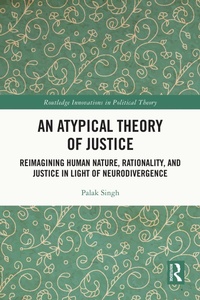
An Atypical Theory of Justice
Reimagining Human Nature, Rationality, and Justice in Light of Neurodivergence
Published on 25. May 2026
242 pages
978-1-040-60352-9 (ISBN)
Description

What does justice mean for individuals whose cognition diverges from these implicit norms? Can a theory of fairness truly be universal if it fails to account for autism, ADHD, psychopathy, and other forms of neurodiversity?
Palak Singh confronts these questions head-on by exposing the neurotypical biases embedded in liberal theories of justice and proposing a radical alternative: an atypical, neuropluralistic justice. Through a critical engagement with Rawls, Kant, Nussbaum, and feminist and disability theorists, she reveals how psychopathic instrumentalism, autistic rule-based reasoning, and other atypical cognitive profiles disrupt conventional notions of reciprocity, public reason, and moral personhood. Yet rather than dismissing these disruptions as anomalies, Singh reframes them as catalysts for reimagining justice itself.
At its core, this book advances a revised social contract-one where the 'veil of ignorance' includes cognitive variation, ensuring principles of fairness are robust across neurotypes. From education to criminal law, it charts a path towards a society where neurodivergent individuals are not merely accommodated but recognized as essential to human flourishing and as equal participants in shaping collective life, arguing for an 'Atypical Theory' for 'atypical minds.'
Timely and provocative, An Atypical Theory of Justice bridges political philosophy, cognitive science, and disability studies to offer a groundbreaking and transformative framework. It argues for a world where justice is measured not by its adherence to a neurotypical standard but by its capacity to embrace the full spectrum of human cognition.
Palak Singh confronts these questions head-on by exposing the neurotypical biases embedded in liberal theories of justice and proposing a radical alternative: an atypical, neuropluralistic justice. Through a critical engagement with Rawls, Kant, Nussbaum, and feminist and disability theorists, she reveals how psychopathic instrumentalism, autistic rule-based reasoning, and other atypical cognitive profiles disrupt conventional notions of reciprocity, public reason, and moral personhood. Yet rather than dismissing these disruptions as anomalies, Singh reframes them as catalysts for reimagining justice itself.
At its core, this book advances a revised social contract-one where the 'veil of ignorance' includes cognitive variation, ensuring principles of fairness are robust across neurotypes. From education to criminal law, it charts a path towards a society where neurodivergent individuals are not merely accommodated but recognized as essential to human flourishing and as equal participants in shaping collective life, arguing for an 'Atypical Theory' for 'atypical minds.'
Timely and provocative, An Atypical Theory of Justice bridges political philosophy, cognitive science, and disability studies to offer a groundbreaking and transformative framework. It argues for a world where justice is measured not by its adherence to a neurotypical standard but by its capacity to embrace the full spectrum of human cognition.
Reviews / Votes
An Atypical Theory of Justice is a strikingly original contribution that reshapes long-standing assumptions in political philosophy. By placing neurodiversity at the heart of moral and political theory, it opens an urgently needed conversation about inclusion, agency, and justice. A bold and timely work.Stephane Mechoulan, Associate Professor, Faculty of Management, Dalhousie University
Palak Singh's timely work explores how theories of justice in political philosophy might be reconsidered in light of neurodiversity. It skilfully examines the implicit assumptions shaping prevailing models of justice, and raises important questions about inclusion, recognition, and the scope of political theorising.
Niki Young, Lecturer, University of Malta
This book profoundly reorients the debate on justice. Palak Singh compellingly dismantles the neurotypical scaffold of political philosophy, arguing that neurodivergence is not a deficit but a vital epistemic resource. This is an essential, transformative framework for building a truly inclusive polity.
Sonali Singh, Professor, Department of Political Science, Banaras Hindu University
More details
Series
Language
English
Place of publication
London
United Kingdom
Publishing group
Taylor & Francis Ltd
Target group
College/higher education
File size
4,12 MB
ISBN-13
978-1-040-60352-9 (9781040603529)
Copyright in bibliographic data and cover images is held by Nielsen Book Services Limited or by the publishers or by their respective licensors: all rights reserved.
Schweitzer Classification
Other editions
Additional editions
Palak Singh
An Atypical Theory of Justice
Reimagining Human Nature, Rationality, and Justice in Light of Neurodivergence
Book
05/2026
1st Edition
Routledge
€188.50
Shipment within 15-20 days
Person
Palak Singh is a scholar working at the intersection of moral-political philosophy, feminism, ethics, and political psychology. Her research critically engages classical and contemporary theories of justice, human nature, and moral responsibility, with a particular focus on the ethical implications of neurodivergence and psychopathy. Through a critical epistemological lens, her work challenges normative frameworks that pathologize difference while obscuring structural violence, aiming instead to reframe questions of justice, autonomy, and agency within marginalized and neurodivergent communities.
Content
1. Conceptions of Human Nature in Western Political Philosophy: An Overview
2. Neurodiversity and Psychopathy: The Need for Inclusion in Moral Political Framework
3. Moral Political Philosophy: Exploring Spaces for Inclusion of Neurodiversity and Psychopathy
4. Implication for Moral Political Philosophy and Normative Political Constructs: An Atypical Theory of Justice?
5. Conclusion: Towards Inclusive Political Frameworks
2. Neurodiversity and Psychopathy: The Need for Inclusion in Moral Political Framework
3. Moral Political Philosophy: Exploring Spaces for Inclusion of Neurodiversity and Psychopathy
4. Implication for Moral Political Philosophy and Normative Political Constructs: An Atypical Theory of Justice?
5. Conclusion: Towards Inclusive Political Frameworks
