

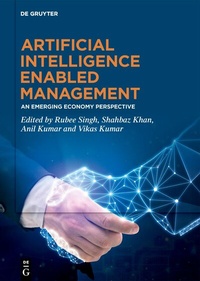
Artificial Intelligence Enabled Management
Description

Companies in developing countries are adopting Artificial Intelligence applications to increase efficiency and open new markets for their products. This book explores the multifarious capabilities and applications of AI in the context of these emerging economies and its role as a driver for decision making in current management practices.
Artificial Intelligence Enabled Management argues that the economic problems facing academics, professionals, managers, governments, businesses and those at the bottom of the economic pyramid have a technical solution that relates to AI. Businesses in developing countries are using cutting-edge AI-based solutions to improve autonomous delivery of goods and services, implement automation of production and develop mobile apps for services and access to credit. By integrating data from websites, social media and conventional channels, companies are developing data management platforms, good business plans and creative business models. By increasing productivity, automating business processes, financial solutions and government services, AI can drive economic growth in these emerging economies. Public and private sectors can work together to find innovative solutions that simultaneously alleviate poverty and inequality and increase economic mobility and prosperity.
The thought-provoking contributions in this book also bring attention to new barriers that have emerged in the acceptance, use, integration and deployment of AI by businesses in developing countries and explore the often-overlooked drawbacks of AI adoption that can hinder or even cause value loss. The book is a must-read for policymakers, researchers, and anyone interested in understanding the critical role of AI in the emerging economy perspective.
More details
Other editions
Additional editions
Persons
Dr Rubee Singh is Assistant Professor of Human Resource at the Institute of Business Management, GLA University, India. She is currently pursuing post-doctoral research (D. Lit) at Kumaun University, Nainital, India. Her areas of research are sustainability, digital HRM, sustainable HRM, circular economy/net zero, corporate social responsibility, Industry 4.0/5.0, and artificial intelligence.
Dr Shahbaz Khan is an Assistant Professor at the Department of Industrial Engineering, University of Tabuk, Kingdom of Saudi Arabia. His research interests are supply chain management, human resource management, Halal supply chain management, circular economy and sustainability, Industry 4.0, performance measurement, process management and benchmarking, and decision modelling for sustainable business.
Prof. Anil Kumar is Senior Lecturer (Associate Professor) at Guildhall School of Business and Law, London Metropolitan University (LMU), London, U.K. His areas of research are sustainability science, green/sustainable supply chain management, customer retention, green purchasing behaviour, sustainable procurement, sustainable development, circular economy, Industry 4.0, performance measurement, human capital in supply chain and operations; decision modelling for sustainable business, and integration of operations with other areas.
Prof. Vikas Kumar is Associate Dean for Research Innovation and Enterprise and Professor of Operations and Supply Chain Management at the Faculty of Business, Law and Social Sciences, Birmingham City University, Birmingham, United Kingdom. His research interest areas include digital supply chains, industry 4.0/5.0, sustainability, circular economy, sustainable supply chains, food supply chains and operational excellence.
Content
- Intro
- Preface
- Acknowledgments
- Contents
- Part I: Introduction to Data Enabled Management
- Chapter 1 What Does Artificial Intelligence-Powered ChatGPT Bring to Academia? A Review
- Chapter 2 Education Policies Through Data Driven Decision Making: Accelerating Inclusive Education for People with Disabilities
- Chapter 3 The Role of Artificial Intelligence in the Emerging Digital Economy Era
- Chapter 4 A Review of Machine Learning Methods for Diagnosis and Classification of Thyroid Disease
- Chapter 5 A Question and Answering System Using Natural Language Processing and Deep Learning
- Part II: Role of AI and Big Data in Management Functions
- Chapter 6 The Reinvention of HRM Practices Through Artificial Intelligence: Opportunities and Challenges in the Digital World of Work
- Chapter 7 Challenges and Artificial Intelligence-Centered Defensive Strategies for Authentication in Online Banking
- Chapter 8 Catalyzing Human Potential: The Crucial Role of AI in Modern HR Management
- Chapter 9 Exploring How Artificial Intelligence is Changing the HRM Landscape: Refuting the Fiction with Reality!
- Chapter 10 Artificial Intelligence in HR: Employee Engagement Using Chatbots
- Part III: Application of AI in Different Sectors
- Chapter 11 An Empirical Analysis of Artificial Intelligence Applications of Manufacturing Companies in Turkey
- Chapter 12 A Comprehensive View of Artificial Intelligence (AI)-Based Technologies for Sustainable Development Goals (SDGs)
- Chapter 13 Leveraging Artificial Intelligence for Enhanced Risk Management in Banking: A Systematic Literature Review
- Chapter 14 Exploring the Influence of Artificial Intelligence on the Management of Hospitality and Tourism Sectors: A Bibliometric Overview
- Chapter 15 Artificial Intelligence in Healthcare Sector in India: Application, Challenges and a Way Forward
- Chapter 16 Application of Artificial Intelligence and Machine-Learning Algorithms for Forecasting Risk: The Case of the Indian Stock Market
- List of Figures
- List of Tables
- About the Editors
- Index
