

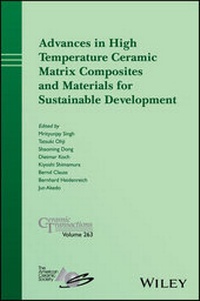
Advances in High Temperature Ceramic Matrix Composites and Materials for Sustainable Development, Volume 263
Description

More details
Other editions
Additional editions
Persons
Content
Preface xi
DESIGN AND DEVELOPMENT OF ADVANCED CERAMIC FIBERS, INTERFACES, AND INTERPHASES IN COMPOSITES
Physical and Chemical Properties of Silicon Carbide Fibers 3
S. Loison and C. Huguet
Heat-Resistant Inorganic Fibers 7
Toshihiro Ishikawa and Hiroshi Oda
Synthesis, Properties and Applications of SiC Ultrathin Fibers Via Electrospinning Combined with the Polymer-Derived Ceramics Route 19
Ying-de Wang, Bing Wang, and De-chuan Zheng
Novel Oxide Fibers to Reinforce Ceramic and Metal Matrices 27
S. T. Mileiko
A Journey in the Field of Ceramic Matrix Composites 39
R. Naslain
Effects of the Microstructure, and Degradation Reaction under Heat-Treatment on Mechanical Properties of SiC-Polycrystalline Fiber 55
Hiroshi Oda and Toshihiro Ishikawa
INNOVATIVE DESIGN, ADVANCED PROCESSING, AND MANUFACTURING TECHNOLOGIES
Fabrication and Mechanical Properties of ZrC-Modified C/C-SiC Composites 67
J. X. Dai, J. J. Sha, Y. F. Zu, J.Q. Shao, S.H. Wang, and M. K. Lei
Manufacture of SiC/ZrSi2 Composite Materials: Assessing Thermal Compatibility between Matrix and Reinforcement 75
Olga Coloma Esteban, Mario Caccia, Antonio Camarano, and Javier Narciso
Influence of the Annealing Process Parameters in the Production of New Short-Fibre-Reinforced C/C-SiC Composites 85
N. Nier, D. Nestler, H. Gurk, K. Roder, G. Wagner, E. Päßler, L. Kroll, J. Weißhuhn, and St. Spange
Fiber-Matrix Adhesion in CFRC Greenbodies and Its Influence on Microcrack Formation during the Carbonization Process 97
S. J. A. Haug, W. M. Mueller, M. G. R. Sause, and S. Horn
Effects of Source Gas Flow Paths on the Matrix Infiltration Behaviors and Mechanical Properties of CVI-Processed SiCf/SiC Composite Tubes 109
Ji Yeon Park, Sang Min Jeong, Daejong Kim, Hyeon-Geun Lee, Soon Gil Yoon, and Weon-Ju Kim
Fabrication of Co-Toughened C-SiC Based Composite by Carbon Fibers and SiC Nanofibers 117
J. J. Sha, J. X. Dai, J. Q. Shao, Z. F. Zhang, J. Li, Y. F. Zu, S. Flauder, and W. Krenkel
Influencing the Mechanical Properties of Weak Matrix C/C Composites by Means of Microstructural Design 125
Andreas Todt, Daisy Nestler, Kristina Roder, Natalia Nier, Bernhard Wielage, and Guntram Wagner
Spark Plasma Sintering of Silicon Carbide Powders with Carbon and Boron as Additives 137
Jinhua Yang, Jian Jiao, Ling Wang, and Baowei Li
Comparison of Machining Technologies for CMC Materials using Advanced 3D Surface Analysis 145
A. Rösiger and R. Goller
Infiltration of Molten Silicon in a Porous Body of B4C under Microwave Heating 157
Mathieu Dutto, Dominique Goeuriot, Sébastien Saunier, Sergio Sao-Joao, Matthieu Lenci, Sylvain Marinel, Shmuel Hayun, and Nachum Frage
Refractory Adhesives for Bonding of Polymer Derived Ceramics 167
R. Cook, C. Klein, and H. Armstrong
ADVANCED THERMAL AND ENVIRONMENTAL BARRIER COATINGS
Self-Healing EBC Material for Gas Turbine Applications 175
Willy Kunz and Hagen Klemm
Mass Transfer Mechanism in Yb2Si2O7 under Oxygen Potential Gradients at High Temperatures 187
S. Kitaoka, T. Matsudaira, M. Wada, N. Kawashima, D. Yokoe, T. Kato, and M. Takata
Magnetron Sputtered Y2SiO5 Environmental Barrier Coatings for SiC/SiC CMCS 197
V. Leisner, A. Lange, P. Mechnich, and U. Schulz
THERMOMECHANICAL BEHAVIOR AND PERFORMANCE OF COMPOSITES
Thermal Ablation Performance of Cf-HfB2 Composites with and without a C Matrix Deposited by CVI 213
V. Rubio, P. Ramanujam, D. K. Ramachandran, A. D'Angio, and J. G. P. Binner
Experimental Research on Air Permeability of Fiber Reinforced Aerogel 223
Y. Ma, F. Zhang, and Q. Xiong
Fatigue Behavior of an Advanced SiC/SiC Ceramic Composite at 1300°C in Air and in Steam 231
M. B. Ruggles-Wrenn and M. D. Lee
Strength Recovery and Crack-Filling Behavior of Alumina/TiC Self-Healing Ceramics 243
S. Yoshioka and W. Nakao
Hot Gas Stability of Various Ceramic Matrix Composites 253
H. Klemm, W. Kunz, T. Wamser, A. Rüdinger, R. Weiß, A. Lauer, C. Wilhelmi, T. Machry, S. Hofmann, and D. Koch
Damage Analysis in 3D Woven SiC/SiC Ceramic Matrix Composite 261
B. Legin, Z. Aboura, F. Bouillon, and S. Denneulin
The Wedge-Loaded Double Cantilever Beam Test: A Friction Based Method for Measuring Interlaminar Fracutre Properties in Ceramic Matrix Composites 273
Rabih Mansour, Manigandan Kannan, Gregory N. Morscher, Frank Abdi, Cody Godines, and Saber DorMohammadi
Damage Monitoring of MI CMCS with Stress Concentrations Utilizing Acoustic Emission and Electrical Resistance 283
Ryan Maxwell and Gregory N. Morscher
Damage Evolution and Fracture in SiCF/SiC Ceramic Matrix Composite Specimens 297
C. D. Newton, J. P. Jones, M. R. Bache, Z. Quiney, and A. L. Chamberlain
Damage Characterization of High Velocity Impact in Curved SiC/SiC Composites 311
Michael J. Presby, Rabih Mansour, Manigandan Kannan, and Gregory N. Morscher, Frank Abdi, Cody Godines, and Sung Choi
Effect of Vacuum on Microstructure and Mechanical Properties of Silicon Carbide Produced by Reactive Infiltration 323
Antonio Camarano, Mario Caccia, and Javier Narciso
High-Temperature Mechanical Properties of Silica Aerogel Composites Reinforced by Mullite Fibers 333
Yonggang Jiang, Junzong Feng, Jian Feng, and Chunxiao Shi
Oxidation Resistance Mechanism of TiAlSiCN and TiCrSiCN Compositions made by Plasma Spark Sintering at 1200°C 341
Alexander Manulyk
Effects of Binders (Ni-Co) and Ternary Carbide (TaC) on Friction and Wear Behavior of Ti(CN) Based Cermets 353
V. Verma and B. V. Manoj Kumar
COMPONENT TESTING AND APPLICATIONS OF COMPOSITES
Application of CMC Materials in Rocket Propulsion 367
F. Olufsen and E. Ørbekk
Development of Carbon Fiber Reinforced CMC for Automotive Applications 375
K. S. Kim, D. W. Im, Y. H. Choi, S. M. Lee, K. Yoo, N. C. Lee, J. H. Shim, and E. J. Hyun
Octra-Optimized Ceramic for Hypersonic Application with Transpiration Cooling 389
Christian Dittert and Marius Kütemeyer
Oxide-Oxide Ceramic Matrix Composites-Enabling Widespread Industry Adoption 401
J. Lincoln, B. Jackson, A. Barnes, A. R. Beaber, and L. Visser
Updating Composite Materials Handbook-17 Volume 5-Ceramic Matrix Composites 413
J. Douglas Kiser, Kaia E. David, Curtis Davies, Rachael Andrulonis, and Cindy Ashforth
MULTIFUNCTIONAL COATINGS FOR SUSTAINABLE ENERGY AND ENVIRONMENTAL APPLICATIONS
Development of Superfine Nano-Composites Antifouling Coatings for Ship Hulls 427
A.S. Khanna, Varun Kasturi, and Pankaj Grover
Effect of Heat Exposure on the Microstructures and Mechanical Properties of 3Al2O3 2SiO2/Si/SiC Coating System 443
Ryo Inoue, Kazuma Chikamoto, Yasuo Kogo, and Hideki Kakisawa
Suspension Plasma Spray of Yttria Stabilized Zirconia Coatings 451
P. Xu, J. Mostaghimi, T. W. Coyle, and L. Pershin
Thick Aluminum Nitride Coatings by Reactive DC Plasma 465
Mohammed Shahien, Motohiro Yamada, and Masahiro Fukumoto
Using an Axial Feeding DC-Plasma Spray Gun for Fabrication of Ceramic Coatings 479
Mohammed Shahien and Masato Suzuki
CERAMICS FOR SUSTAINABLE INFRASTRUCTURE
Characterization of Two Calcium Aluminate Cement Pastes 493
John F. Zapata, Maryory Gomez, and Henry A. Colorado
Additive Manufacturing of Kaolinite Clay from Colombia 505
Carlos F. Revelo and Henry A. Colorado
ADVANCED MATERIALS, TECHNOLOGIES, AND DEVICES FOR ELECTRO-OPTICAL AND MEDICAL APPLICATIONS
Elastic Constants Evaluated by Sound Velocities in Relaxor Single-Crystal Plates Applying to Ultrasonic Probe for Medical Uses 519
Toshio Ogawa
High Piezoelectricity in Ceramics Evaluated by Elastic Constants 535
Toshio Ogawa
A Thermo-Electro-Mechanical Vibration Analysis of Size-Dependent Functionally Graded Piezoelectric Nanobeams 547
A. R. Ashoori, E. Salari, and S. A. Sadough Vanini
Development of Liquid Crystal Display with RGB Laser Backlight 559
Y. Fujii, E. Niikura, N. Okimoto, S. Maeda, H. Yasui, and A. Heishi
Development of High Thermal Conductivity Silicon Nitride Substrates 567
Dai Kusano, Hideki Hyuga, You Zhou, and Kiyoshi Hirao
HEAT-RESISTANT INORGANIC FIBERS
Toshihiro Ishikawa1, Hiroshi Oda2
1 Tokyo University of Science, Yamaguchi, 1-1-1 Daigaku-Dori, Sanyo-Onoda, Yamaguchi 756-0884, Japan
2 UBE industries, Ltd., 1978-5 Kogushi, Ube, Yamaguchi, 755-8633, Japan
ABSTRACT
Up to now, many researchers have developed various inorganic fibers (For example: Glass fiber, Carbon fiber, Metal oxide fibers, Boron-based fiber, Single crystalline fibers, Eutectic oxide fiber, SiCCVD-based fiber, and Polymer-derived SiC-based fibers) for developing composite materials with lightweight and high fracture toughness. Of these, carbon fiber has established a very big market after being adopted in airplane applications. Besides the mechanical properties have been dramatically improved. And presently, SiC-polycrystalline fibers have been also addressed in the field of airplane engines for the severer applications at very high temperatures. Ube Industries, Ltd. (UBE) is one of suppliers of SiC-polycrystalline fibers. UBE's SiC-polycrystalline fiber (Tyranno SA) shows very high heat-resistance up to 2000°C and relatively high mechanical properties. And so, some programs on the CMC technology using Tyranno SA have been performed in the field of airplane engines. In these programs, the higher mechanical properties are expected for expanding the application parts. The historical tide on the technical issue of Tyranno SA is very similar to that of carbon fiber. And also, the control factors on the mechanical strength of this fiber are very similar. Now, the research on the mechanical properties of the SiC-polycrystalline fiber has been actively performed. In this paper, the aforementioned historical viewpoint of inorganic fibers and the important factors for controlling the mechanicalproperties of the SiC-polycrystalline fiber was reported.
INTRODUCTION
The first continuous inorganic fiber was developed about 70 years ago. The main objective was to obtain composite materials with light weight and high fracture toughness. Up to now, lots of inorganic fibers have been developed. The time series regarding the development of inorganic fibers are shown in Fig.1.
Fig.1 The time series regarding the development of inorganic fibers
Of these, glass fiber and carbon fiber are well known all over the world. In addition, aluminasilica fiber, single crystalline oxide fiber and silicon carbide fiber, which show excellent oxidation resistance at high temperatures even in air, have been developed and commercialized except for the single crystalline oxide fiber. Of these, glass fiber and carbon fiber made a lot of progress in a field of the reinforcement of plastics. Especially, carbon fiber has been already established a very big market. Oxide fibers such as alumina-silica fiber had been used for insulating materials of space shuttle as a form of fabrics, and so forth. However, up to now those oxide fibers have not been able to make a very big market such as the carbon fiber whereas the researches on composite materials using oxide fibers have been performed in many research laboratories [1]. On the other hand, silicon carbide fibers have achieved great progress in the specific characteristics [2-4]. As the result of development of the aforementioned inorganic fibers, lots of advanced researches concerning ceramic composite materials making the best use of the excellent physical properties (for example: mechanical strength, heat-resistance and oxidation-resistance, and so forth) have been performed actively. By the way, as mentioned before, carbon fiber has been already established a very big market because of the excellent mechanical properties along with very low density. However, in air, it is relatively difficult for the carbon fiber to show the high-temperature properties because of its low oxidation-resistance. On the other hand, silicon carbide can show balanced heat-resistance both in air and inert gas atmosphere. Accordingly, the development of SiC-based fiber had been attracted. The first developed SiC-based fibers have been produced since the mid-1960s by chemical vapor deposition onto tungsten or carbon filament core. However, as these types of SiC-based fiber had a large diameter, their applications were limited by their difficulties for use. After that, a SiC-based fiber with small diameters of about 10 micron meters were synthesized from organo-silicon polymer. This type of fiber was classified into a polymer-derived SiC fiber. The first polymer-derived SiC fiber was developed from polycarbosilane by Professor Yajima in the middle 1970s [5]. After that, many types of polymer-derived SiC-based fibers have been developed and commercialized [6,7]. These SiC-based fibers can show good mechanical strength and oxidation-resistance up to very high temperatures over 1000°C. So, research and development on composite materials using the SiC-based fibers have been widely performed [8-10]. In particular, stoichiometric SiC-polycrystalline fibers (Tyranno SA, and Hi-Nicalon Type S) show an excellent heat-resistance up to 2000°C [3,4]. Accordingly, representative airplane engine manufacturers have actively evaluated these fibers. However, to extend the application field, increase in the mechanical strength of these fibers is eagerly required. By the way, the production processes of the polymer-derived SiC fibers are very similar to that of carbon fiber [11]. That is to say, regarding the improvements of the mechanical strength of these fibers, the history of the development of the strongest carbon fiber would be very suggestive for the study on the increase in the mechanical strength of the SiC-based fibers. The tensile strength of firstly commercialized carbon fiber (T-300 produced by Toray Industries, Inc.) was only about 3 GPa. However, presently, the highest strength (about 7 GPa) has been successfully achieved by the same company [12,13]. Until the success, lots of defects contained in the inside and outside of each filament of the carbon fiber have been remarkably reduced. On the other hand, present tensile strengths of all commercial SiC fibers have been still around 3 GPa. The present stoichiometric SiC-polycrystalline fiber (Tyranno SA) also shows the almost similar strength. Tyranno SA is synthesized by further heat-treatment (~2000°C) of an amorphous Si-Al-C-O fiber, which is synthesized from polyaluminocarbosilane [3]. During the aforementioned further heat-treatment, the degradation reaction of the amorphous Si-Al-C-O fiber and the sintering of the degraded fiber proceed as well, accompanied by the release of CO gas and compositional changes, to obtain the dense structure. Since these changes proceed in each filament, a strict control should be needed to minimize residual defects on the surface and in the inside of each filament. Considering the aforementioned present strength (around 3 GPa) of the stoichiometric SiC-polycrystalline fiber (Tyranno SA), this fiber must contain some residual defects. So, the remarkable increase in the strength would be expected by an effective decrease in the residual defects. In this paper, the historical points of inorganic fibers and important things for development of heat-resistant inorganic fibers are described. Of these, the development story of the polymer-derived SiC fibers and the progress of highest heat-resistant SiC-polycrystalline fiber will be addressed.
HISTRICAL POINTS OF INORGANIC FIBERS
As mentioned before, since the first inorganic fiber (Glass fiber) was developed about 70 years ago, lots of inorganic fibers have been developed. The good information regarding the basic materials constructing the aforementioned inorganic fibers was published by W.C.Miller [14]. It is summarized in Table 1.
Table 1. The basic information of developed inorganic fibers
Basic materialsfor inorganic fibers Melting point
(°C) Heat resistance(°C) In air In inert...
