

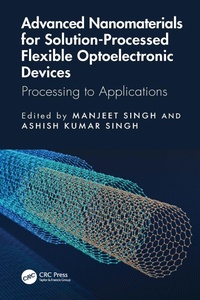
Advanced Nanomaterials for Solution-Processed Flexible Optoelectronic Devices
Processing to Applications
1st Edition
Published on 17. March 2025
374 pages
978-1-040-30540-9 (ISBN)
Description

This book covers the recent advancements in the fabrication of flexible optoelectronic devices using advanced nanomaterials. It provides information on how to process non-layered advanced nanomaterials such as carbon nanotubes, fullerenes, nanowires, colloidal quantum dots, inorganic halide perovskite, perovskite nanomaterials stabilized in porous materials, doped-ZnO, lead chalcogenide nano crystals for the easy fabrication of the optoelectronic devices at an industrial scale.
Advanced Nanomaterials for Solution-Processed Flexible Optoelectronic Devices provides up-to-date knowledge centered on the various non-layered nanomaterials and their different types of application in optoelectronic device fabrication. The first few chapters focus on the processing and applications of carbon nanotubes and fullerenes into devices for photovoltaics. Throughout the book the authors demonstrate not only device fabrication but processing of the advanced nanomaterials to make them suitable for wide applications as different components in optoelectronics. The book also presents discussions on the current challenges and future perspective for the proper processing and utilization of advanced nanomaterials for the fabrication of devices.
This book is intended for graduate students, researchers, and engineers working in the area of advanced nanomaterials, energy conversion, energy storage, sensors, and different types of optoelectronic devices.
Advanced Nanomaterials for Solution-Processed Flexible Optoelectronic Devices provides up-to-date knowledge centered on the various non-layered nanomaterials and their different types of application in optoelectronic device fabrication. The first few chapters focus on the processing and applications of carbon nanotubes and fullerenes into devices for photovoltaics. Throughout the book the authors demonstrate not only device fabrication but processing of the advanced nanomaterials to make them suitable for wide applications as different components in optoelectronics. The book also presents discussions on the current challenges and future perspective for the proper processing and utilization of advanced nanomaterials for the fabrication of devices.
This book is intended for graduate students, researchers, and engineers working in the area of advanced nanomaterials, energy conversion, energy storage, sensors, and different types of optoelectronic devices.
More details
Edition
1. Auflage
Language
English
Place of publication
London
United Kingdom
Publishing group
Taylor & Francis Ltd
Target group
College/higher education
Professional and scholarly
Illustrations
5 Tables, black and white; 53 Line drawings, black and white; 54 Halftones, black and white; 107 Illustrations, black and white
File size
9,61 MB
ISBN-13
978-1-040-30540-9 (9781040305409)
Copyright in bibliographic data and cover images is held by Nielsen Book Services Limited or by the publishers or by their respective licensors: all rights reserved.
Schweitzer Classification
Other editions
Additional editions
Manjeet Singh | Ashish Kumar Singh
Advanced Nanomaterials for Solution-Processed Flexible Optoelectronic Devices
Processing to Applications
Book
approx. 06/2026
1st Edition
CRC Press
€69.00
Not yet published
Manjeet Singh | Ashish Kumar Singh
Advanced Nanomaterials for Solution-Processed Flexible Optoelectronic Devices
Processing to Applications
Book
03/2025
1st Edition
CRC Press
€244.30
Shipment within 10-20 days
Persons
Dr. Manjeet Singh completed his Ph.D. in Chemistry from IIT-BHU, India in the area of nanoparticles synthesis and characterization. He has worked in the area of optoelectronic devices for the last 12 years. He has also worked on the fabrication of solution-processed perovskite, CIGS and CZTS and solar cells at Osaka University, Japan and Incheon National University, South Korea. His research group is also working on the silver nanowire-based flexible optoelectronic devices.
Dr. Ashish Kumar Singh has a Ph.D. from IIT-BHU, India and post doc from University of South Africa, Johannesburg, South Africa. He is an Assistant Professor, Department of Chemistry, Hansraj College, University of Delhi, India, and is currently working in the area of preparation and application of advanced materials for corrosion inhibitors. He is among the highly cited top 2% scientist according to the list published by Stanford University every year.
Dr. Balram Pani is a Professor at Bhaskaracharya College of Applied Sciences, University of Delhi, India. He obtained his Ph.D. from Jawaharlal Nehru University. Dr. Pani has 20 years of research and teaching experience in the field of chemistry and Environmental Science.
Dr. Ashish Kumar Singh has a Ph.D. from IIT-BHU, India and post doc from University of South Africa, Johannesburg, South Africa. He is an Assistant Professor, Department of Chemistry, Hansraj College, University of Delhi, India, and is currently working in the area of preparation and application of advanced materials for corrosion inhibitors. He is among the highly cited top 2% scientist according to the list published by Stanford University every year.
Dr. Balram Pani is a Professor at Bhaskaracharya College of Applied Sciences, University of Delhi, India. He obtained his Ph.D. from Jawaharlal Nehru University. Dr. Pani has 20 years of research and teaching experience in the field of chemistry and Environmental Science.
Content
Chapter 1- Application of carbon nanotube for fabrication of photovoltaic devices
Chapter 2- Application of fullerene-based materials in fabrication of photovoltaic devices
Chapter 3- Solution processed advanced materials as hole transporting layer for application in optoelectronic device
Chapter 4- Fabrication and challenges for fabrication of solution-processed optoelectronic devices
Chapter 5- Processing and application of silver nanowires in fabrication of different components of photovoltaic devices
Chapter 6- Advanced nanomaterials for the deposition of all layers solution-processed photovoltaic devices
Chapter 7- Perovskite nanocrystals-based thin film deposition for photovoltaic devices
Chapter 8- Strategies for Deposition of Thin Films of Silver Nanowires in Fabrication of Optoelectronic Devices
Chapter 9- Colloidal Quantum Dots for Solution Processed Flexible Optoelectronic Devices: From Synthesis to Device Integration
Chapter 10- Optoelectronic applications of Perovskite nanomaterials stabilized in porous materials
Chapter 11- Fabrication of doped ZnO thin films for photoelectrochemical application
Chapter 12- Solution processed lead chalcogenide nanocrystals and their Potential applications in optoelectronic devices
Chapter 13- Inorganic halide perovskite for photocatalytic applications
Chapter 2- Application of fullerene-based materials in fabrication of photovoltaic devices
Chapter 3- Solution processed advanced materials as hole transporting layer for application in optoelectronic device
Chapter 4- Fabrication and challenges for fabrication of solution-processed optoelectronic devices
Chapter 5- Processing and application of silver nanowires in fabrication of different components of photovoltaic devices
Chapter 6- Advanced nanomaterials for the deposition of all layers solution-processed photovoltaic devices
Chapter 7- Perovskite nanocrystals-based thin film deposition for photovoltaic devices
Chapter 8- Strategies for Deposition of Thin Films of Silver Nanowires in Fabrication of Optoelectronic Devices
Chapter 9- Colloidal Quantum Dots for Solution Processed Flexible Optoelectronic Devices: From Synthesis to Device Integration
Chapter 10- Optoelectronic applications of Perovskite nanomaterials stabilized in porous materials
Chapter 11- Fabrication of doped ZnO thin films for photoelectrochemical application
Chapter 12- Solution processed lead chalcogenide nanocrystals and their Potential applications in optoelectronic devices
Chapter 13- Inorganic halide perovskite for photocatalytic applications
