

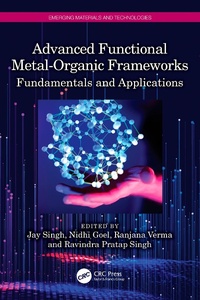
Advanced Functional Metal-Organic Frameworks
Fundamentals and Applications
1st Edition
Published on 1. May 2023
334 pages
978-1-000-86284-3 (ISBN)
Description

Due to the structural flexibility, large surface area, tailorable pore size and functional tenability, metal-organic frameworks (MOFs) can lead to materials with unique properties. This book covers the fundamental aspects of MOFs, their synthesis and modification, including their potential applications in different domains. The major focus is on applications including chemical, biosensors, catalysis, drug delivery, supercapacitors, energy storage, magnetics and their future perspectives.
The volume:
Covers all aspects related to metal-organic frameworks (MOFs), including characterization, modification, applications and associated challenges
Illustrates designing and synthetic strategies for MOFs
Describes MOFs for gas adsorption, separation and purification, and their role in heterogeneous catalysis
Covers sensing of different types of noxious substances in the aqueous environment
Includes concepts of molecular magnetism, tunable magnetic properties and future aspects
This book is aimed at graduate students, and researchers in material science, coordination and industrial chemistry, chemical and environmental engineering and clean technologies.
The volume:
Covers all aspects related to metal-organic frameworks (MOFs), including characterization, modification, applications and associated challenges
Illustrates designing and synthetic strategies for MOFs
Describes MOFs for gas adsorption, separation and purification, and their role in heterogeneous catalysis
Covers sensing of different types of noxious substances in the aqueous environment
Includes concepts of molecular magnetism, tunable magnetic properties and future aspects
This book is aimed at graduate students, and researchers in material science, coordination and industrial chemistry, chemical and environmental engineering and clean technologies.
More details
Series
Edition
1. Auflage
Language
English
Place of publication
London
United Kingdom
Publishing group
Taylor & Francis Ltd
Target group
Professional and scholarly
Product notice
Reflowable
Illustrations
21 Tables, black and white; 107 Line drawings, black and white; 5 Halftones, black and white; 112 Illustrations, black and white
ISBN-13
978-1-000-86284-3 (9781000862843)
Copyright in bibliographic data and cover images is held by Nielsen Book Services Limited or by the publishers or by their respective licensors: all rights reserved.
Schweitzer Classification
Other editions
Additional editions
Jay Singh | Nidhi Goel | Ranjana Verma
Advanced Functional Metal-Organic Frameworks
Fundamentals and Applications
Book
11/2024
1st Edition
CRC Press
€72.40
Shipment within 10-20 days
Jay Singh | Nidhi Goel | Ranjana Verma
Advanced Functional Metal-Organic Frameworks
Fundamentals and Applications
Book
05/2023
1st Edition
CRC Press
€232.30
Shipment within 10-20 days
Persons
Dr Jay Singh is currently working as an assistant professor at the Department of Chemistry, Institute of Sciences, Banaras Hindu University, Varanasi, Uttar Pradesh, since 2017. He received his PhD degree in polymer science from Motilal Nehru National Institute of Technology in 2010 and did MSc and BSc from Allahabad University, Uttar Pradesh, India. He had a postdoctoral fellow at National Physical Laboratory, New Delhi, Chonbuk National University, South Korea and Delhi Technological University, Delhi. Dr. Jay has received many prestigious fellowships like CSIR (RA), DST-Young Scientist fellowship, DST-INSPIRE faculty award etc. He is actively engaged in the development of nanomaterials (CeO2, NiO, rare-earth metal oxide, Ni, Nife2O4, Cu2O, Graphene, RGO etc.), based nanobiocomposite, conducting polymer and self-assembled monolayers based clinically important biosensors for estimation of bioanalaytes such as cholesterol, xanthine, glucose, pathogens and pesticides/toxins using DNA and antibodies. Dr. Jay has published more than 80 international research papers with total citations more than 3,600 and an h-index being 34. He has completed/running various research projects in different funding agencies. He has many edited/authored books (under pipeline) and has authored more than 10 book chapters of internationally reputed press for publications, namely Elsevier, Springer Nature, IOP, Wiley and CRC. He is actively engaged in fabricating metal oxide-based biosensors for clinical diagnosis, food packaging applications, drug delivery, and tissue engineering applications. His research has contributed significantly toward the fundamental understanding of interfacial charge transfer processes and sensing aspects of metal nanoparticles.
Dr Nidhi Goel received her doctorate in chemistry, Indian Institute of Technology Roorkee, India. After postdoctoral research (Young Scientist) from the Indian Institute of Science Bangalore, Karnataka, India, she started her independent academic career as an assistant professor in the Department of Chemistry, Institute of Science, Banaras Hindu University, Varanasi, India. Her research focuses on developing strategies, based on supramolecular building approaches, for rational construction of functional metal-organic frameworks. Their prospective uses include magnetic, luminescence, and sensing applications. She is also working on topics such as drug design, medicinal chemistry, and chemical biology. Dr. Goel has published 51 peer-reviewed research papers and book chapters in reputed international journals/books. Moreover, Dr. Goel is editing several books with international publishers. She has been the principal investigator on three research projects from the government of India, and has 15 years of research experience along with four years of teaching experience at the UG and PG level. She is also a regular reviewer of a variety of international reputed journals.
Dr Ranjana Verma received her master's and doctorate in material chemistry from Tezpur University Assam, India, in 2012 and 2017, respectively. Currently, she is working as a postdoctoral fellow under (DSKPDF) UGC funded in the Department of Physics, Banaras Hindu University, Varanasi, India, since 2019. Her research focuses on developing strategies based on synthesis, characterization, properties modification, design, fabrication, nanostructure and photocatalyst, photovoltaic cell and biofuel conversion. Their perspective includes solar photocatalyst and biosensing applications. Dr. Verma has received many prestigious fellowships like DST (NPDF), UGC (DSKPDF), UGC (JRF), CSIR (SRF) awards, etc. In addition, Dr. Verma has published various research papers (15) and has authored more than three book chapters for internationally reputed press, namely Elsevier, Springer Nature and CRC Press.
Dr Ravindra Pratap Singh completed his BSc from Allahabad University India and his MSc and PhD in Biochemistry from Lucknow University, India. He is currently working as an assistant professor in the Department of Biotechnology, Indira Gandhi National Tribal University, Amarkantak Madhya Pradesh, India. He has previously worked as a scientist at various esteemed laboratories globally, namely Sogang University, IGR Paris, etc. His work and research interests include biochemistry, biosensors, nanobiotechnology, electrochemistry, material sciences, and biosensors applications in biomedical, environmental, agricultural and forensics. He has, to his credit, several reputed national and international honors/awards. Dr. Singh has authored over 60 articles in international peer-reviewed journals, more than 50 book chapters of international repute, and has edited nine books. He serves as a reviewer of many reputed international journals and is also a member of many international societies. He is currently also involved in editing various books, which will be published in internationally reputed publication houses, namely IOP Publishing, CRC Press, Elsevier, and Springer Nature. Moreover, he is a book series editor of Emerging advances in Bionanotechnology, CRC Press, Taylor and Francis Group. He is also actively involved in guest-editing special issues (SI) for reputed international journals, and one of the latest edited SI by Dr. Singh is "Smart and Intelligent Nanobiosensors: Multidimensional applications" for Materials Letters, Elsevier.
Dr Nidhi Goel received her doctorate in chemistry, Indian Institute of Technology Roorkee, India. After postdoctoral research (Young Scientist) from the Indian Institute of Science Bangalore, Karnataka, India, she started her independent academic career as an assistant professor in the Department of Chemistry, Institute of Science, Banaras Hindu University, Varanasi, India. Her research focuses on developing strategies, based on supramolecular building approaches, for rational construction of functional metal-organic frameworks. Their prospective uses include magnetic, luminescence, and sensing applications. She is also working on topics such as drug design, medicinal chemistry, and chemical biology. Dr. Goel has published 51 peer-reviewed research papers and book chapters in reputed international journals/books. Moreover, Dr. Goel is editing several books with international publishers. She has been the principal investigator on three research projects from the government of India, and has 15 years of research experience along with four years of teaching experience at the UG and PG level. She is also a regular reviewer of a variety of international reputed journals.
Dr Ranjana Verma received her master's and doctorate in material chemistry from Tezpur University Assam, India, in 2012 and 2017, respectively. Currently, she is working as a postdoctoral fellow under (DSKPDF) UGC funded in the Department of Physics, Banaras Hindu University, Varanasi, India, since 2019. Her research focuses on developing strategies based on synthesis, characterization, properties modification, design, fabrication, nanostructure and photocatalyst, photovoltaic cell and biofuel conversion. Their perspective includes solar photocatalyst and biosensing applications. Dr. Verma has received many prestigious fellowships like DST (NPDF), UGC (DSKPDF), UGC (JRF), CSIR (SRF) awards, etc. In addition, Dr. Verma has published various research papers (15) and has authored more than three book chapters for internationally reputed press, namely Elsevier, Springer Nature and CRC Press.
Dr Ravindra Pratap Singh completed his BSc from Allahabad University India and his MSc and PhD in Biochemistry from Lucknow University, India. He is currently working as an assistant professor in the Department of Biotechnology, Indira Gandhi National Tribal University, Amarkantak Madhya Pradesh, India. He has previously worked as a scientist at various esteemed laboratories globally, namely Sogang University, IGR Paris, etc. His work and research interests include biochemistry, biosensors, nanobiotechnology, electrochemistry, material sciences, and biosensors applications in biomedical, environmental, agricultural and forensics. He has, to his credit, several reputed national and international honors/awards. Dr. Singh has authored over 60 articles in international peer-reviewed journals, more than 50 book chapters of international repute, and has edited nine books. He serves as a reviewer of many reputed international journals and is also a member of many international societies. He is currently also involved in editing various books, which will be published in internationally reputed publication houses, namely IOP Publishing, CRC Press, Elsevier, and Springer Nature. Moreover, he is a book series editor of Emerging advances in Bionanotechnology, CRC Press, Taylor and Francis Group. He is also actively involved in guest-editing special issues (SI) for reputed international journals, and one of the latest edited SI by Dr. Singh is "Smart and Intelligent Nanobiosensors: Multidimensional applications" for Materials Letters, Elsevier.
Content
1. Overview: What are Metal-Organic Frameworks?. 2. Methods for the Preparation of Metal-Organic Frameworks. 3. Properties and Factors Affecting the Preparation of Metal-Organic Frameworks. 4. Promising Functional Metal-Organic Frameworks for Gas Adsorption, Separation and Purification. 5. Metal-Organic Frameworks in Heterogeneous Catalysis. 6. Metal-Organic Frameworks as Chemical Sensors for Detection of Environmental Pollutants. 7. Recent Advancements in Metal-Organic Frameworks for Drug Delivery. 8. Metal-Organic Frameworks for the Development of Biosensors. 9. Potentiality of Magnetic Metal-Organic Frameworks. 10. Utility of Metal-Organic Frameworks in an Electrochemical Charge Storage. 11. Potential Redox Functions for Catalytic Hybrid Materials of Dimensional Cyanide-Bridged MOFs and Laccase Protein. 12. Metal-Organic Framework-Based Electrochemical Immunosensors for Virus Detection. 13. Future Challenges and Opportunities in the Field of Metal-Organic Frameworks.
