

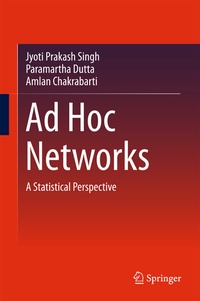
Ad Hoc Networks
Description

This book identifies the time-dependent network parameters: neighbour count, link load, path length, cluster count and delay, and presents a first-of-its-kind discussion on temporal parameters in mobile ad hoc networks. Frequent topology changes and multiple link failures occur in mobile ad hoc network due to arbitrary and random movement of nodes. This dynamic environment challenges the delivery of data and makes it essential to find better models for network parameters that are shifting with time. The parameters identified are put into the framework of time series because of their temporal characteristic, and when they are modelled using time series framework they exhibit a sound fit with Autoregressive AR(p) models of order p. The order p is evaluated for each fitted model and found to lie between one and three. The book also analyses the dependence of end-to-end delay of ad hoc network on various external factors such as the number of nodes, routing protocol, mobility models and path length and develops two prediction models. The book will be useful for researchers and professionals alike.
All prices
More details
Other editions
Additional editions
Persons
Jyoti Prakash Singh did his B.Tech in Computer Science and Technology from Kalyani Government Engineering College, West Bengal, India and M.Tech in Information Technology from Sikkim Manipal Institute of Technology, Sikkim, India. He completed his Doctor of Philosophy in Technology from University of Calcutta in 2015. He is currently an Assistant Professor in the Department of Computer Science and Engineering in National Institute of Technology Patna, Bihar, India.
He has co-authored six books in the area of C programming, Data Structures and Operating systems with leading publishing house such as McGraw Hill and Vikas Publishing. He has more than 40 research publications in various national and international journals, conference proceedings and book chapters. His research interests include big data analytics, text mining and ad hoc network. He is senior member of IEEE and member of ACM, life member of Computer Society of India (CSI), Indian Society for Technical Education (ISTE), International Association of Engineers (IAEng), Hong Kong, International Association of Computer and Information Technology (IACIT), Singapore.Dr. Paramartha Dutta , born 1966, did his Bachelors and Masters in Statistics from the Indian Statistical Institute, Calcutta in the years 1988 and 1990 respectively. He afterwards completed his Master of Technology in Computer science from the same Institute in the year 1993 and Doctor of Philosophy in Engineering from the Bengal Engineering and Science University, Shibpur in 2005 respectively. He has served in the capacity of research personnel in various projects funded by Govt. of India, which include DRDO, CSIR, Indian Statistical Institute, Calcutta etc. Dr. Dutta is now a Professor in the Department of Computer and System Sciences of the Visva Bharati University, West Bengal, India. Prior to this, he served Kalyani Government Engineering College and College of Engineering in WestBengal as full time faculty members. Dr. Dutta remained associated as Visiting/Guest Faculty of several Universities/Institutes encompassing West Bengal University of Technology, Kalyani University, Tripura University, National Institute of Technology, Arunachal Pradesh to name some. He has coauthored eight books and has also seven edited books with leading publishing house such as Springer, Elsevier IGI Global etc. to his credit. He has published about hundred eighty five papers in various journals and conference proceedings, both international and national as well as several book chapters in edited volumes of reputed International publishing house like Elsevier, Springer-Verlag, CRC Press, John Wiley to name a few. Dr. Dutta has guided three scholars who already had been awarded their Ph. D. Presently, he is supervising six scholars for their Ph. D program. Dr. Dutta as investigator, have successfully implemented projects funded by AICTE, DST of the Govt. of India. Dr. Dutta is a Life Fellow of the Optical Society of India (OSI), Institute of Electronics and Telecommunication Engineering (IETE), Life Senior Member of Computer Society of India (CSI), Life Member of Indian Science Congress Association (ISCA), International Association for Computer Science and Information Technology (IACSIT), Institution of Engineers, Hong Kong (IEng), Indian Society for Technical Education (ISTE), Indian Unit of Pattern Recognition and Artificial Intelligence (IUPRAI) - the Indian affiliate of the International Association for Pattern Recognition (IAPR), Institute of Engineers of India (IEI), Senior Member of Association of Computing Machinery (ACM), IEEE Computer Society (USA), and IEEE Computational Intelligence Society, USA.
Professor Amlan Chakrabarti is at present the Dean Faculty of Engineering and Technology and and Director at the A.K.Choudhury School of Information Technology, University of Calcutta. He is an M.Tech. from the University of Calcutta and has done his Doctoral research at Indian Statistical Institute, Kolkata, 2004-2008. He was a Post-Doctoral fellow at the School of Engineering, Princeton University, USA during 2011-2012. He is the recipient of BOYSCAST fellowship award in the area of Engineering Science from the Department of Science and Technology Govt. of India in 2011, Indian National Science Academy Visiting Faculty Fellowship in 2014 and JSPS Invitation Research Award, 2016. He is the Team leader of the ALICE-India CRU project at CERN Geneva on behalf of the University of Calcutta and also the Principal Investigator of the TEQIP-II funded Center of Excellence in Systems Biology and Biomedical Engineering, University of Calcutta. He has supervised several research projects funded by DRDO, DST, DAE, DeITy, UGC, Ministry of Social Justice and Empowerment, Tata Consultancy Services etc.
He has published around 100 research papers in referred journals and conferences. He is a Senior Member ofIEEE, Member of ACM. His research interests are: Quantum Computing, VLSI design, Embedded System Design, Video and Image Processing Algorithms and Biomedical Signal Processing.
