

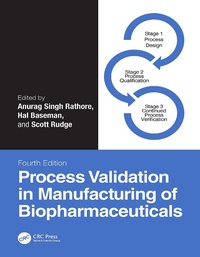
Process Validation in Manufacturing of Biopharmaceuticals
4th Edition
Published on 18. December 2023
410 pages
978-1-003-80547-2 (ISBN)
Description

The fourth edition of Process Validation in Manufacturing of Biopharmaceuticals is a practical and comprehensive resource illustrating the different approaches for successful validation of biopharmaceutical processes. A pivotal text in its field, this new edition provides guidelines and current practices, contains industrial case studies, and is expanded to include in-depth analysis of the new Process Validation (PV) guidance from the US FDA.
Key Features:
Offers readers a thorough understanding of the key concepts that form the basis of a good process validation program for biopharmaceuticals.
Includes case studies from the various industry leaders that demonstrate application of these concepts.
Discusses the use of modern tools such as multivariate analysis for facilitating a process validation exercise.
Covers process characterization techniques for scaling down unit operations in biopharmaceutical manufacturing, including chromatography, chemical modification reactions, ultrafiltration, and microfiltration, and practical methods to test raw materials and in-process samples.
Providing a thorough understanding of the key concepts that form the basis of a good process validation program, this book will help readers ensure that PV is carried out and exceeds expectations. Fully illustrated, this is a much-needed practical guide for biopharmaceutical manufacturers.
Key Features:
Offers readers a thorough understanding of the key concepts that form the basis of a good process validation program for biopharmaceuticals.
Includes case studies from the various industry leaders that demonstrate application of these concepts.
Discusses the use of modern tools such as multivariate analysis for facilitating a process validation exercise.
Covers process characterization techniques for scaling down unit operations in biopharmaceutical manufacturing, including chromatography, chemical modification reactions, ultrafiltration, and microfiltration, and practical methods to test raw materials and in-process samples.
Providing a thorough understanding of the key concepts that form the basis of a good process validation program, this book will help readers ensure that PV is carried out and exceeds expectations. Fully illustrated, this is a much-needed practical guide for biopharmaceutical manufacturers.
More details
Series
Edition
4th edition
Language
English
Place of publication
London
United Kingdom
Publishing group
Taylor & Francis Ebooks
Target group
College/higher education
Professional and scholarly
Product notice
Reflowable
Illustrations
61 Tables, black and white; 47 Line drawings, color; 50 Line drawings, black and white; 8 Halftones, color; 55 Illustrations, color; 50 Illustrations, black and white
ISBN-13
978-1-003-80547-2 (9781003805472)
Copyright in bibliographic data and cover images is held by Nielsen Book Services Limited or by the publishers or by their respective licensors: all rights reserved.
Schweitzer Classification
Other editions
Additional editions
Anurag Singh Rathore | Hal Baseman | Scott Rudge
Process Validation in Manufacturing of Biopharmaceuticals
Book
approx. 07/2026
4th Edition
CRC Press
€82.00
Not yet published
Anurag Singh Rathore | Hal Baseman | Scott Rudge
Process Validation in Manufacturing of Biopharmaceuticals
Book
12/2023
4th Edition
CRC Press
€250.80
Shipment within 15-20 days
Persons
ANURAG S. RATHORE is an Institute Chair Professor at the Department of Chemical Engineering, Indian Institute of Technology, Delhi, India. He is also the Coordinator for the DBT COE for Biopharmaceutical Technology. His areas of interest include process development, scale-up, technology transfer, process validation, biosimilars, continuous processing, medical image analysis, process analytical technology and quality by design. He is presently serving as the Editor-in-Chief of Preparative Biochemistry and Biotechnology and Associate Editor for Journal of Chemical Technology and Biotechnology. He also serves on the Editorial Advisory Boards for Biotechnology Progress, Biotechnology Journal, Electrophoresis, BioPharm International, Journal of Chromatography B, Journal of Chromatography Open, Pharmaceutical Technology Europe, and Separation and Purification Reviews. Dr. Rathore has edited books titled Preparative Chromatography for Separation of Proteins and Peptides (2017), Quality by Design for Biopharmaceuticals: Perspectives and Case Studies (2009), Elements of Biopharmaceutical Production (2007), Process Validation (2005), Electrokinetic Phenomena (2004), and Scale-up and Optimization in Preparative Chromatography (2003). He has a Ph.D. in Chemical Engineering from Yale University.
HAL BASEMAN is the Chief Operating Officer at ValSource Inc., a consulting services firm. Hal has held various positions in the biopharmaceutical manufacturing and consulting industry and has been involved in sterile product manufacturing for over 45 years. He is the past Chair of the PDA Board of Directors, the past Co-chair of PDA Science Advisory Board, past Chair or Lead on several PDA groups and efforts, including the PDA Process Validation Interest Group, the task forces for PDA Technical Reports on Process Validation, Aseptic Process Simulation, and Quality Risk Management, and the PDA Aseptic Processing Points to Consider. He is currently a member of the PDA TRI (Training and Research Institute faculty, Co-lead for the Kilmer Conference Regulatory Innovation Collaboration team, Chair of the SfSAP (Society for Sterility Assurance Professionals) Aseptic Processing Team, and Co-chair of the PDA Annex 1 revision response team. Hal has presented and published numerous articles and book chapters on topics related to sterile product manufacturing, risk management, and validation. He has edited books on Process Validation and Quality Risk Management. Hal holds a Bachelor of Science Degree in Biology from Ursinus College and a Master of Business Administration in Management from La Salle University.
Dr. Scott Rudge is a Principal Consultant and a member of the Syner-G team since January 2023. He is an experienced pharmaceutical professional with 33 years of progressive experience directing Process Engineering, Process Development, Product Development and overall Pharmaceutical Operations. Scott was a co-founder of RMC Pharmaceutical Solutions in 2004, which was acquired by SynerG Biopharma Group in January, 2023. Scott has built and led several organizations in the biopharmaceutical industry, including process engineering, process development and product development teams at Synergen, Amylin Pharmaceuticals and FeRx, where he reported to the CEO. Ultimately, Scott formed his own consulting company, RMC Pharmaceutical Solutions with the vision to provide product development services to biotech and pharmaceutical companies of all sizes and all stages of development. Scott has remained active as a thought leader and innovator in biotechnology and pharmaceutical development. Scott is a co-author on the award winning textbook "Bioseparation Science and Engineering", co-author on the new chapter in Perry's "Chemical Engineering Handbook" on Biotechnology, co-editor on the CRC "Process Validation in Manufacturing of Biopharmaceuticals", and has been a reviewer for the National Academy of Science's ten year strategic goals for separation sciences in 2020, in addition to many publications and patents. Scott earned his B.S. in Chemical Engineering from Worcester Polytechnic Institute and his M.S. and Ph.D in Chemical Engineering from Purdue University.
HAL BASEMAN is the Chief Operating Officer at ValSource Inc., a consulting services firm. Hal has held various positions in the biopharmaceutical manufacturing and consulting industry and has been involved in sterile product manufacturing for over 45 years. He is the past Chair of the PDA Board of Directors, the past Co-chair of PDA Science Advisory Board, past Chair or Lead on several PDA groups and efforts, including the PDA Process Validation Interest Group, the task forces for PDA Technical Reports on Process Validation, Aseptic Process Simulation, and Quality Risk Management, and the PDA Aseptic Processing Points to Consider. He is currently a member of the PDA TRI (Training and Research Institute faculty, Co-lead for the Kilmer Conference Regulatory Innovation Collaboration team, Chair of the SfSAP (Society for Sterility Assurance Professionals) Aseptic Processing Team, and Co-chair of the PDA Annex 1 revision response team. Hal has presented and published numerous articles and book chapters on topics related to sterile product manufacturing, risk management, and validation. He has edited books on Process Validation and Quality Risk Management. Hal holds a Bachelor of Science Degree in Biology from Ursinus College and a Master of Business Administration in Management from La Salle University.
Dr. Scott Rudge is a Principal Consultant and a member of the Syner-G team since January 2023. He is an experienced pharmaceutical professional with 33 years of progressive experience directing Process Engineering, Process Development, Product Development and overall Pharmaceutical Operations. Scott was a co-founder of RMC Pharmaceutical Solutions in 2004, which was acquired by SynerG Biopharma Group in January, 2023. Scott has built and led several organizations in the biopharmaceutical industry, including process engineering, process development and product development teams at Synergen, Amylin Pharmaceuticals and FeRx, where he reported to the CEO. Ultimately, Scott formed his own consulting company, RMC Pharmaceutical Solutions with the vision to provide product development services to biotech and pharmaceutical companies of all sizes and all stages of development. Scott has remained active as a thought leader and innovator in biotechnology and pharmaceutical development. Scott is a co-author on the award winning textbook "Bioseparation Science and Engineering", co-author on the new chapter in Perry's "Chemical Engineering Handbook" on Biotechnology, co-editor on the CRC "Process Validation in Manufacturing of Biopharmaceuticals", and has been a reviewer for the National Academy of Science's ten year strategic goals for separation sciences in 2020, in addition to many publications and patents. Scott earned his B.S. in Chemical Engineering from Worcester Polytechnic Institute and his M.S. and Ph.D in Chemical Engineering from Purdue University.
Content
The Evolution of Modern Process Validation: Commentary on the U.S. Food and Drug Administration's 2011 Guidance for Industry, Process Validation Principles and Practices
Hal Baseman
Applications of Failure Modes and Effects Analysis to Biotechnology Manufacturing Processes
Robert J. Seely and John Haury
Process Characterization
James E. Seely
Scale-Down Models for Microbial and Mammalian Cell Culture Processes: Approaches and Applications
Ravali Raju et al.
Scale-Down Models for Purification Processes: Approaches and Application
Arch Creasy et al.
Principles of Quality Risk Management for Validation
Tiffany Baker and Patrick Mains
Lifespan Studies for Chromatography and Filtration Media
Anurag S. Rathore and Gail Sofer
Analytical Test Methods for Well-Characterized Biological and Biotechnological Products
Nadine Ritter and John McEntire
Adventitious Agents: Concerns and Testing for Biopharmaceuticals
Raymond W. Nims et al.
Biotech Facility Design for Validation
Phil DeSantis
Process Validation at Contract Manufacturing Organizations: Approaches, Incentives, Benefits, and Risks
Maria Wik and Scott Rudge
Validation of a Filtration Step
Jennifer Campbell et al.
Validation of Continuous Bioprocesses
Marc Bisschops and Mark Schofield
Role of Multivariate Analysis in Process Validation
Anurag S. Rathore and Vishwanath Hebbi
Process Development for Plasmid DNA Production
Frank Agbogdo et al.
Hal Baseman
Applications of Failure Modes and Effects Analysis to Biotechnology Manufacturing Processes
Robert J. Seely and John Haury
Process Characterization
James E. Seely
Scale-Down Models for Microbial and Mammalian Cell Culture Processes: Approaches and Applications
Ravali Raju et al.
Scale-Down Models for Purification Processes: Approaches and Application
Arch Creasy et al.
Principles of Quality Risk Management for Validation
Tiffany Baker and Patrick Mains
Lifespan Studies for Chromatography and Filtration Media
Anurag S. Rathore and Gail Sofer
Analytical Test Methods for Well-Characterized Biological and Biotechnological Products
Nadine Ritter and John McEntire
Adventitious Agents: Concerns and Testing for Biopharmaceuticals
Raymond W. Nims et al.
Biotech Facility Design for Validation
Phil DeSantis
Process Validation at Contract Manufacturing Organizations: Approaches, Incentives, Benefits, and Risks
Maria Wik and Scott Rudge
Validation of a Filtration Step
Jennifer Campbell et al.
Validation of Continuous Bioprocesses
Marc Bisschops and Mark Schofield
Role of Multivariate Analysis in Process Validation
Anurag S. Rathore and Vishwanath Hebbi
Process Development for Plasmid DNA Production
Frank Agbogdo et al.
