

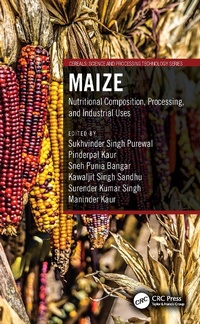
Maize
Nutritional Composition, Processing, and Industrial Uses
1st Edition
Published on 30. September 2022
383 pages
978-1-000-68593-0 (ISBN)
Description

Maize is widely cultivated throughout the world due to its high-yield potential. The economic and nutritional value of maize grains is associated with its starch content, protein, fibre, bioactive compounds, and minerals. Maize is used worldwide in the preparation of health-benefiting, antioxidant-rich, fortified products and dietary supplements.
Maize: Nutritional Composition, Processing, and Industrial Uses explores the status of maize in terms of its production, nutritional composition, biofortification, processing methods, health benefits, maize-based products and storage. This book also emphasizes the key features of maize grains which make it an ideal crop for industrial use. It covers all aspects of recent research about the maize and provides updated information.
Features:
Discusses information related to chemistry of maize components
Highlights comprehensive information on the physical and milling properties of maize
Explains the structure, functional, and antioxidant properties of maize flour
Provides the latest scientific development in the modification of maize starch
Explores various maize-based food products and their storage
Examines maize protein, scenarios, and quality improvement through bio-fortification
In-depth information is provided regarding various health-benefiting nutrient components of maize flour, offering meaningful information for product formulation. This book unfolds the potential of maize grains for industrial use.
Maize: Nutritional Composition, Processing, and Industrial Uses explores the status of maize in terms of its production, nutritional composition, biofortification, processing methods, health benefits, maize-based products and storage. This book also emphasizes the key features of maize grains which make it an ideal crop for industrial use. It covers all aspects of recent research about the maize and provides updated information.
Features:
Discusses information related to chemistry of maize components
Highlights comprehensive information on the physical and milling properties of maize
Explains the structure, functional, and antioxidant properties of maize flour
Provides the latest scientific development in the modification of maize starch
Explores various maize-based food products and their storage
Examines maize protein, scenarios, and quality improvement through bio-fortification
In-depth information is provided regarding various health-benefiting nutrient components of maize flour, offering meaningful information for product formulation. This book unfolds the potential of maize grains for industrial use.
More details
Series
Edition
1. Auflage
Language
English
Place of publication
London
United Kingdom
Publishing group
Taylor & Francis Ltd
Illustrations
20 Tables, black and white; 17 Line drawings, color; 21 Line drawings, black and white; 11 Halftones, color; 16 Halftones, black and white; 28 Illustrations, color; 37 Illustrations, black and white
ISBN-13
978-1-000-68593-0 (9781000685930)
Copyright in bibliographic data and cover images is held by Nielsen Book Services Limited or by the publishers or by their respective licensors: all rights reserved.
Schweitzer Classification
Other editions
Additional editions
Sukhvinder Singh Purewal | Pinderpal Kaur | Sneh Punia Bangar
Maize
Nutritional Composition, Processing, and Industrial Uses
Book
10/2024
1st Edition
CRC Press
€127.30
Shipment within 10-20 days
Sukhvinder Singh Purewal | Pinderpal Kaur | Sneh Punia Bangar
Maize
Nutritional Composition, Processing, and Industrial Uses
Book
09/2022
1st Edition
CRC Press
€290.70
Shipment within 10-20 days
Persons
Sukhvinder Singh Purewal, Ph.D. is presently working as Young Scientist, DST (SYST Scheme) in Department of Food Science & Technology, Maharaja Ranjit Singh Punjab Technical University, Bathinda. His area of interests includes solid state fermentation, bioactive compounds from natural resources, antioxidants and fruits processing. He has presented his research in various national and international conferences and publishes more than 40 research papers/book chapters in national and international journals/books. Dr. Purewal has published one authored book with CRC Press, Taylor & Francis Group. He is an active member of Association of Microbiologists of India (AMI), Mycological Society of India (MSI), Association of Food Scientists and Technologists (AFSTI), Mysore, India and Indian Science Congress Association (ISCA). Dr. Purewal received his M.Sc., M.Phil and Doctorate degree in Biotechnology from Chaudhary Devi Lal University, Sirsa, Haryana (India). He has also worked on a UGC, Delhi sponsored Major Research Project during 2012-2015. He was awarded for best paper presentation in National as well as International Conferences.
Pinderpal Kaur is a currently a Ph.D. Research scholar in Department of Food Science and Technology, Maharaja Ranjit Singh Punjab Technical University, Bathinda. Her area of interests includes antioxidant from natural resources, starch modifications and cereal technology. She has published more than 10 research papers in Journals of International repute. She has actively participated in National and International conferences. She is an active life member of Association of Food Scientists and Technologists (AFSTI), Mysore.
Sneh Punia, Ph.D. is presently working as Assistant Professor (C) in the Department of Food Science and Technology, Chaudhary Devi Lal University, Sirsa. Dr. Punia is involved in the mandated research activities of institution and has expertise on extraction and functional characterization of antioxidants, starch, their modifications and functional products. She has presented her research in various national and international conferences and publishes more than 100 research papers/book chapters in national and international journals/books. Dr. Punia has published two edited and one authored book with CRC Taylor and Francis Group. She also serves as the reviewer for various international journals. Dr. Punia received her M.Sc. and Doctorate degree in Food Science and Technology, Chaudhary Devi Lal University, Sirsa, Haryana (India).
Kawaljit Singh Sandhu, Ph.D. is presently working as Associate Professor in Department of Food Science and Technology, Maharaja Ranjit Singh Punjab Technical University, Bathinda. He was awarded with postdoctoral fellowship from Korea University, Seoul, South Korea. With more than 15 years of research and teaching experience, his research interest is focused on starch, starch modification, antioxidants, nano-technology and drug delivery. Dr. Sandhu received several research projects from UGC, New Delhi, DST, New Delhi and MOFPI, New Delhi. He was awarded with Young Scientist Award from Association of Food Scientists and Technologists (AFSTI), Mysore, India. Dr. Sandhu is active member AFSTI, India, Association of Microbiologists of India and Korean Society of Food Science and Technology, South Korea. He has published more than 60 research paper in various national and international journals.
Surender Kumar Singh, Ph.D. is Principal Scientist at National Centre for Integrated Pest Management, NCIPM, New Delhi. He has 3 International and 7 National Patents in his credit. Technology transfer to industry during 27 years of research experience is 9. Dr. Singh received several research projects from Government of India. He received many awards during National and International Conferences. He is an active member of Indian Journal of Entomology, Indian Journal of Plant Protection, Annals of Plant Protection, Journal of Biological Control, Journal of Oilseed Research and Journal of Insect Science. Books Published: 8
Maninder Kaur, Ph.D. is Associate Professor at Department of Food Science and Technology, Guru Nanak Dev University, Amritsar, India. She has published more than 60 research articles in various International and National peer-reviewed Journals. Dr. Kaur is a member of various scientific societies and associations including active member of Association of Food Scientists and Technologists (AFSTI), Mysore, India and Punjab Academy of Sciences. She also serves as the reviewer for various international journals. She was awarded with Postdoctoral fellowship from Korea University, Seoul, South Korea. Specialization of Dr. Kaur is characterization of bio-macromolecules from different botanical sources, their modifications and applications. Dr. Kaur supervised 3 Ph.D. students.
Pinderpal Kaur is a currently a Ph.D. Research scholar in Department of Food Science and Technology, Maharaja Ranjit Singh Punjab Technical University, Bathinda. Her area of interests includes antioxidant from natural resources, starch modifications and cereal technology. She has published more than 10 research papers in Journals of International repute. She has actively participated in National and International conferences. She is an active life member of Association of Food Scientists and Technologists (AFSTI), Mysore.
Sneh Punia, Ph.D. is presently working as Assistant Professor (C) in the Department of Food Science and Technology, Chaudhary Devi Lal University, Sirsa. Dr. Punia is involved in the mandated research activities of institution and has expertise on extraction and functional characterization of antioxidants, starch, their modifications and functional products. She has presented her research in various national and international conferences and publishes more than 100 research papers/book chapters in national and international journals/books. Dr. Punia has published two edited and one authored book with CRC Taylor and Francis Group. She also serves as the reviewer for various international journals. Dr. Punia received her M.Sc. and Doctorate degree in Food Science and Technology, Chaudhary Devi Lal University, Sirsa, Haryana (India).
Kawaljit Singh Sandhu, Ph.D. is presently working as Associate Professor in Department of Food Science and Technology, Maharaja Ranjit Singh Punjab Technical University, Bathinda. He was awarded with postdoctoral fellowship from Korea University, Seoul, South Korea. With more than 15 years of research and teaching experience, his research interest is focused on starch, starch modification, antioxidants, nano-technology and drug delivery. Dr. Sandhu received several research projects from UGC, New Delhi, DST, New Delhi and MOFPI, New Delhi. He was awarded with Young Scientist Award from Association of Food Scientists and Technologists (AFSTI), Mysore, India. Dr. Sandhu is active member AFSTI, India, Association of Microbiologists of India and Korean Society of Food Science and Technology, South Korea. He has published more than 60 research paper in various national and international journals.
Surender Kumar Singh, Ph.D. is Principal Scientist at National Centre for Integrated Pest Management, NCIPM, New Delhi. He has 3 International and 7 National Patents in his credit. Technology transfer to industry during 27 years of research experience is 9. Dr. Singh received several research projects from Government of India. He received many awards during National and International Conferences. He is an active member of Indian Journal of Entomology, Indian Journal of Plant Protection, Annals of Plant Protection, Journal of Biological Control, Journal of Oilseed Research and Journal of Insect Science. Books Published: 8
Maninder Kaur, Ph.D. is Associate Professor at Department of Food Science and Technology, Guru Nanak Dev University, Amritsar, India. She has published more than 60 research articles in various International and National peer-reviewed Journals. Dr. Kaur is a member of various scientific societies and associations including active member of Association of Food Scientists and Technologists (AFSTI), Mysore, India and Punjab Academy of Sciences. She also serves as the reviewer for various international journals. She was awarded with Postdoctoral fellowship from Korea University, Seoul, South Korea. Specialization of Dr. Kaur is characterization of bio-macromolecules from different botanical sources, their modifications and applications. Dr. Kaur supervised 3 Ph.D. students.
Content
1. Physical and Milling Properties of Maize 2. Chemistry of Maize Components 3. Nutritional Profile of Maize and Effect of Processing Methods 4. Maize Starch: pasting, rheological and morphological properties 5. Maize starch modifications and industrial uses 6. Maize Protein: Extraction, Quality and Current Scenario 7. Bioactive Compounds, Antioxidant Properties and Health Benefits of Whole Maize and its Components 8. Colored Maize and Their Unique Features 9. Quality Improvement Through Bio-Fortification 10. Storage of Maize and its Products.
