

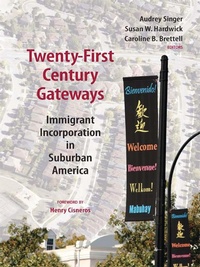
Twenty-First Century Gateways
Immigrant Incorporation in Suburban America
1st Edition
Published on 1. April 2009
331 pages
978-0-8157-7928-5 (ISBN)
Description

While federal action on immigration faces an uncertain future, states, cities and suburban municipalities craft their own responses to immigration. Twenty-First-Century Gateways, focuses on the fastest-growing immigrant populations in metropolitan areas with previously low levels of immigration¿places such as Atlanta, Austin, Charlotte, Dallas-Fort Worth, Minneapolis-St. Paul, Phoenix, Portland, Sacramento, and Washington, D.C. These places are typical of the newest, largest immigrant gateways to America, characterized by post-WWII growth, recent burgeoning immigrant populations, and predominantly suburban settlement.
More immigrants, both legal and undocumented, arrived in the United States during the 1990s than in any other decade on record. That growth has continued more slowly since the Great Recession; nonetheless the U.S. immigrant population has doubled since 1990. Many immigrants continued to move into traditional urban centers such as New York, Chicago, and Los Angeles, but burgeoning numbers were attracted by the economic and housing opportunities of fast-growing metropolitan areas and their largely suburban settings. The pace of change in this new geography of immigration has presented many local areas with challenges¿social, fiscal, and political.
Edited by Audrey Singer, Susan W. Hardwick, and Caroline B. Brettell, Twenty-First-Century Gateways provides in-depth, comparative analysis of immigration trends and local policy responses in America's newest gateways. The case examples by a group of leading multidisciplinary immigration scholars explore the challenges of integrating newcomers in the specific gateways, as well as their impact on suburban infrastructure such as housing, transportation, schools, health care, economic development, and public safety.
The changes and trends dissected in this book present a critically important understanding of the reshaping of the United States today and the future impact of
More details
Edition
1. Auflage
Language
English
Place of publication
New York
United States
Publishing group
Bloomsbury Publishing Plc
ISBN-13
978-0-8157-7928-5 (9780815779285)
DOI
10.5771/9780815779285
Copyright in bibliographic data and cover images is held by Nielsen Book Services Limited or by the publishers or by their respective licensors: all rights reserved.
Schweitzer Classification
Other editions
Additional editions
Audrey Singer | Susan W. Hardwick | Caroline B. Brettell
Twenty-First Century Gateways
Immigrant Incorporation in Suburban America
Book
02/2008
Brookings Institution
€93.04
Article exhausted; check different version
Audrey Singer | Susan W. Hardwick | Caroline B. Brettell
Twenty-First Century Gateways
Immigrant Incorporation in Suburban America
Book
02/2008
Brookings Institution
€42.20
Shipment within 10-20 days
Persons
Audrey Singer is a senior fellow in Metropolitan Policy at the Brookings Institution. Susan W. Hardwick is a professor of geography at the University of Oregon and senior research fellow at the Vancouver Metropolis Center. Caroline B. Brettell is the Dedman Family Distinguished Professor in the department of anthropology at Southern Methodist University and Dean ad Interim of Dedman College.
Content
- Cover
- Title Page
- Copyright Information
- Table of Contents
- Foreword
- Acknowledgments
- Introduction
- Toward a Suburban Immigrant Nation
- Big D
- Diverging Trajectories
- Unsettled in the Suburbs
- Edge Gateways
- Immigrant Space and Place in Suburban Sacramento
- Impediments to the Integration of Immigrants
- Placing" the Refugee Diaspora in Suburban Portland, Oregon
- Austin
- The "Nuevo South
- Afterword
- Contributors
- Index
- Back Cover
