

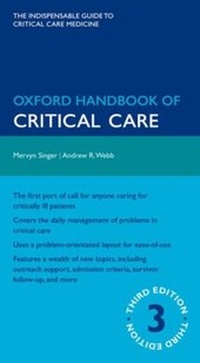
Oxford Handbook of Critical Care
1st Edition
Published on 26. March 2009
700 pages
978-0-19-158558-6 (ISBN)
Description

The fully revised, third edition of this bestselling Handbook describes best practice of critical care in a succinct, concise and clinically-orientated way. Covering the principles of general management, it includes therapeutic and monitoring devices, specific disorders of organ systems, as well as detailed information on drugs and fluids. New material has been added on key areas such as airway maintenance, dressing techniques, infection control, echocardiography,tissue perfusion monitoring, coma and more. With up-to-date references and invaluable clinical advice, there is also plenty of space to add notes or amend sections to suit local protocols. Patient-centred and practical, it will serve the consultant, trainee, nurse or other allied health professionals as both a reference and aide memoir. This is the indispensable Oxford Handbook for all those working within critical care.
More details
Other editions
New editions
Mervyn Singer | Andrew Webb | Alice Carter
Oxford Handbook of Critical Care
E-Book
03/2025
1st Edition
OUP Oxford
€60.99
Available for download
Mervyn Singer | Andrew Webb | Alice Carter
Oxford Handbook of Critical Care
E-Book
03/2025
1st Edition
OUP Oxford
€60.99
Available for download
Additional editions
Mervyn Singer | Andrew Webb
Oxford Handbook of Critical Care
Book
03/2009
3rd Edition
Oxford University Press
€44.63
Article exhausted; check different version
Content
- Intro
- Contents
- Preface to the previous editions
- Preface to this edition
- Abbreviations
- 1 Critical care organisation and management
- Critical Care Unit layout
- Critical Care Unit staffing (medical)
- Critical Care Unit staffing (nursing)
- Outreach support
- Critical Care Unit admission criteria
- Survivor follow-up
- Patient safety
- Fire safety
- Communication
- Medicolegal aspects
- Clinical governance
- Audit
- Critical care scoring systems
- APACHE scoring
- SAPS score
- SOFA score
- Trauma score
- 2 Respiratory therapy techniques
- Oxygen therapy
- Airway maintenance
- Endotracheal intubation
- Ventilatory support-indications
- IPPV-description of ventilators
- IPPV-modes of ventilation
- IPPV-adjusting the ventilator
- IPPV-failure to tolerate ventilation
- IPPV-failure to deliver ventilation
- IPPV-complications of ventilation
- IPPV-weaning techniques
- IPPV-assessment of weaning
- High frequency jet ventilation
- High frequency oscillatory ventilation
- Positive end expiratory pressure (1)
- Positive end expiratory pressure (2)
- Continuous positive airway pressure
- Lung recruitment
- Prone positioning
- Non-invasive respiratory support
- Extracorporeal respiratory support
- Tracheotomy
- Mini-tracheotomy
- Chest drain insertion
- Pleural aspiration
- Fibreoptic bronchoscopy
- Chest physiotherapy
- 3 Cardiovascular therapy techniques
- Electrical cardioversion
- Temporary pacing (1)
- Temporary pacing (2)
- Therapeutic hypothermia
- Intra-aortic balloon counterpulsation
- Coronary revascularisation techniques
- 4 Renal therapy techniques
- Haemo(dia)flltration (1)
- Haemo(dia)flltration (2)
- Peritoneal dialysis
- Plasma exchange
- 5 Gastrointestinal therapy techniques
- Sengstaken-type tube
- Upper gastrointestinal endoscopy
- Enteral feeding and drainage tubes
- 6 Nutrition and metabolic therapy
- Nutrition-use and indications
- Enteral nutrition
- Parenteral nutrition
- Tight glycaemic control/intensive insulin therapy
- 7 Wound and pressure area management
- Wound management principles
- Dressing techniques
- Special support surfaces
- 8 Respiratory monitoring
- Pulse oximetry
- CO[sub(2)] monitoring
- Pulmonary function tests
- Volume-pressure relationship
- Blood gas machine
- Blood gas analysis
- Extravascular lung water measurement
- Respiratory imaging
- 9 Cardiovascular monitoring
- ECG monitoring
- Blood pressure monitoring
- Arterial cannulation
- Central venous catheter-insertion
- Central venous catheter-use
- Central venous catheter-complications
- Pulmonary artery catheter-insertion
- Pulmonary artery catheter-use
- Cardiac output-central thermodilution
- Cardiac output-peripheral thermodilution
- Cardiac output-indicator dilution
- Cardiac output-Doppler ultrasound
- Cardiac output-pulse contour analysis
- Cardiac output-other techniques
- Pressure and stroke volume variation
- Echocardiography
- Tissue perfusion monitoring
- Gut tonometry
- 10 Neurological monitoring
- Intracranial pressure monitoring
- Jugular venous bulb saturation
- EEG/CFM monitoring
- Other neurological monitoring
- 11 Laboratory monitoring
- Urea and creatinine
- Electrolytes (Na[sup(+)], K[sup(+)], Cl[sup(-)], HCO[sub(3)][sup(-)] )
- Calcium, magnesium, and phosphate
- Cardiac function tests
- Liver function tests
- Full blood count
- Coagulation monitoring
- Bacteriology
- Virology, serology, and assays
- Toxicology
- 12 Miscellaneous monitoring
- Urinalysis
- Indirect calorimetry
- Lactate
- Colloid osmotic pressure
- 13 Fluids
- Crystalloids
- Sodium bicarbonate
- Colloids
- Blood transfusion
- Blood products
- 14 Respiratory drugs
- Bronchodilators
- Respiratory stimulants
- Nitric oxide
- Surfactant
- 15 Cardiovascular drugs
- Inotropes
- Vasodilators
- Vasopressors
- Hypotensive agents
- Anti-arrhythmics
- Chronotropes
- Anti-anginal agents
- 16 Renal drugs
- Diuretics
- Dopamine
- 17 Gastrointestinal drugs
- H[sub(2)] blockers and proton pump inhibitors
- Sucralfate
- Antacids
- Anti-emetics
- Gut motility agents
- Anti-diarrhoeals
- Anti-constipation agents
- 18 Neurological drugs
- Non-opioid analgesics
- Opioid analgesics
- Epidural analgesia
- Sedatives and tranquilisers
- Muscle relaxants
- Anticonvulsants
- Neuroprotective agents
- 19 Haematological drugs
- Anticoagulants
- Thrombolytics
- Coagulants and antifibrinolytics
- 20 Miscellaneous drugs
- Antimicrobials
- Corticosteroids
- Prostaglandins
- Immunomodulatory therapies in sepsis
- Rituximab
- 21 Resuscitation
- Basic resuscitation
- Cardiac arrest
- Fluid challenge
- 22 Respiratory disorders
- Dyspnoea
- Airway obstruction
- Respiratory failure
- Atelectasis and pulmonary collapse
- Chronic airflow limitation
- Acute chest infection (1)
- Acute chest infection (2)
- Acute respiratory distress syndrome (1)
- Acute respiratory distress syndrome (2)
- Asthma-general management
- Asthma-ventilatory management
- Pneumothorax
- Haemothorax
- Haemoptysis
- Inhalation injury
- Pulmonary embolus
- 23 Cardiovascular disorders
- Hypotension
- Hypertension
- Tachyarrhythmias
- Bradyarrhythmias
- Acute coronary syndrome (1)
- Acute coronary syndrome (2)
- Heart failure-assessment
- Heart failure-management
- 24 Renal disorders
- Oliguria
- Acute renal failure-diagnosis
- Acute renal failure-management
- 25 Gastrointestinal disorders
- Vomiting/gastric stasis
- Diarrhoea
- Failure to open bowels
- Upper gastrointestinal haemorrhage
- Bleeding varices
- Oesophageal perforation
- Intra-abdominal bowel perforation and obstruction
- Lower intestinal bleeding and colitis
- Abdominal sepsis
- Pancreatitis
- 26 Hepatic disorders
- Jaundice
- Acute liver failure
- Hepatic encephalopathy
- Chronic liver failure
- 27 Neurological disorders
- Coma
- Acute weakness
- Delirium
- Generalised seizures
- Meningitis
- Intracranial haemorrhage
- Subarachnoid haemorrhage
- Stroke
- Raised intracranial pressure
- Guillain-Barré syndrome
- Myasthenia gravis
- Critical care neuromuscular disorders
- Tetanus
- Botulism
- 28 Haematological disorders
- Bleeding disorders
- Clotting disorders
- Anaemia
- Sickle cell disease
- Haemolysis
- Platelet disorders
- 29 Metabolic disorders
- Electrolyte management
- Hypernatraemia
- Hyponatraemia
- Hyperkalaemia
- Hypokalaemia
- Hypomagnesaemia
- Hypercalcaemia
- Hypocalcaemia
- Hypophosphataemia
- General acid-base principles
- Metabolic acidosis
- Metabolic alkalosis
- Hypoglycaemia
- Hyperglycaemia
- Diabetic ketoacidosis
- Hyperosmolar diabetic emergencies
- Thyroid emergencies
- Hypoadrenal crisis
- 30 Poisoning
- Poisoning-general principles
- Salicylate poisoning
- Paracetamol poisoning
- Sedative poisoning
- Tricyclic antidepressant poisoning
- Amphetamines and Ecstasy
- Cocaine poisoning
- Inhaled poisons
- Household chemicals
- Methanol and ethylene glycol
- Organophosphate poisoning
- 31 Infection and inflammation
- Infection control-general principles
- Infection control-HIV
- Infection control-dangerous pathogens
- Routine changes of disposables
- Infection-diagnosis
- Infection-treatment
- Systemic inflammation/multi-organ failure-causes
- Systemic inflammation/multi-organ failure-management
- Sepsis and septic shock-treatment
- Multi-resistant infections
- Necrotising fasciitis
- HIV-related disease
- Malaria
- SARS, VHF, and H5N1
- Rheumatic disorders
- Vasculitis
- Toxic epidermal necrolysis
- Anaphylactoid reactions
- 32 Trauma and burns
- Multiple trauma (1)
- Multiple trauma (2)
- Head injury (1)
- Head injury (2)
- Spinal cord injury
- Burns-fluid management
- Burns-general management
- Blast injury
- 33 Physical disorders
- Hypothermia
- Pyrexia-causes
- Pyrexia-management
- Hyperthermia
- Electrocution
- Near-drowning
- Rhabdomyolysis
- Raised intra-abdominal pressure
- 34 Pain and post-operative critical care
- Pain
- Post-operative critical care
- 35 Oncological critical care
- Pain and comfort
- Effects of chemo- and radiotherapy
- Neutropaenia and infection
- Leukaemia/lymphoma
- 36 Obstetric emergencies
- Pre-eclampsia and eclampsia
- HELLP syndrome
- Post-partum haemorrhage
- Amniotic fluid embolus
- 37 Transport of the critically ill
- Intra-hospital transport
- Inter-hospital transport-road
- Inter-hospital transport-air
- 38 Death and the dying patient
- Brain stem death
- Withdrawal and withholding treatment
- Care of the potential organ/tissue donor
- Index
- A
- B
- C
- D
- E
- F
- G
- H
- I
- J
- K
- L
- M
- N
- O
- P
- Q
- R
- S
- T
- U
- V
- W
