

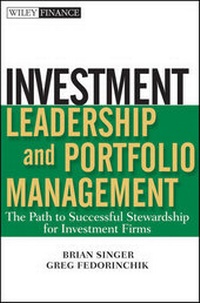
Investment Leadership and Portfolio Management
Description

More details
Other editions
Additional editions
Persons
Content
Preface
In Murfreesboro, TN, childhood home of one of the co-authors, a weathered farmer walks out to get the morning newspaper in her usual morning back pain. Mary had forgotten to take her nightly painkiller to treat arthritis in her back and the impact of her weekly immune system inhibitor injection was beginning to wane. Regardless, she hobbles back into the old wood farmhouse and settles in to an easy chair, molded to her body after years of this morning ritual. She reads the local newspaper, building up the energy to mount the tractor for another day's labor.
Mary spots an article in the newspaper about a terrorist attack in South-east Asia. She has never heard of the terrorist group, but she is certain that "some Muslim group" is behind the devastation. Mary hates Muslims and is sure that they hate her for her fundamentalist Christian beliefs. No bother, though, as they are on the other side of the world and Muslims are unlikely to have any influence on her narrow existence in this rural little corner of the world.
She couldn't be more wrong. What Mary doesn't realize is that both of the drugs she uses to control her daily pain would not have been possible without the generous financial support of those individuals whom she unjustly loathes. Conversely, the people who produce her pills may equally dislike Mary for her bigotry and hatred; yet they enable her to get up on most days to live a pain-free existence. Moreover, their investments created two successful drugs-interestingly developed by an Israeli company-that garnered generous returns supporting unprecedented infrastructure building around the world.
It is not from the benevolence of the butcher, the brewer, or the baker, that we expect our dinner, but from their regard to their own interest. We address ourselves, not to their humanity but from their regard to their own interest. We address ourselves, not to their humanity but to their self-love, and never talk to them of our own necessities but of their advantages . . . He generally, indeed, neither intends to promote the public interest, nor knows how much he is promoting it . . . He intends only his own gain, and he is in this, as in many other cases, led by an invisible hand to promote an end which was no part of his intention.
-Adam Smith
These parties don't know and perhaps can't stand each other, yet they depend on, benefit from, and support each other on a daily basis. How can this happen?
ARE WE SETTING A GOOD EXAMPLE FOR OUR CHILDREN?
To understand how this happens every second of every day, consider a common misperception that was so eloquently portrayed in Tom Wolfe'sThe Bonfire of the Vanities (Random House, 2001). Sherman McCoy, a self-styled "Master of the Universe" bond trader on Wall Street, is asked by his daughter, Campbell, what he does for a living. The question is prompted by the fact that seven-year-old Campbell's friend's dad produces tangible things at his printing business and Campbell wants to tell her friend what her daddy does.
After several failed attempts to explain what he does, Sherman's wife Judy explains that, "Daddy doesn't build roads or hospitals, and that he doesn't help build them." Rather, Judy explains, "Just imagine that a bond is a slice of cake, and you didn't bake the cake, but every time you hand somebody a slice of the cake a tiny little bit comes off, like a little crumb, and you keep that. . . . Imagine little crumbs, but lots of little crumbs. If you pass around enough slices of cake, pretty soon you have enough crumbs to make a gigantic cake." (p. 239) Having equated the gains from bond trading to gathering millions of "golden crumbs," Judy has implied, in quite memorable manner, that Sherman doesn't produce anything tangible. Sherman is portrayed as a parasite on the efforts of others.
While Tom Wolfe provided a wonderful story (and a New York Timesbestseller), he has shredded the contribution of investing. The critical role of an investor is to locate the best and cheapest cakes in the world and make them available to the individuals who want cakes the most. For providing this service, they get a very small piece of the cakes-the crumbs. Most likely, the consumer and baker don't know and will never know each other. In fact, the consumer may hate the baker and the baker may, likewise, despise the consumer, yet they merrily come to each other's service.
Mary, our rural farmer, benefits from the continuous efforts of investors around the world. Investors evaluate every investment opportunity, every request for money to build a business, research a drug, develop a new manufacturing process, and so on. When good opportunities are identified, they place capital in these opportunities. These same investors beseech entities that have capital to entrust it with them to make good decisions regarding which opportunities to support. Investors serve as stewards of society's wealth. That said, investors are not doing not-for-profit social work. Finding opportunities that may be profitable is incredibly difficult, and successful investors get and should get paid a lot of money. However, they should be successful to be paid handsomely, and it is difficult to distinguish success from randomly positive outcomes.
Another important consideration for investment managers is the fact that actually delivering successful performance outcomes to clients requires more than just improving the efficiency of the global allocation of capital, and generating value-added investment performance. It requires successful communication with clients that helps them overcome the natural human biases that often lead to poor investment outcomes. Succeeding in this endeavor is one of the greatest challenges in this business, and one that requires additional attention and great execution.
It is for these reasons that we have decided to write this book. After collectively accumulating nearly 70 years of experience, we feel a need to document the characteristics of firms that are and are likely to be successful stewards of client capital and the behaviors of these firms' leaders and their investment teams.
OVERVIEW OF THE BOOK
The book is a top-down analysis of successful strategies, structures, and actions that create an environment for generating strong investment performance and, most important, for delivering rewarding investor outcomes. Additionally, we discuss various aspects of the framework that we have found useful in this regard so that readers can examine real applications of the ideas. Each chapter can stand on its own and can be read in isolation; however, the chapters are best read in sequence.
The book begins with a discussion of the differences between investment firms and product firms. Both types of firms have their place in the industry, but they are motivated by different means and to different ends. The bulk of Chapter 1 focuses on the characteristics that are found in successful firms of both types, and includes discussion on the importance of culture, leadership, integrity, and the governance that must be in place to sustain investment success and superior investor outcomes.
Chapter 2 discusses "Building a Cathedral," with a focus on organizational mission, cultures, and values. It addresses some of the practical considerations required for living organizational values, setting mission and goals and measuring organizational success. We draw upon our own experiences and discuss what we have found to be successful and unsuccessful. The successful aspects of our experience will be delineated in detail for the useful application of senior managers in other investment firms.
Chapter 3 deals with some of the most important practical considerations in developing a meritocratic investment process that rewards individual contributions appropriately. We argue that far too much attention is paid to last year's performance results in determining the compensation of investment professionals. We outline and discuss our views on the two primary components of employee compensation, namely, performance and criticality. We lay out an approach that we have successfully employed for managing the compensation process and for encouraging individual development with a key focus on transparency.
Together, Chapters 4 and 5 discuss the importance of investment philosophy and process. The alignment of the two empowers individuals while setting clear boundaries to help govern the actions of investment professionals. These chapters explore a variety of issues related to fundamentally driven investment philosophies and processes. They also describe a number of the most important behavioral biases that serve to confound good investment decision making. Market behavior analysis can contribute significantly to successful execution of investment decision-making processes. In Chapter 5 we also cover theories of evolution and recently popularized notions of "black swan" tail events and their application to investing.
Chapter 6 demonstrates the importance of communication for superior investor outcomes, realizing that a successful investment process is equal parts investing and communication. Our experience has taught us that generating superior investment performance is extremely difficult but achievable for the highest quality firms. However, actually delivering superior investor outcomes raises additional challenges that most of the investment industry cannot achieve. Sound, consistent, and transparent communication with investors is the highest success strategy for achieving superior outcomes and helping investors avoid the pitfalls of...
