

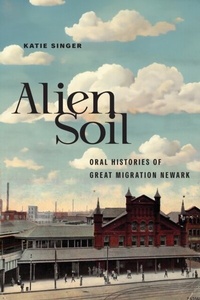
Alien Soil
Oral Histories of Great Migration Newark
1st Edition
Published on 16. August 2024
250 pages
978-1-9788-3357-9 (ISBN)
Description

Alien Soil: Oral Histories of Great Migration Newark explores Newark's Krueger-Scott African-American Cultural Center collection of over 100 oral histories. Historian Katie Singer separates these stories into thematic categories of social and political events, including church, work, and activism, in order to paint an intimate portrait of everyday urbanity and the larger Black urban experience in Newark. Through the examination of these Krueger-Scott narratives, Singer challenges historical falsehoods with the lived experiences of Newarkers who traveled North during the Great Migration, as well as established city residents. Alien Soil effectively contextualizes Newark history and re-inserts Black voices into historiography traditionally dominated by "outsiders."
The book begins with the Krueger-Scott Mansion's deep history, followed by the sequence of events surrounding the proposed Cultural Center. Last owned by African-American millionaire and beauty-culture entrepreneur Louise Scott, the Victorian Krueger-Scott Mansion was built by beer baron Gottfried Krueger in 1888. Through the history of the Mansion, and the ultimately failed Cultural Center project, one learns about the Newark that African Americans migrated to, what they found when they got there, how living in the city changed them, and how they, individually and collectively, changed Newark.
After the Cultural Center project was officially halted in 2000, the cassette tapes of the oral history interviews were stored away at the Newark Public Library. Ten years later they were unearthed, and ultimately digitized. As of yet, no one has applied these sources directly to their research. Deeply committed to these rich, insightful stories, Singer calls for a more thoughtful consideration of all cities, reminding us that Newark is much more than its 1967 rebellion.
The book begins with the Krueger-Scott Mansion's deep history, followed by the sequence of events surrounding the proposed Cultural Center. Last owned by African-American millionaire and beauty-culture entrepreneur Louise Scott, the Victorian Krueger-Scott Mansion was built by beer baron Gottfried Krueger in 1888. Through the history of the Mansion, and the ultimately failed Cultural Center project, one learns about the Newark that African Americans migrated to, what they found when they got there, how living in the city changed them, and how they, individually and collectively, changed Newark.
After the Cultural Center project was officially halted in 2000, the cassette tapes of the oral history interviews were stored away at the Newark Public Library. Ten years later they were unearthed, and ultimately digitized. As of yet, no one has applied these sources directly to their research. Deeply committed to these rich, insightful stories, Singer calls for a more thoughtful consideration of all cities, reminding us that Newark is much more than its 1967 rebellion.
Reviews / Votes
Alien Soil: Oral Histories of Great Migration Newark constitutes a valuable resource that has both important historical and methodological value. It contributes to scholarly discussions on the history of Newark, the Great Migration, African-American history in New Jersey, and the value of oral and community history for fostering community engagement. - Kristin O'Brassill-Kulfan (Coordinator of Public History at Rutgers New Brunswick) Katie Singer has gleaned a wealth of information from extensive research and informative interviews, which are like jewels on a crown now adeptly arranged for the public to admire. - Elizabeth MacGonagle (author of Crafting Identity in Zimbabwe and Mozambique) "Katie Singer deftly excerpts compelling stories from Newark's Krueger-Scott African American Oral History Project to teach readers about the city's powerful Black historical narrative and, more broadly, about the power of oral history to preserve the past when other documentation and interpretation efforts prove too expensive, logistically complicated, and politically fraught."- Melissa Ziobro (director of Public History, Monmouth University)
More details
Series
Language
English
Place of publication
New Brunswick NJ
United States
Target group
College/higher education
Professional and scholarly
Illustrations
31 B-W & 4 color images
ISBN-13
978-1-9788-3357-9 (9781978833579)
Copyright in bibliographic data and cover images is held by Nielsen Book Services Limited or by the publishers or by their respective licensors: all rights reserved.
Schweitzer Classification
Other editions
Additional editions
Book
08/2024
Rutgers University Press
€34.00
Shipment within 3-4 weeks
Person
KATIE SINGER holds a Ph.D. in American Studies from Rutgers University-Newark and an M.F.A. in Creative Writing from Fairleigh Dickinson University. She teaches writing at Arizona State University's Los Angeles campus and also teaches boxing. She lives in Glendale, CA.
Content
Prologue
Notes
Chapter One: Putting Black History Somewhere: The Krueger-Scott Mansion Project
Part One: The Mansion
The Backstory
Gottfried Krueger (1888-1925)
The Masons (1925-1958)
Louise Scott (circa 1902-1983)
Looking Forward
Consciousness Shifts (1960s)
Baby Steps (1970s - 1980s)
Progress (1990s)
Trouble (still the 90s)
Conclusion
Part Two: The Oral Histories
Notes
Chapter 2: Sundays
Part One: Church
"Community" (1930-1990)
Bethany Baptist (1870s - 1990s)
Queen Of Angels (1926 - 2016)
Individuals (1919-1997)
Politicians (1971-1997)
Part Two: Not Just Church
Sunday Best (1924-1965)
On The Field (1938-1996)
Leisure Activities (1927-1979)
Radio (1936-1997)
Conclusion
Notes
Chapter 3: Workdays
Part One: Paid Work
Domestic Work
Non-Domestic Work
Getting Work (1940s-1950s)
Nursing Work (1948-1969)
Part Two: Socio-Political Work
Women Working (1965-1994)
Men At Work (1974-2006)
Ministry (1912-1969)
Conclusion
Notes
Chapter 4: Hot Days
Part One: The Set-Up
Perpetuated Narratives & Actual Stories (1961-2011)
Firefighting (1950-1994)
"Important Events" (1949-1968)
Remembering (1920-1972)
Cooperation (1944-1961)
The Personal (1935-1977)
Fears
Part Two: Rebellion
"The Riots" (1967)
Memory and the Event
Aftermath Of Words (1967-2007)
Lasting Perceptions (1967-1997)
Conclusion
Notes
Afterword
Questionnaire
Bibliography
Illustrations
Index
Notes
Chapter One: Putting Black History Somewhere: The Krueger-Scott Mansion Project
Part One: The Mansion
The Backstory
Gottfried Krueger (1888-1925)
The Masons (1925-1958)
Louise Scott (circa 1902-1983)
Looking Forward
Consciousness Shifts (1960s)
Baby Steps (1970s - 1980s)
Progress (1990s)
Trouble (still the 90s)
Conclusion
Part Two: The Oral Histories
Notes
Chapter 2: Sundays
Part One: Church
"Community" (1930-1990)
Bethany Baptist (1870s - 1990s)
Queen Of Angels (1926 - 2016)
Individuals (1919-1997)
Politicians (1971-1997)
Part Two: Not Just Church
Sunday Best (1924-1965)
On The Field (1938-1996)
Leisure Activities (1927-1979)
Radio (1936-1997)
Conclusion
Notes
Chapter 3: Workdays
Part One: Paid Work
Domestic Work
Non-Domestic Work
Getting Work (1940s-1950s)
Nursing Work (1948-1969)
Part Two: Socio-Political Work
Women Working (1965-1994)
Men At Work (1974-2006)
Ministry (1912-1969)
Conclusion
Notes
Chapter 4: Hot Days
Part One: The Set-Up
Perpetuated Narratives & Actual Stories (1961-2011)
Firefighting (1950-1994)
"Important Events" (1949-1968)
Remembering (1920-1972)
Cooperation (1944-1961)
The Personal (1935-1977)
Fears
Part Two: Rebellion
"The Riots" (1967)
Memory and the Event
Aftermath Of Words (1967-2007)
Lasting Perceptions (1967-1997)
Conclusion
Notes
Afterword
Questionnaire
Bibliography
Illustrations
Index
