

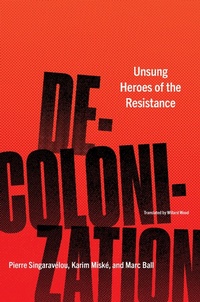
Decolonization
Unsung Heroes of the Resistance
Published on 1. November 2022
192 pages
978-1-63542-104-0 (ISBN)
Description

Full of gripping historical vignettes and evocative photographs, an accessible overview of the dynamic figures who resisted colonization, from India, Senegal, and Algeria to Vietnam, Kenya, and Congo.
Decolonization started on the very first day of colonization.
From the arrival of the Europeans, the peoples of Africa and Asia rose up. No one willingly accepts subjugation, but in order to one day regain freedom, you first and foremost need to stay alive. Faced with the Europeans' machine guns, the colonized hit back in other ways: from civil disobedience to communist revolution, by way of soccer and literature. It was a struggle marked by infinite patience and unlimited determination, fought by heroic men and women now largely unknown.
Condensing a wealth of scholarly research into short, lively chapters, Decolonization brings their extraordinary stories to light:
Manikarnika Tambe, the Indian queen who led her troops into battle against the British;
Mary Nyanjiru, the Kenyan activist who spearheaded a protest in Nairobi;
Lamine Senghor, the Senegalese infantryman who became an anti-colonial militant in Paris;
and many more.
With them, a current of resistance swept the world, culminating in the independence of almost all the colonies in the 1960s. But at what price? In the atomic India of Indira Gandhi, in the Congo subjected to Mobutu's dictatorship, or in a London shaken by the rioting of young immigrants, we can see just how crucial it is that we understand and learn from this painful history.
Decolonization started on the very first day of colonization.
From the arrival of the Europeans, the peoples of Africa and Asia rose up. No one willingly accepts subjugation, but in order to one day regain freedom, you first and foremost need to stay alive. Faced with the Europeans' machine guns, the colonized hit back in other ways: from civil disobedience to communist revolution, by way of soccer and literature. It was a struggle marked by infinite patience and unlimited determination, fought by heroic men and women now largely unknown.
Condensing a wealth of scholarly research into short, lively chapters, Decolonization brings their extraordinary stories to light:
Manikarnika Tambe, the Indian queen who led her troops into battle against the British;
Mary Nyanjiru, the Kenyan activist who spearheaded a protest in Nairobi;
Lamine Senghor, the Senegalese infantryman who became an anti-colonial militant in Paris;
and many more.
With them, a current of resistance swept the world, culminating in the independence of almost all the colonies in the 1960s. But at what price? In the atomic India of Indira Gandhi, in the Congo subjected to Mobutu's dictatorship, or in a London shaken by the rioting of young immigrants, we can see just how crucial it is that we understand and learn from this painful history.
More details
Other editions
Additional editions
Book
01/2023
Other Press LLC
€25.00
Shipment within 3-4 weeks
Persons
Pierre Singaravélou is British Academy Global Professor at King's College London and Professor of History at Panthéon-Sorbonne University. He has published numerous works on the history of empires, colonialism, and globalization, including A Past of Possibilities (with Quentin Deluermoz) and France in the World (editor, with Patrick Boucheron, et al).
Karim Miské grew up in Paris and studied journalism in Dakar. Now resident in France, he makes documentary films on a wide range of subjects including deafness and the common roots between the Judaism and Islam. His first novel, Arab Jazz, won the Grand Prix de Littérature Policière and the Prix du Goéland Masqué.
Marc Ball is a documentary filmmaker whose films set out to describe the world around us from the people's perspective. He has directed, with Karim Miské, Tunisie, les voix de la revolution, for Arte, and Police, illégitime violence, for France 3 and Public Sénat.
Willard Wood grew up in France and has translated more than thirty works of fiction and nonfiction from the French. He has won the Lewis Galantière Award for Literary Translation and received a National Endowment for the Arts Fellowship in Translation. He lives in Norfolk, Connecticut.
Karim Miské grew up in Paris and studied journalism in Dakar. Now resident in France, he makes documentary films on a wide range of subjects including deafness and the common roots between the Judaism and Islam. His first novel, Arab Jazz, won the Grand Prix de Littérature Policière and the Prix du Goéland Masqué.
Marc Ball is a documentary filmmaker whose films set out to describe the world around us from the people's perspective. He has directed, with Karim Miské, Tunisie, les voix de la revolution, for Arte, and Police, illégitime violence, for France 3 and Public Sénat.
Willard Wood grew up in France and has translated more than thirty works of fiction and nonfiction from the French. He has won the Lewis Galantière Award for Literary Translation and received a National Endowment for the Arts Fellowship in Translation. He lives in Norfolk, Connecticut.
