

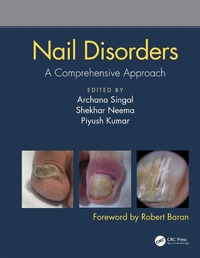
Nail Disorders
A Comprehensive Approach
1st Edition
Published on 4. February 2019
558 pages
978-1-351-13971-7 (ISBN)
Description

Nail disorders are a specialized group of disorders which are often neglected during post graduate teaching. This book aims to provide a comprehensive review covering the diagnostic and therapeutic aspects of nail disorders. It discusses the basics of nail unit, common conditions like infections, tumors and genetic diseases, diagnostic armamentarium involved in nail diseases like KOH mount, onychoscopy, imaging and surgical management of nail diseases which includes anesthesia of nail unit, nail biopsy and advanced nail procedures including video demonstration of such procedures. This book elaborates on nails in systemic diseases and briefly covers nail cosmetics and nail photography.
Key Features
Comprehensively reviews nail disorders
Includes diagnosis, therapeutic and surgical aspect
Discusses Onychoscopy
Reviews the importance of nail photography
Key Features
Comprehensively reviews nail disorders
Includes diagnosis, therapeutic and surgical aspect
Discusses Onychoscopy
Reviews the importance of nail photography
Reviews / Votes
"There is an excellent pictorial dictionary of nail terminology and helpful tips on how to photograph nails. The main strength of this book is the unique didactic approach to explaining normal physiology of the nail unit and then discussing how disruption of this process leads to development of nail dystrophy, leukonychia, splinter hemorrhages, etc. This allows readers to really understand how to expertly interpret the nail abnormalities that they observe clinically rather than memorizing or referring to a list of causes of nail pitting, for example.I highly recommend this book to all dermatologists and students in the field. Ihaven't seen any other books on this subject cover the diagnostic imaging studies for nails."
Patricia Wong, MD (Private Practice)
"Nail disorders: A comprehensive approach" is updated as per current information and useful to private practitioners, academicians, and students alike. Illustrated with 691 color images, this book presents concise, clinically relevant information in each chapter, and is useful for the management of common as well as difficult conditions involving nails. This book paves its way through history, pathology, pathogenesis, laboratory investigations, clinical examination, and onychoscopy, and finally offers therapeutic solutions, both medical and surgical, and also contains chapters on relatively new topics of nail imaging, nail photography, and nail cosmetics.
Chakravarthi Rangachari Srinivas
Department of Dermatology, Venereology, and Leprosy, Kalinga Institute of Medical Sciences, Bhubanewar, Odisha, India published in Indian Dermatology Online Journal 2020
This book is designed to provide an elaborate review about the anatomy of nail unit, physiological changes in nails especially in children and elderly population, approach to examination, diagnostics and detailed description of various nail abnormalities. The book also elucidates nail abnormalities associated with inflammatory, infective and psychocutaneous conditions. Subsequent chapters describe nail involvement in systemic, occupational and drug-related conditions. The book being detailed and, at the same time, very well structured, is a very useful tool for postgraduate students as well as practicing clinicians. Considering the growing trend of nail involvement in various diseases and the ambiguity related to approach to these conditions, this book is a good read to obtain in-depth knowledge about nail disorders.
Colonel Manas Chatterjee, Major Surbhi Rajput
Department of Dermatology, Institute of Naval Medicine, INHS Asvini, Mumbai, Maharashtra, India published in Indian Journal of Dermatology, Venereology and Leprology 2020
More details
Edition
1. Auflage
Language
English
Place of publication
London
United Kingdom
Publishing group
Taylor & Francis Ltd
Target group
College/higher education
Professional and scholarly
Illustrations
691 Illustrations, color; 41 Illustrations, black and white
File size
287,84 MB
ISBN-13
978-1-351-13971-7 (9781351139717)
Copyright in bibliographic data and cover images is held by Nielsen Book Services Limited or by the publishers or by their respective licensors: all rights reserved.
Schweitzer Classification
Other editions
Additional editions
Book
12/2020
1st Edition
CRC Press
€61.00
Shipment within 15-20 days
Book
04/2019
1st Edition
CRC Press
€111.50
Shipment within 15-20 days
Persons
Archana Singal is Director professor in the department of dermatology and STI, at University College of Medical Sciences, New Delhi, India. She has 30 years' experience in clinical dermatology. She is a fellow of the National Academy of Medical Sciences (FAMS). She did her clinical and research fellowship at the University of Sydney, Australia (2001?2002). She has a special interest in the diagnosis and management of nail diseases. She is the founder president of the Nail Society of India (NSI). Her other areas of interest include tropical dermatology and genodermatoses. She has to her credit more than 180 scientific publications in indexed journals and has authored nearly 30 chapters pertaining to dermatology in various textbooks. She is editor of Comprehensive Approach to Infections in Dermatology and Atlas of Infections in Dermatology. She has been awarded the Indian Association of Dermatologist, Venereologist and Leprologist (IADVL) Systopic Oration, Sardarilal Memorial Award for academic excellence and the IADVL teacher parexcellence award. She was the organizing president for the second ONYCHOCON conference (Annual National conference of NSI in 2013), third International Summit for Nail Diseases (ISND) and the fourth ONYCHOCON (2015). She was the scientific chairperson for the Dermatology and Allied Specialty Summit (DAAS) during 2014?2018. Dr. Singal also served as president of IADVL, Delhi State Branch, in 2009. She is a regular invited faculty to various national and international dermatology congresses.
Shekhar Neema is an alumnus of the Armed Forces Medical College, Pune, India. He excelled in MBBS with 10 distinctions to his name and was awarded the President Gold Medal for the best academic record in 2006. He was awarded gold medal from Maharashtra University of Health Sciences (MUHS) in MD (Dermatology). He successfully cleared the European Board of Dermatology and Venereology examination. He has done an International Society of Dermatology (ISD) fellowship at Ludwig Maximilian University, Munich. He has more than 30 publications in indexed journalsand has authored many chapters in various dermatology textbooks. He is the editor of the books Dermoscopy in Darker Skin and Handbook of Biologics and Biosimilars in Dermatology. He has been involved as assistant editor of various books, namely the IADVL Atlas of Dermatology, Clinical Correlations in Dermatology, and Association of Cutaneous Surgeons of India (ACSI) textbook of procedural dermatology. His areas of special interest are immunodermatology, dermatotherapeutics, dermatosurgery, dermoscopy, and nail diseases. He is presently working as an associate professor atthe Armed Forces Medical College, Pune.
Piyush Kumar graduated from the University of Calcutta with a gold medal. He finished his post-graduate studies in Dermatology at the Medical College and Hospital, Kolkata, in 2011, and was judged the best outgoing university medical graduate in Dermatology. He received various scholarships during and after his post-graduation studies to attend and present papers at international conferences. His interest in academics led him to pursue teaching in a medical collegeas a career and he is currently working as an associate professor. He has published more than 100 papers in indexed national and international journals and works as a reviewer for various national and international specialty journals. He has contributed many chapters to various books and is currently editing three books. His areas of interest are clinical dermatology, dermatopathology, nail disorders, and genital dermatoses.
Shekhar Neema is an alumnus of the Armed Forces Medical College, Pune, India. He excelled in MBBS with 10 distinctions to his name and was awarded the President Gold Medal for the best academic record in 2006. He was awarded gold medal from Maharashtra University of Health Sciences (MUHS) in MD (Dermatology). He successfully cleared the European Board of Dermatology and Venereology examination. He has done an International Society of Dermatology (ISD) fellowship at Ludwig Maximilian University, Munich. He has more than 30 publications in indexed journalsand has authored many chapters in various dermatology textbooks. He is the editor of the books Dermoscopy in Darker Skin and Handbook of Biologics and Biosimilars in Dermatology. He has been involved as assistant editor of various books, namely the IADVL Atlas of Dermatology, Clinical Correlations in Dermatology, and Association of Cutaneous Surgeons of India (ACSI) textbook of procedural dermatology. His areas of special interest are immunodermatology, dermatotherapeutics, dermatosurgery, dermoscopy, and nail diseases. He is presently working as an associate professor atthe Armed Forces Medical College, Pune.
Piyush Kumar graduated from the University of Calcutta with a gold medal. He finished his post-graduate studies in Dermatology at the Medical College and Hospital, Kolkata, in 2011, and was judged the best outgoing university medical graduate in Dermatology. He received various scholarships during and after his post-graduation studies to attend and present papers at international conferences. His interest in academics led him to pursue teaching in a medical collegeas a career and he is currently working as an associate professor. He has published more than 100 papers in indexed national and international journals and works as a reviewer for various national and international specialty journals. He has contributed many chapters to various books and is currently editing three books. His areas of interest are clinical dermatology, dermatopathology, nail disorders, and genital dermatoses.
Content
1. History of Nail Diseases. 2. Nail anatomy and physiology. 3. Nail unit signs. 4. An approach to Nail examination. 5. Laboratory investigations of nail diseases. 6. Imaging in Nail diseases. 7. Onychoscopy. 8. Basics of Onychopathology. 9. Onychopathology of common nail diseases. 10. Nail plate abnormalities. 11. Chromonychia. 12. Ingrown nail. 13. Nail psoriasis. 14. Nail lichen planus. 15. Trachyonychia. 16. Dermatophytic onychomycosis. 17. Non-dermatophytic onychomycosis. 18. Infections and infestations of nail unit. 19. Nail in Dermatological diseases. 20. Nail in systemic diseases. 21. Occupational nail diseases. 22. Chronic Paronychia. 23. Drug Induced Nail Changes. 24. Nail in children- Congenital and hereditary diseases. 25. Nail in elderly population. 26. Benign tumors. 27. Malignant tumors. 28. Nail Tic disorders. 29. Basics of nail surgery. 30. Anesthesia of the nail unit. 31. Nail Biopsy techniques. 32. Injection therapies for nail disorders. 33. Surgery for benign tumors. 34. Nail care and Nail cosmetics. 35. Science of nail polish, nail polish removers and Nail moisturizers. 36. Nail Degloving syndrome. 37. Miscellaneous Nail conditions. 38. Photography of the nail unit.
