

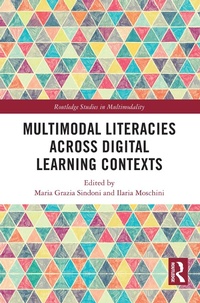
Multimodal Literacies Across Digital Learning Contexts
1st Edition
Published on 29. November 2021
286 pages
978-1-000-50546-7 (ISBN)
Description

This collection critically considers the question of how learning and teaching should be conceived, understood, and approached in light of the changing nature of learning scenarios and new pedagogies in this current age of multimodal digital texts, practices, and communities.
The book takes the concept of digital artifacts as being composed of multiple meaning-making semiotic resources, such as visuals, music, and design, as its point of departure to explore how diverse communities interact with these tools and develop and explore their understanding of digital practices in learning contexts. The first section of the volume examines different case studies in which involved participants learn to grapple with the introduction of digital tools for learning in children's early years of schooling. The second section extends the focus to secondary and higher education settings as digital learning tools grow more complex as do students, parents, and teachers' interactions with them and the subsequent need for new pedagogies to rethink these multimodal artifacts. A final section reflects on the implications of new multimodal tools, technologies, and pedagogies for teachers, such as on teacher training and community building among educators.
In its in-depth look at multimodal approaches to learning as meaning-making in a digital world, this book will be of interest to students and scholars in multimodality, English language teaching, digital communication, and education.
The book takes the concept of digital artifacts as being composed of multiple meaning-making semiotic resources, such as visuals, music, and design, as its point of departure to explore how diverse communities interact with these tools and develop and explore their understanding of digital practices in learning contexts. The first section of the volume examines different case studies in which involved participants learn to grapple with the introduction of digital tools for learning in children's early years of schooling. The second section extends the focus to secondary and higher education settings as digital learning tools grow more complex as do students, parents, and teachers' interactions with them and the subsequent need for new pedagogies to rethink these multimodal artifacts. A final section reflects on the implications of new multimodal tools, technologies, and pedagogies for teachers, such as on teacher training and community building among educators.
In its in-depth look at multimodal approaches to learning as meaning-making in a digital world, this book will be of interest to students and scholars in multimodality, English language teaching, digital communication, and education.
Reviews / Votes
"During the early period of the COVID-19 pandemic in 2020, the adoption of digital technologies in mainstream education was a response to a crisis - an emergent response, unplanned and less than ideal. In 2022, as we move into a more stable phase, many are recognizing this as a moment to 'reimagine education'.With fourteen chapters and a solid introduction that investigate learning and teaching in the digital context, Multimodal Literacies Across Digital Learning Contexts has arrived in good time to contribute to the reimagining conversation." - Cheng-Wen Huang, Senior Lecturer, University of Cape Town Centre for Higher Education Development, South Africa, Multimodality & Society"Ranging from educational apps for preschool children to online university lectures and from critical software analyses to detailed curriculum and assessment proposals, this up to date and comprehensive collection will be an unmissable source of information and insight for anyone interested in the ever greater role of digital media and multimodal communication in education and learning generally." - Theo van Leeuwen, Professor of Language and Communication at the University of Southern Denmark and Honorary Professor at the University of New South Wales, Australia
More details
Series
Edition
1. Auflage
Language
English
Place of publication
London
United Kingdom
Publishing group
Taylor & Francis Ltd
Target group
College/higher education
Illustrations
13 Tables, black and white; 34 Halftones, black and white; 34 Illustrations, black and white
ISBN-13
978-1-000-50546-7 (9781000505467)
Copyright in bibliographic data and cover images is held by Nielsen Book Services Limited or by the publishers or by their respective licensors: all rights reserved.
Schweitzer Classification
Other editions
Additional editions
Maria Grazia Sindoni | Ilaria Moschini
Multimodal Literacies Across Digital Learning Contexts
Book
09/2023
1st Edition
Routledge
€63.60
Shipment within 15-20 days
Maria Grazia Sindoni | Ilaria Moschini
Multimodal Literacies Across Digital Learning Contexts
Book
11/2021
1st Edition
Routledge
€205.90
Shipment within 15-20 days
Persons
Maria Grazia Sindoni, PhD, is Professor of English Linguistics and Translation in the Department of Ancient and Modern Civilizations at the University of Messina, Italy. Her main interests include multimodal discourse studies, systemic-functional grammar, applied linguistics and video-mediated communication.
Ilaria Moschini, PhD, is Assistant Professor of English Linguistics and Translation in the Department of Education, Languages, Intercultures, Literatures and Psychology at the University of Florence, Italy. Her main research interests are digital media language and political discourse that she investigates adopting a critical multimodal approach.
Ilaria Moschini, PhD, is Assistant Professor of English Linguistics and Translation in the Department of Education, Languages, Intercultures, Literatures and Psychology at the University of Florence, Italy. Her main research interests are digital media language and political discourse that she investigates adopting a critical multimodal approach.
Content
Multimodal Literacies Across Digital Learning Contexts: An Open-Ended Agenda
Maria Grazia Sindoni and Ilaria Moschini
A Sensational Theory of Designed Experience: Replacement Parts for a Theory of Multimodality
Qing Archer Zhang and James Paul Gee
Pedagogies for Digital Learning: From Transpositional Grammar to the Literacies of Education
Bill Cope and Mary Kalantzis
Section A. Focus on Children: From Pre-School to Primary Education
Stars, Scores and Cheers. A Social Semiotic Critique of "Fun" Learning in Commercial Educational Software for Children
Gunhild Kvale
Storytelling with Children in Informal Contexts: Learning to Narrate Across the Offline/Online Boundaries
Maria Bortoluzzi, Elisa Bertoldi and Ivana Marenzi
Multilingual Children's Expressions of Participation in Preschools Using Digital Tablets Petra Petersen
Watching the Sound: Sign-Making in Musical Expressiveness of Children with Motor-Related Disabilities Made Through Eye Tracking Software
Zaira Bomfante Dos Santos, Clarice Lage Gualberto and Sonia Maria Oliveira Pimenta
Popularizing Scientific Knowledge for Children: A Multimodal Perspective
Giuliana Diani
Section B. Focus on Youth: From Secondary to Higher Education
Exploring Multimodality in Video Podcasting to Enhance Intercultural Awareness in the East Asian Context
Martin Parsons, Mikel Garant and Larry Walker
Recognition of Student Resources in Digital Environments
Arlene Archer
Theory and Practice of the Common Framework of Reference for Intercultural Digital Literacies (CFRIDiL)
Maria Grazia Sindoni, Elisabetta Adami, Styliani Karatza, Ilaria Moschini and Sandra Petroni
Section C. Focus on Teachers: Practices and Pedagogies
Preparing for Teaching Digital Literacies in the Curriculum Disciplines: Meta-Semiotic Knowledge and Pedagogy
Pauline Jones, Annette Turney, Helen Georgiou and Wendy Nielsen
Analyzing Attitudinal Stance in OpenCourseWare Lectures: An Experimental Mixed-Method Approach
Belinda Crawford Camiciottoli
Making Science Easier to Access: Investigating Academic Social Networks as "Composites of Connotations"
Flavia Cavaliere
Teaching, Learning and Assessment of Multimodal Digital Academic Numeracy Practices
Robert Prince
Maria Grazia Sindoni and Ilaria Moschini
A Sensational Theory of Designed Experience: Replacement Parts for a Theory of Multimodality
Qing Archer Zhang and James Paul Gee
Pedagogies for Digital Learning: From Transpositional Grammar to the Literacies of Education
Bill Cope and Mary Kalantzis
Section A. Focus on Children: From Pre-School to Primary Education
Stars, Scores and Cheers. A Social Semiotic Critique of "Fun" Learning in Commercial Educational Software for Children
Gunhild Kvale
Storytelling with Children in Informal Contexts: Learning to Narrate Across the Offline/Online Boundaries
Maria Bortoluzzi, Elisa Bertoldi and Ivana Marenzi
Multilingual Children's Expressions of Participation in Preschools Using Digital Tablets Petra Petersen
Watching the Sound: Sign-Making in Musical Expressiveness of Children with Motor-Related Disabilities Made Through Eye Tracking Software
Zaira Bomfante Dos Santos, Clarice Lage Gualberto and Sonia Maria Oliveira Pimenta
Popularizing Scientific Knowledge for Children: A Multimodal Perspective
Giuliana Diani
Section B. Focus on Youth: From Secondary to Higher Education
Exploring Multimodality in Video Podcasting to Enhance Intercultural Awareness in the East Asian Context
Martin Parsons, Mikel Garant and Larry Walker
Recognition of Student Resources in Digital Environments
Arlene Archer
Theory and Practice of the Common Framework of Reference for Intercultural Digital Literacies (CFRIDiL)
Maria Grazia Sindoni, Elisabetta Adami, Styliani Karatza, Ilaria Moschini and Sandra Petroni
Section C. Focus on Teachers: Practices and Pedagogies
Preparing for Teaching Digital Literacies in the Curriculum Disciplines: Meta-Semiotic Knowledge and Pedagogy
Pauline Jones, Annette Turney, Helen Georgiou and Wendy Nielsen
Analyzing Attitudinal Stance in OpenCourseWare Lectures: An Experimental Mixed-Method Approach
Belinda Crawford Camiciottoli
Making Science Easier to Access: Investigating Academic Social Networks as "Composites of Connotations"
Flavia Cavaliere
Teaching, Learning and Assessment of Multimodal Digital Academic Numeracy Practices
Robert Prince
