

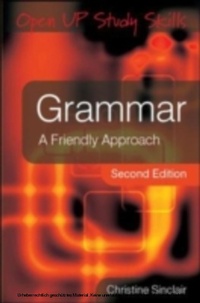
Grammar
A Friendly Approach
1st Edition
Published on 1. March 2010
201 pages
978-0-335-24087-6 (ISBN)
Description

This book introduces grammar in a gentle way by illustrating the kinds of issues students may come across by setting them in context using a soap opera style script.
More details
Other editions
Additional editions
Book
03/2010
2nd Edition
Open University Press
€20.50
Shipment within 15-20 days
Content
- Front cover
- Half title page
- Title page
- Copyright page
- Dedication
- Contents
- List of figures
- Introduction to the second edition
- 1 Introduction
- 1.1 A soap opera in a grammar book
- 1.2 Questions about grammar
- 1.3 How the book is structured
- 1.4 How to annoy teachers and professors
- 1.5 What students worry about
- 1.6 Comments on questions
- 1.7 Conclusion: general advice about grammar and language
- 2 Bad language
- 2.1 Trying to be posh
- 2.2 Questions about language
- 2.3 Idioms: how words are usually used
- 2.4 Easily confused words
- 2.5 Going through a bad spell
- 2.6 Singulars and plurals
- 2.7 Formal doesn't have to mean pompous
- 2.8 What are you trying to say?
- 2.9 The author, one or I?
- 2.10 It's, like, a figure of speech
- 2.11 Comments on questions
- 2.12 Conclusion: advice about word choice
- 3 Standard practice
- 3.1 Why can't I use my own language?
- 3.2 Questions about 'correct' English
- 3.3 Standard English: do we need it?
- 3.4 Examples of uses that are not standard
- 3.5 Spoken and written English
- 3.6 Academic English
- 3.7 Comments on questions
- 3.8 Conclusion: advice about dialects and Standard English
- 4 Who or what is the subject?
- 4.1 A favourite subject - 'I'
- 4.2 Questions about subjects of sentences
- 4.3 Simple and compound subjects
- 4.4 When subjects move around
- 4.5 Subject closed
- 4.6 Comments on questions
- 4.7 Conclusion: advice about sentences and subjects
- 5 Where's the action? The verb
- 5.1 Doing, being and happening
- 5.2 Questions about verbs
- 5.3 Mangling and dangling participles
- 5.4 Getting tense with verbs
- 5.5 My past, present and future
- 5.6 Facts and possibilities
- 5.7 Comments on questions
- 5.8 Conclusion: advice about verbs
- 6 The complete sentence
- 6.1 Can students write in sentences?
- 6.2 Questions about sentences
- 6.3 The sentence as a unit of thought or grammatical structure
- 6.4 The sentence and punctuation
- 6.5 Sentences and paragraphs
- 6.6 Breaking up is hard to do
- 6.7 Comments on questions
- 6.8 Conclusion: advice about sentences
- 7 What goes wrong with sentences?
- 7.1 Too much or too little
- 7.2 Questions about sentence errors
- 7.3 How to avoid running sentences together
- 7.4 How to avoid chopping sentences in two
- 7.5 Sentenced to death!
- 7.6 Comments on questions
- 7.7 Conclusion: advice about fixing sentences
- 8 Speaking personally
- 8.1 Having a voice
- 8.2 Questions about personal expression
- 8.3 Reasons for using the passive
- 8.4 When passives get awkward
- 8.5 When people get awkward
- 8.6 Expressing an opinion without saying 'I'
- 8.7 Bring me back: reflective writing
- 8.8 Reflections on what's going wrong
- 8.9 Comments on questions
- 8.10 Conclusion: advice about personal writing
- 9 More on complex sentences: relationships and relatives
- 9.1 Talking about relatives
- 9.2 Questions about relationships and clauses
- 9.3 Words expressing relationship
- 9.4 Revisiting the subordinates
- 9.5 Relative clauses: defining and describing a brother
- 9.6 Every which way but that
- 9.7 Comments on questions
- 9.8 Conclusion: advice about relative clauses
- 10 How to be offensive with punctuation
- 10.1 Define without using commas
- 10.2 Questions about punctuation
- 10.3 The functions of punctuation marks
- 10.4 Putting punctuation to work
- 10.5 Punctuation within words
- 10.6 A dodgy colon and a full stop
- 10.7 Comments on questions
- 10.8 Conclusion: advice about punctuation
- 11 That pesky apostrophe
- 11.1 Getting possessive and going missing
- 11.2 Questions about apostrophes
- 11.3 What's happening to the apostrophe?
- 11.4 How to use an apostrophe to show possession
- 11.5 How to use an apostrophe to show omission
- 11.6 Hold the apostrophe!
- 11.7 That Lynne Truss has a lot to answer for!
- 11.8 Comments on questions
- 11.9 Conclusion: advice about apostrophes
- 12 Checking the checker
- 12.1 A house of correction
- 12.2 Questions about grammar checkers
- 12.3 Pitfalls with grammar checkers
- 12.4 How to use a grammar checker knowledgeably
- 12.5 What happens next?
- 12.6 Comments on questions
- 12.7 Conclusion: advice about grammar checkers
- 13 Quote/unquote - avoiding plagiarism
- 13.1 Credit where it's due
- 13.2 Questions about referencing
- 13.3 Grammar and punctuation in referencing
- 13.4 What goes in the quotation marks?
- 13.5 Double or single quotes
- 13.6 Different systems for referencing
- 13.7 Oh what a giveaway
- 13.8 In your own words
- 13.9 Comments on questions
- 13.10 Conclusion: advice about avoiding plagiarism
- 14 The machine's out to get us
- 14.1 Technology makes it possible
- 14.2 Questions about technology in grammar and language
- 14.3 Catching plagiarism - or helping to avoid it
- 14.4 Should computers mark essays?
- 14.5 Friendly computing: assistive technology
- 14.6 The human touch
- 14.7 Comments on questions
- 14.8 Conclusion: comments on technology and grammar
- 15 Finale
- 16 Glossary
- Bibliography
- Index
- Back cover
