

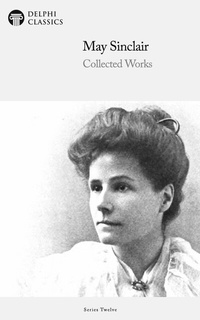
Delphi Collected Works of May Sinclair (Illustrated)
Description

The forgotten modernist, May Sinclair was close friends with Ezra Pound, Ford Madox Ford, Robert Frost and prominent figures of the London literary scene. She was the first critic to use the term "stream of consciousness" to describe a literary technique. Quick to assimilate new ideas of the Modernist movement, she wrote the stirring and formally experimental Bildungsroman 'Mary Olivier' (1919). A critically-respected and popular novelist, Sinclair was also a poet, philosopher, translator and critic, whose works span from the late 1880's up until the late 1920's. This comprehensive eBook presents May Sinclair's collected works, with numerous illustrations, many rare texts, informative introductions and the usual Delphi bonus material. (Version 1)
* Beautifully illustrated with images relating to Sinclair's life and works
* Concise introductions to the novels and other texts
* All 19 novels in the US public domain, with individual contents tables
* Features many rare novels appearing for the first time in digital publishing
* Images of how the books were first published, giving your eReader a taste of the original texts
* Excellent formatting of the texts
* Rare short stories
* Special chronological and alphabetical contents tables for the short stories
* Easily locate the short stories you want to read
* Sinclair's chilling ghost stories
* Includes Sinclair's rare and complete poetry - available in no other collection
* Sinclair's important essay on 'Feminism' - digitised here for the first time
* Her landmark study on the Brontë sisters
* Ordering of texts into chronological order and genres
Please note: due to US copyright restrictions, three novels and two story collections cannot appear in this edition. When new texts become available, they will be added to the eBook as a free update.
CONTENTS:
The Novels
Audrey Craven (1897)
Mr and Mrs Nevill Tyson (1898)
The Divine Fire (1904)
The Helpmate (1907)
The Immortal Moment (1908)
The Creators (1910)
The Flaw in the Crystal (1912)
The Combined Maze (1913)
The Three Sisters (1914)
The Belfry (1916)
The Tree of Heaven (1917)
Mary Olivier (1919)
The Romantic (1920)
Mr. Waddington of Wyck (1921)
Life and Death of Harriett Frean (1922)
Anne Severn and the Fieldings (1922)
A Cure of Souls (1924)
Arnold Waterlow (1924)
The Rector of Wyck (1925)
The Shorter Fiction
Two Sides of a Question (1901)
The Judgment of Eve (1907)
The Return of the Prodigal (1914)
Uncanny Stories (1923)
The Short Stories
List of Short Stories in Chronological Order
List of Short Stories in Alphabetical Order
The Poetry Collections
Nakiketas and Other Poems (1886)
Essays in Verse (1892)
The Dark Night (1924)
The Non-Fiction
The Three Brontës (1912)
Feminism (1912)
A Journal of Impressions in Belgium (1915)
Please visit www.delphiclassics.com to browse through our range of exciting titles or to purchase this eBook as a Parts Edition of individual eBooks
All prices
More details
Content
CHAPTER II
SCANDAL WAS MISTAKEN. Miss Audrey Craven was not in search of a religion, but she had passed all her life looking for a revelation. She had no idea of the precise form it was to take, but had never wavered in her belief that it was there, waiting for her, as it were, round a dark corner. Hitherto the ideal had shown a provoking reticence; the perfectly unique sensation had failed to turn up at the critical moment. Audrey had reached the ripe age of ten before the death of her father and mother, and this event could not be expected to provide her with a wholly new emotion. She had been familiarised with sorrow through fine gradations of funereal tragedy, having witnessed the passing of her canary, her dormouse, and her rabbit. The end of these engaging creatures had been peculiarly distressing, hastened as it was by starvation, under most insanitary conditions.
The age of ten is the age of disenchantment - for those of us who can take a hint. For Audrey disenchantment never wholly came. She went on making the same extravagant demands, without a suspicion of the limited resources of life. It was the way of the Cravens. Up to the last her father never lost his blind confidence in a world which had provided him with a great deal of irregular amusement. But the late Mr. Craven could be wise for others, though not for himself, and he had taken a singular precaution with regard to his daughter. Not counting the wife whom he had too soon ceased to care for, he had a low opinion of all women, and he distrusted Audrey's temperament, judging it probably by his own and that of his more intimate acquaintance. By a special clause in his will, she had to wait for her majority four years longer than the term by law appointed. Further, until she reached her majority she was to spend six months of the year at Oxford, near her guardian, for the forming and informing of her mind - always supposing that she had a mind to form. And now, at the age of five-and-twenty, being the mistress of her own person, her own income, and her own house in Chelsea, she was still looking out for a revelation.
Her cousin, Mr. Vincent Hardy, believed that he had been providentially invented to supply it. But in the nature of things a cousin whom you have known familiarly from childhood cannot strike you as a revelation. He is really little better than a more or less animated platitude.
Vincent Hardy would have been unaffectedly surprised if you had told him so. To himself he seemed the very incarnation of distinguished paradox. This simply meant that he was one of those who innocently imagine that they can defy the minor conventions with a rarer grace than other men.
Certainly his was not exactly the sort of figure that convention expects to find in its drawing-rooms at nine o'clock in the evening. It was in Audrey's house in Chelsea, the little brown house with discreet white storm-shutters, that stands back from the Embankment, screened by the narrow strip of railed plantation known as Chelsea Gardens. Here or hereabouts Hardy was to be met with at any hour of the day; and late one July evening he had settled himself, as usual, near a certain "cosy corner" in the big drawing-room. His face, and especially his nose, was bronzed with recent exercise in sun and wind, his hair was limp with the steam of his own speed, and on his forehead his hat had left its mark in a deep red cincture. His loose shooting jacket, worn open, displayed a flannel shirt, white, but not too white. This much of Hardy was raised and supported on his elbow; the rest of him, encased in knickerbockers, stockings, and exceedingly muddy boots, sprawled with a naïve abandonment at the feet of the owner of the drawing-room. Lying in this easy attitude, he delivered himself of the following address -
"Life in London is a life for lunatics. And life in England generally is a glorious life for clergymen and counter-hoppers, but it's not the life for a man. It was all very well in the last century, you know, when Englishmen were men first, and lunatics, if they chose, or clergymen or counter-hoppers, afterwards. Ah! if that wasn't exactly our golden age, it was the age of our maturity, of our manhood. If you doubt it, read the literature of the eighteenth century. Take Fielding - no, don't take Fielding. Anyhow, since then we have added nothing to the fabric of life. To pile it on above, we've simply been digging away like mad from below, and at last our top-heavy civilisation is nodding to its fall; and its fall will sweep us all back into barbarism again. Then, when we are forced back into natural conditions, the new race will be born. No more of your big-headed, spindle-shanked manikins: we shall have a chance then of seeing a man - that is, a perfect animal. You may turn up your nose, my superfine lady: let me tell you that this glorious animalism means sanity, and sanity means strength, and strength means virtue. Vis - vir - virtus, ma'am."
Hardy sat up and caressed the calves of his legs with thoughtful emotion, as if he recognised them as the sources of the moral law within him. His cousin had not followed his precipitate logic. With woman's well-known aversion from the abstract, she was concentrating her attention on the concrete case, the glorious animal before her. Now it would be very wrong to suppose that Hardy was in the least tainted with socialism, anarchism, or any such pestilent heresies, or that he had read "Emile" and "Walden." He had never heard of either of these works, and had no desire whatever for the restoration of society on a primitive basis of animalism, modified by light literature, clothing, and the moral law. For all modern theories he had a withering contempt, his own simple creed being that in the beginning God made man a Tory squire. His quarrel with the social order was a purely private and particular one. In our modern mythology, Custom, Circumstance, and Heredity are the three Fates that weave the web of human life. Hardy did not wholly sympathise with this belief. He had too profound a respect for his own pedigree to lay his sins at his great-grandfather's door. As the nephew of a Tory squire, he was but two degrees removed from original righteousness. In spite of this consideration, he was wont to describe himself with engaging candour as a "bad hat." In doing so he recognised that he was a dependent part of a vast and complicated system. If he, Vincent Hardy, was a bad hat, who was to blame for it? Obviously, civilisation for providing him with temptation, and society for supplying encouragement. As a consequence he owed both civilisation and society a grudge.
"Therefore I say that a return to barbarism will be our salvation. You and I mayn't live to see the day, but - -"
Here the impassioned orator, who had been making charges at his boots with the point of his walking-stick, succeeded in detaching a large cake of mud, which he immediately ground to powder on the carpet. Civilisation personified in Audrey Craven gazed at him in polite reproach.
"My new carpet will certainly not live to see it. It may be part of the detestable social order, but it is not responsible for it, any more than I am."
"Never mind, Audrey. It's honest Hertfordshire mud - clean from the country as God made it, if I hadn't had to cross your filthy London in order to get here."
Audrey smiled, though she knew that brown streaks of the honest Hertfordshire mud marked the hero's passage from the doorway to her feet. She was naturally long-suffering, and seldom repulsed any one, save a few of the more impertinent of her own sex. She lay back in her cosy corner, outwardly contemplating the unusual length of muscular humanity extended before her, inwardly admiring her own smile, a smile of indulgent lips and arch eyebrows, in which the eyes preserved a languid neutrality.
Being thus pleasantly preoccupied, she may be supposed ignorant of her cousin's broad gaze of unreflecting admiration, and totally unprepared for his rapid change of theme.
"Audrey," he began, with alarming suddenness, "some people would lead up to the subject cautiously. That would only waste time, and time's everything now. Is Miss Craven at home?"
"Miss Craven is always at home when I am. Would you like to see her?"
"See her? Good heavens, no! Do you know positively where she is secreting herself, or must I lock the door?"
"That is unnecessary. She will not come in - she never does."
A suspicious look darted from the corners of Hardy's eyes.
"Except when I ask her," added Audrey, sweetly.
"Well, then, if you can ensure me against the sort of interruption that annoyed me before, we will return to the question we were discussing when - -"
"Please don't go over any old ground. That would bore me."
"It would bore me. I will begin where we left off. The problem, if you remember, was this - to put it baldly - do you care for me, or do you not?"
"Didn't we get any farther than that?"
"No, we didn't."
"Do I - or - do I not? Really I cannot tell you, Vincent, for I don't know myself."
"Nonsense! there's no logical dilemma. You can't go on for ever treating it as an open...
