

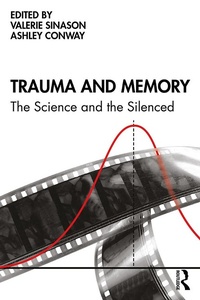
Trauma and Memory
The Science and the Silenced
1st Edition
Published on 11. August 2021
188 pages
978-1-000-42123-1 (ISBN)
Description

Trauma and Memory will assist mental health experts and professionals, as well as the interested public, in understanding the scientific issues around trauma memory, and how this differs from other areas of memory.
This book provides accounts of the damage caused to psychology and survivors internationally by false memory groups and ideas. It is unequivocally passionate about the truth of trauma memory and exposing the damaging disinformation that can seep into the field. Contributors to this book include leading professionals from the field of criminology, law, psychology and psychotherapy in the UK and USA, along with survivor-professionals who understand only too well the damage such disinformation can cause.
This book is a valuable resource for mental health professionals of all disciplines including those involved with relevant law and public health policy. It will also help survivors and survivor-professionals in gaining insight into the forces resisting disclosure.
This book provides accounts of the damage caused to psychology and survivors internationally by false memory groups and ideas. It is unequivocally passionate about the truth of trauma memory and exposing the damaging disinformation that can seep into the field. Contributors to this book include leading professionals from the field of criminology, law, psychology and psychotherapy in the UK and USA, along with survivor-professionals who understand only too well the damage such disinformation can cause.
This book is a valuable resource for mental health professionals of all disciplines including those involved with relevant law and public health policy. It will also help survivors and survivor-professionals in gaining insight into the forces resisting disclosure.
Reviews / Votes
"Sinason and Conway have assembled a stellar group of authors who cover a range of topics concerning the history of the idea of False Memory of childhood abuse and the reliability of the science recruited in support of this notion. They also analyse, from a variety of viewpoints, the nature of repression and the lasting effects of trauma on memory. The authors bring expertise from various disciplines, casting light on many facets of this complex and contentious issue, creating a collection that is at once scholarly and easy to read. This book will be essential reading for clinicians working with adults who were abused as children and for anyone concerned with the more obscure reaches of human memory." - John Morton, OBE, FRS Professor Emeritus, Institute of Cognitive Neuroscience; Former Director of the Medical Research Council Cognitive Development Unit, University College London, UK"I am honoured to endorse this book dedicated to my friend Jennifer Freyd. It is a unique collection of reasoned contributions by a well-chosen set of accomplished authors, a number of whom had the reality of their childhood abuse affirmed in court. They write with courage, clarity and authenticity. This book chronicles and critiques the way we as a society have had to go to the brink in order not to succumb to falsehood." - Professor Warwick Middleton MB BS, FRANZCP, MD, Professor, University of Queensland, Australia; Past President, International Society for the Study of Trauma & Dissociation (ISSTD)
"Trauma and Memory explores many facets of trauma memory and the concept of 'false memories', including exploring the damage caused internationally by false memory groups and ideas. Contributors to this book include many ISSTD members who are leading professionals from the field of criminology, law, psychology and psychotherapy, along with survivor-professionals. Lynn Crook writes about the stories the media missed. Ruth Blizzard and Valerie Sinason re-examine the lost-in the-mall study and ask "Were 'false memories' created to promote a false defence?" Winja Buss evaluates false memory and Michael Salter discusses finding a new narrative in response to 'false memory' disinformation. These are just a few chapters in an edited collection that promises to be a valuable resource for ISSTD members of all disciplines." - ISSTD Newsletter
More details
Edition
1. Auflage
Language
English
Place of publication
London
United Kingdom
Publishing group
Taylor & Francis Ltd
Target group
College/higher education
Professional and scholarly
Product notice
Reflowable
Illustrations
2 Tables, black and white
ISBN-13
978-1-000-42123-1 (9781000421231)
Copyright in bibliographic data and cover images is held by Nielsen Book Services Limited or by the publishers or by their respective licensors: all rights reserved.
Schweitzer Classification
Other editions
Additional editions
Book
08/2021
1st Edition
Routledge
€195.90
Shipment within 10-20 days
Book
08/2021
1st Edition
Routledge
€52.80
Shipment within 10-20 days
Persons
Valerie Sinason, PhD, is a widely published Writer and Psychoanalyst. She has pioneered disability and trauma-informed therapy for over 30 years, is President of the Institute of Psychotherapy and Disability, Founder and Patron of the Clinic for Dissociative Studies and on the Board of the ISSTD.
Ashley Conway, PhD, AFBPsS, is a Counselling Psychologist. He has worked in a wide range of fields of trauma, ranging through severe critical incidents to long term abuse, and has published widely in these areas. He is currently the Chair of the Clinic for Dissociative Studies in London, UK.
Ashley Conway, PhD, AFBPsS, is a Counselling Psychologist. He has worked in a wide range of fields of trauma, ranging through severe critical incidents to long term abuse, and has published widely in these areas. He is currently the Chair of the Clinic for Dissociative Studies in London, UK.
Content
Introduction; 1: In conversation with Ross Chei; 2: False Memory Syndrome Movement: The Origins and the Promoters; 3: The Rocky Road to False Memories - Stories the Media Missed; 4: Re-examining the Lost-in-the-Mall Study: Were "false memories" created to promote a false defence? In conversation with Ruth Blizzard; 5: Evaluating False Memory Research, Winja Buss; 6: The Abuse of Science to Silence the Abused; 7: False memory syndrome; 8: Trauma, skin: memory, speech; 9: Sigmund Freud's Concept of Repression: Historical and Empirical Perspectives; 10: Terror in the consulting-room - memory, trauma, and dissociation; 11: How can we remember but be unable to recall? The complex functions of multi-modular memory; 12: "What if I should die?"; 13: Finding a new narrative: Meaningful responses to 'false memory' disinformation; 14: `Do No Harm'? Hearing and responding to victims and survivors
