

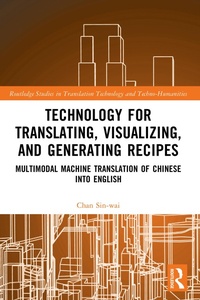
Technology for Translating, Visualizing, and Generating Recipes
Multimodal Machine Translation of Chinese into English
Published on 19. November 2025
372 pages
978-1-040-41549-8 (ISBN)
Description

This book details the process of building a Chinese-English machine translation system that automatically translates Chinese recipes into English through machine processing without human intervention (TransRecipe). This system is able to translate recipes into pictures and videos (VisualRecipe) through image technology and develop a system that generates a recipe from a video on dish preparation (GenRecipe) through deep learning.
Recipe processing is covered in four parts across ten chapters. The first part, Translating Recipes, studies the machine processing of different parts of recipes for the construction of the TransRecipe system. The second part, Visualizing Recipes, is about the creation of the VisualRecipe system through image technology and a demonstration of its operations in practice. The third part, Generating Recipes, is about recipe creation through deep learning and the creation of the GenRecipe system. Lastly, the book concludes by looking into the future of recipe technology.
The title is a vital read for researchers and students in translation technology, multimodal translation, and techno-humanities.
Recipe processing is covered in four parts across ten chapters. The first part, Translating Recipes, studies the machine processing of different parts of recipes for the construction of the TransRecipe system. The second part, Visualizing Recipes, is about the creation of the VisualRecipe system through image technology and a demonstration of its operations in practice. The third part, Generating Recipes, is about recipe creation through deep learning and the creation of the GenRecipe system. Lastly, the book concludes by looking into the future of recipe technology.
The title is a vital read for researchers and students in translation technology, multimodal translation, and techno-humanities.
More details
Series
Language
English
Place of publication
London
United Kingdom
Publishing group
Taylor & Francis Ltd
Target group
College/higher education
Illustrations
6 Tables, black and white; 22 Line drawings, black and white; 22 Halftones, black and white; 44 Illustrations, black and white
File size
189,45 MB
ISBN-13
978-1-040-41549-8 (9781040415498)
Copyright in bibliographic data and cover images is held by Nielsen Book Services Limited or by the publishers or by their respective licensors: all rights reserved.
Schweitzer Classification
Other editions
Additional editions
Chan Sin-Wai
Technology for Translating, Visualizing, and Generating Recipes
Multimodal Machine Translation of Chinese into English
Book
approx. 11/2025
1st Edition
Routledge
€207.30
Not yet published

Sin-wai Chan
Technology for Translating, Visualizing, and Generating Chinese Recipes
Multimodal Machine Translation of Chinese Into English
Book
09/2025
Routledge
Unfortunately, price unknown
Available (delivery time upon request)
Person
Chan Sin-wai is Professor-cum-Dean of Ip Ying To Lee Yu Yee School of Humanities and Languages of Saint Francis University, Hong Kong, China. He received his PhD from the School of Oriental and African Studies, University of London. His research interests lie mainly in the areas of translation technology and techno-humanities. He has published 96 academic books in 121 volumes.
Content
Contents
List of Figures
List of Tables
Acknowledgements
Chapter 1, Introduction
Translating Recipes
Chapter 2. TransRecipe for Translating Recipes through Machine Processing
Chapter 3. Dish Names in Recipes
Chapter 4. Preparing the Food and Drink Database
Chapter 5. Translating Numerals and Measure Words
Chapter 6. Analysing Sentences by Parts of Speech
Chapter 7. Methods for Translating Recipes and the Creation of TransRecipe
Visualizing Recipes
Chapter 8. VisualRecipe for Visualizing Recipes through Image Technology
Generating Recipes
Chapter 9. GenRecipe for Generating Recipes from Videos through Deep Learning
Conclusion
Chapter 10. Recipe Technology for the Future
List of Figures
List of Tables
Acknowledgements
Chapter 1, Introduction
Translating Recipes
Chapter 2. TransRecipe for Translating Recipes through Machine Processing
Chapter 3. Dish Names in Recipes
Chapter 4. Preparing the Food and Drink Database
Chapter 5. Translating Numerals and Measure Words
Chapter 6. Analysing Sentences by Parts of Speech
Chapter 7. Methods for Translating Recipes and the Creation of TransRecipe
Visualizing Recipes
Chapter 8. VisualRecipe for Visualizing Recipes through Image Technology
Generating Recipes
Chapter 9. GenRecipe for Generating Recipes from Videos through Deep Learning
Conclusion
Chapter 10. Recipe Technology for the Future
