

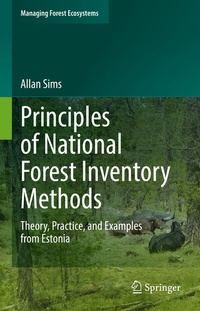
Principles of National Forest Inventory Methods
Description

This Monograph explains the statistical theory behind the National Forest Inventory (NFI) data collection and compares different methods for modelling and inventory design. The author also explains how natural uncertainty in measurement and modelling can affects the results. Forests, as dynamic systems, are influenced by many unpredictable factors over time. Therefore, readers can use this book to develop the right framework of expectations, when using NFI data.
The chapters give an outlook on traditional methods like sample plots, but also consider newer approaches like remote sensing. By merging these different techniqes, NFI datasets can become more reliable and facetted. One of the most contemporary developments in the field, is the use of continuous plots that offer live data at all times. Whether this data should be open to the public, is another discussion point that the author addresses.
Offering a perspective from Estonia, readers will find practical examples for all discussed methods. This bridge from theory to practice, makes the volume a useful resource for scientists and decision makers in the forestry sector.
More details
Other editions
Additional editions
Person
Dr. Allan Sims has been working with sample plots data since his master studies (2002) at the Estonian University of Life Sciences. His PhD thesis discussed "Information system of dendrometric models and data - a tool for modelling of forest growth". The author's research field has been mainly focussed on forest growth and dynamics, stand structure, forest remote sensing and uncertainty in measuring and modelling. Since 2016 he has been leading the scientific and data analysis section of the Estonian National Forest Inventory. He has been a member of the Estonian LULUCF and FRA reporting team.
