

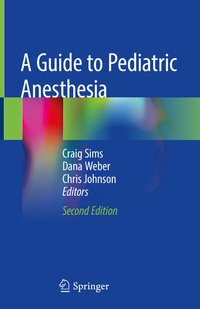
A Guide to Pediatric Anesthesia
Description

The second edition of the successful book "Your Guide to Pediatric Anesthesia" offers a practical approach to pediatric anesthesia with a concise account of the topic in a reader-friendly format. The book begins with an overview of pediatric anesthesia then continues with chapters related to different pediatric surgeries and the relevant anesthetic issues, including a chapter of emergency scenarios in pediatric anesthesia. The final section has chapters containing past exam questions in pediatric anesthesia, a set of clinical scenarios written in an exam question and answer format, and a glossary of syndromes and conditions with brief, important information and practical recommendations. The book also includes an accurate and comprehensive index which helps readers guide themselves through the book.
Written in a consistent, exam-focused, non-academic writing style, chapters provide a clear explanation of each topic with a review of management options, discussingadvantages and disadvantages, and concluding with a suggested practical approach in each case. It contains the syllabus for the College exams, but is also full of practical techniques and discussion for trainees during their pediatric rotation. It is relevant and useful for anesthetists who have completed their exams and are now caring for children in their practice.
A Guide to Pediatric Anesthesia covers the important topics at a level suitable for trainees, occasional pediatric anesthetists and anesthetic assistants.
Reviews / Votes
"This is an up-to-date guide that covers almost all topics of pediatric anesthesia. . The book is suitable for trainee residents who wish to understand basic concepts and their clinical application of pediatric anesthesiology. It is also useful as a compact guide for all engaged in pediatric anesthetic care, either or use in clinical practice or as a reference book." (Munisha Agarwal, Anesthesia & Analgesia, Vol. 131 (2), August, 2020)More details
Other editions
Additional editions
Persons
Craig Sims is a pediatric anesthetist at Perth Children's Hospital who has more than 20 years' experience, including subspecialty training in Canada and the UK. He has completed a 12 year tenure as Examiner with the Australia & New Zealand College of Anaesthetists.
Dana Weber is a pediatric anesthetist at Perth Children's Hospital, having completed subspecialty training in Sydney. She has an interest in acute and chronic pain.
Chris Johnson is a pediatric anesthetist with more than 25 years' experience, including subspecialty training in Melbourne. He recently retired from the Children's Hospital but continues in private pediatric practice. He has completed a 12 year tenure as Examiner with the Australia & New Zealand College of Anaesthetists
Content
1. An Overview of Paediatric Anaesthesia.- 2 Pharmacology of Anaesthetic Agents in Children.- 3 Behavioural Management of Children.- 4 Airway Management.- 5. Fluid Management.- 6 Equipment and Monitoring.- 7 Resuscitation and Emergency Drugs.- 8 Crisis Scenarios.- 8 Acute Pain Management.- 9 Regional Anaesthesia.- 10. Respiratory illnesses and their influence on anaesthesia.- 11 Chronic Diseases of Childhood.- 12 Congenital Syndromes & Conditions.- 13 Neonatal Anaesthesia.- 14 Anaesthesia for Paediatric General Surgery.- 15 Otolaryngology.- 16 Bronchoscopy & Removal of Foreign Bodies from the Trachea.- 17. Anaesthesia for Dental Procedures.- 18 Anaesthesia for Orthopaedic Surgery. 19 Congenital Heart Disease.- 20 Anaesthesia for Thoracic Surgery.- 21 Anaesthesia for Plastic Surgery.- 22 Paediatric Neuroanaesthesia. - 23 Anaesthesia for Ophthalmic Surgery.- 24 Anaesthesia for Urological Surgery.- 25. Trauma and Burns.- 26 Malignancy and Treatment of Malignancies.- 27 Procedural Sedation --- Anaesthesia & Sedation of Children Away from the OR.- 28 Vascular Access.- 29 The Child at Risk - Child Protection and the Anaesthetist.- 30 Paediatric Intensive Care.- 31 A selection of clinical scenarios in short answer question format.- 32 Glossary of Syndromes and Diseases.- 33 Short Answer Questions from Past FANZCA and FRCA Examinations.- 34 Useful Formulae for Paediatric Anaesthesia.
