

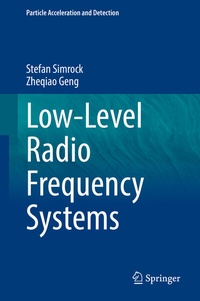
Low-Level Radio Frequency Systems
Description

This book begins with an overview of the RF control concepts and strategies. It then introduces RF system models for optimizing the system parameters to satisfy beam requirements and for controller design. In addition to systematically discussing the RF field control algorithms, it presents typical architecture and algorithms for RF signal detection and actuation. Further, the book addresses the analysis of the noise and nonlinearity in LLRF systems to provide a better understanding of the performance of the RF control system and to specify the performance requirements for different parts of the RF system.
Today, accelerators require increased RF stability and more complex operation scenarios, such as providing beam for different beam lines with various parameters, and as a result LLRF systems are becoming more critical and complex. This means that LLRF system developers need have extensive knowledge of the entire accelerator complex and a wide range of other areas, including RF and digital signal processing, noise analysis, accelerator physics and systems engineering.
Providing a comprehensive introduction to the basic theories, algorithms and technologies, this book enables LLRF system developers to systematically gain the knowledge required to specify, design and implement LLRF systems and integrate them with beam acceleration. It is intended for graduate students, professional engineers and researchers in accelerator physics.
More details
Other editions
Additional editions
Persons
Stefan Simrock is a Control System Coordinator at the ITER Organization located in southern France. He studied physics and microwave engineering at the Technical University of Darmstadt where he received his Ph.D. in engineering physics in 1988. From 1988 - 1996 he worked at the Thomas Jefferson National Accelerator Facility as RF controls group leader and deputy for the technical performance of the accelerator. He joined DESY in 1996 as leader of a multidisciplinary team responsible for the design, construction and commissioning of the control system for the superconducting linac at the TESLA Test Facility. In 2004 he was appointed group leader of beam controls group responsible for the timing, synchronisation, and beam feedback systems of all 10 accelerators at DESY. At the same time he was project leader for the RF Control System for FLASH and the European XFEL. Since 2010 he is responsible for the integration of ITER diagnostics with the central control system, machine protection system, safety system, and plasma control system.
Zheqiao Geng is a senior electronic engineer at the Paul Scherrer Institute in Switzerland. He graduated with a bachelor's degree from Tsinghua University in Beijing, China, in 2002. In 2007 he received his Ph.D. degree in nuclear engineering from the Graduate School of Chinese Academy of Sciences. For more than ten years, he worked on accelerator RF and beam control systems in different labs, including IHEP (China), DESY (Germany), SLAC (USA) and PSI (Switzerland). He was the key developer of critical aspects of the LLRF systems for various accelerator projects such as the European XFEL, LCLS and SwissFEL. At SLAC, he led the system-level design of the LCLS-II LLRF system. Together with Dr. Stefan Simrock, he held a series of lectures on LLRF systems at the International Accelerator School for Linear Colliders. As an internationally acclaimed LLRF expert, he was appointed as a PSI Senior Expert in 2021.
