

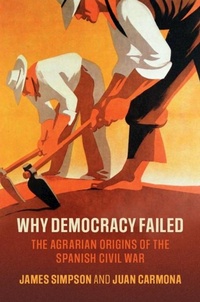
Why Democracy Failed
The Agrarian Origins of the Spanish Civil War
Published on 29. April 2020
978-1-108-80602-2 (ISBN)
Description

In this distinctive new history of the origins of the Spanish Civil War, James Simpson and Juan Carmona tackle the highly-debated issue of why it was that Spain's democratic Second Republic failed. They explore the interconnections between economic growth, state capacity, rural social mobility and the creation of mass competitive political parties, and how these limited the effectiveness of the new republican governments, and especially their attempts to tackle economic and social problems within the agricultural sector. They show how political change during the Republic had a major economic impact on the different groups in village society, leading to social conflicts that turned to polarization and finally, with the civil war, to violence and brutality. The democratic Republic failed not so much because of the opposition from the landed elites, but rather because small farmers had been unable to exploit more effectively their newly found political voice.
Reviews / Votes
'The Spanish Civil War was many wars, Catholics versus anti-clericals, regional nationalists versus centralists - especially military ones, and industrial workers versus employers. Arguably, the most divisive issue was the long-running agrarian war now illuminated by this sophisticated and lucid study. Within a lengthy chronological span and an awareness of the wider European and Latin-American context, the authors have produced a welcome and highly nuanced work that will supplant the now fifty-year old classic on the agrarian question by Edward Malefakis.' Sir Paul Preston, author of The Spanish Holocaust: Inquisition and Extermination in Twentieth Century Spain 'Why Democracy Failed is a breakthrough study of socioeconomic conditions in Spanish agriculture during the early twentieth century. It strikingly restructures our understanding of the conflicts that lead to the breakdown of the Second Republic, replacing often subjective political interpretations with decisive new data to analyze agrarian conditions and social polarization. Broad in scope and impressively original in content, this is the best new historical account of Spanish agriculture in half a century.' Stanley G. Payne, author of The Spanish Civil War 'These two experts in agrarian history advance new and nuanced interpretations of late nineteenth and early twentieth-century Spanish political and economic developments. They make important contributions to the literature on the origins of the Spanish Civil War and place the Spanish situation in a European and global comparative context.' Michael Seidman, author of Transatlantic Antifascism: From the Spanish Civil War to the End of World War II 'This is a very important contribution ... Highly recommended. General readers, advanced undergraduates through faculty, and professionals.' N. Greene, Choice 'Why Democracy Failed is an ambitious and important contribution to the scholarship on European agrarian history and specifically the history of the Second Spanish Republic of the 1930s.' Pamela Radcliff, Agricultural History '... an original and provocative contribution to this debate ... [the authors] find their answers in places very different from where historians usually look.' Adrian Shubert, Journal of Modern History '... essential reading for anyone looking to understand how Spain's problems of inequality led to such a brutal and violent reaction.' Sergio Riesco, EH.net (Economic History Association)More details
Series
Language
English
Place of publication
Cambridge
United Kingdom
Target group
Professional and scholarly
Illustrations
Worked examples or Exercises
File size
0,00 MB
ISBN-13
978-1-108-80602-2 (9781108806022)
Copyright in bibliographic data and cover images is held by Nielsen Book Services Limited or by the publishers or by their respective licensors: all rights reserved.
Schweitzer Classification
Other editions
Additional editions
Book
05/2020
Cambridge University Press
€40.80
Shipment within 15-20 days
Book
05/2020
Cambridge University Press
€103.30
Shipment within 15-20 days
Persons
Content
Introduction; Part I. The European Experience: Economic and Political Development, 1870-1939: 1. The modernization of European societies; 2. European agriculture in an age of economic instability; Part II. Spanish Agriculture, Economic Development and Democracy: 3. The limits to Spanish modernization, 1850-1936; 4. Agricultural growth, regional diversity, and regional land-tenure regimes; Part III. Explaining the Weakness of the Family Farm: 5. The family farm and the limits to village - level cooperation; 6. The persistence of the landed elites and the nature of farm lobbies; Part IV. Rural Elites, Poverty, and the Attempts at Land Reform: 7. Land ownership, economic development and poverty in Andalusia and southern Spain; 8. The limits to land reform; Part V. Rural Conflicts and the Polarization of Village Society: 9. Creating parties, political alliances, and interest groups: rural politics in the 1930s; 10. The growing polarization of rural society during the Second Republic; Conclusion; Appendix 1. Agricultural statistics in Spain, France and Italy in the early 1930s; Appendix 2. Dry-farming and the economics of the family farm.
