

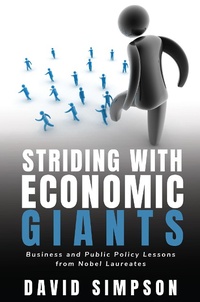
Striding With Economic Giants
Description

Striding explores the modernization process by outlining the economics of agriculture, growth theories of economic development, and problems with growth.
During the last century, policy makers and the public acquired a considerable interest in economics. As a result, this heightened awareness enhanced the well-being of society.
In 1969, the Nobel Foundation initiated the new prize category of economic sciences and started awarding the prize annually. At the forefront of their field, prize winners have introduced many innovative ideas. Moreover, an evaluation of their ideas reveals valuable nuggets to enrich the professional lives of non-economists.
Drawing on publications written by the Laureates, Striding with Economic Giants presents the essence of their thoughts in easy-to-understand concepts for the business and academic communities. This book is perfect for business executives, public policy makers, and economics students.
It describes logic and experimental frameworks in mathematics, econometrics, behavior modeling, and game theory. Next, Striding presents microeconomic contributions, including production theory, theory of institutions, fundamental ideas of markets, and consumerism. Then, it reviews financial theory in capital markets, portfolio choice, and asset pricing.
The book spotlights contributions to the rule of law, public administration, and political science. It also highlights a growing understanding of human capital by tracing demographic trends and describing health, education, minority, and labor economics. Enhancements to macroeconomic theory are featured in economic mechanisms and cycles, managing the economy, and policy making.
Striding explores the modernization process by outlining the economics of agriculture, growth theories of economic development, and problems with growth. It illustrates contributions to international economics in trade, finance, and global public policy. Finally, the book showcases contributions to social justice in social equality, income redistribution, and climate change.
More details
Other editions
Additional editions
Person
Content
- Cover
- Halftitle
- Title
- Copyright
- Description
- Contents
- Testimonials
- Preface
- Chapter 1: Introduction
- Chapter 2: In the Laboratory
- Chapter 3: Small-Scale Economics
- Chapter 4: Finance Theory
- Chapter 5: Role of Government
- Chapter 6: Human Capital
- Chapter 7: Domestic Big Picture
- Chapter 8: Modernization
- Chapter 9: International Economics
- Chapter 10: Social Justice
- References
- About the Author
- Index
- Adpage
- Backcover
