

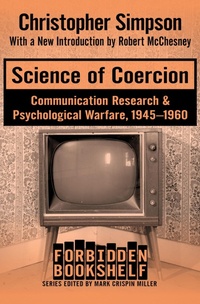
Science of Coercion
Communication Research & Psychological Warfare, 1945-1960
Published on 3. March 2015
208 pages
978-1-4976-7270-3 (ISBN)
Description

A provocative and eye-opening study of the essential role the US military and the Central Intelligence Agency played in the advancement of communication studies during the Cold War era, now with a new introduction by Robert W. McChesney and a new preface by the author
Since the mid-twentieth century, the great advances in our knowledge about the most effective methods of mass communication and persuasion have been visible in a wide range of professional fields, including journalism, marketing, public relations, interrogation, and public opinion studies. However, the birth of the modern science of mass communication had surprising and somewhat troubling midwives: the military and covert intelligence arms of the US government.
In this fascinating study, author Christopher Simpson uses long-classified documents from the Pentagon, the CIA, and other national security agencies to demonstrate how this seemingly benign social science grew directly out of secret government-funded research into psychological warfare. It reveals that many of the most respected pioneers in the field of communication science were knowingly complicit in America's Cold War efforts, regardless of their personal politics or individual moralities, and that their findings on mass communication were eventually employed for the purposes of propaganda, subversion, intimidation, and counterinsurgency.
An important, thought-provoking work, Science of Coercion shines a blazing light into a hitherto remote and shadowy corner of Cold War history.
Since the mid-twentieth century, the great advances in our knowledge about the most effective methods of mass communication and persuasion have been visible in a wide range of professional fields, including journalism, marketing, public relations, interrogation, and public opinion studies. However, the birth of the modern science of mass communication had surprising and somewhat troubling midwives: the military and covert intelligence arms of the US government.
In this fascinating study, author Christopher Simpson uses long-classified documents from the Pentagon, the CIA, and other national security agencies to demonstrate how this seemingly benign social science grew directly out of secret government-funded research into psychological warfare. It reveals that many of the most respected pioneers in the field of communication science were knowingly complicit in America's Cold War efforts, regardless of their personal politics or individual moralities, and that their findings on mass communication were eventually employed for the purposes of propaganda, subversion, intimidation, and counterinsurgency.
An important, thought-provoking work, Science of Coercion shines a blazing light into a hitherto remote and shadowy corner of Cold War history.
More details
Persons
Christopher Simpson is a veteran reporter, historian, and analyst who teaches at American University's School of Communication in Washington, DC. His work has won national awards for investigative journalism, history, and literature, and has been published in more than a dozen languages. Current study includes technology, democracy, revolution, and peer learning.
Content
- Cover Page
- Title Page
- Dedication
- Contents
- Series Introduction
- Preface
- Introduction
- 1. Defining Psychological War
- 2. World War and Early Modern Communication Research
- 3. "The Social Scientists Make a Huge Contribution,"
- 4. Academic Advocates
- 5. Outposts of the Government
- 6. "Barrack and Trench Mates,"
- 7. Internationalization and Enforcement of the Paradigm of Domination
- 8. The Legacy of Psychological Warfare
- Appendix: Dr. Stuart Dodd's List of "Revere-Connected Papers" (1958)
- Bibliographic Essay
- Notes
- Index
- Acknowledgments
- About the Author
- Copyright Page
