

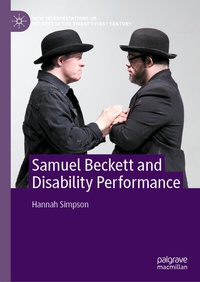
Samuel Beckett and Disability Performance
Description

Beckett's plays have attracted a striking range of disability performances - that is, performances that cast disabled actors, regardless of whether their roles are explicitly described as 'disabled' in the text. Grounded in the history of disability performance of Beckett's work and a new theorising of Beckett's treatment of the impaired body, Samuel Beckett and Disability Performance examines four contemporary disability performances of Beckett's plays, staged in the UK and US, and brings the rich fields of Beckett studies and disability studies into mutually illuminating conversation. Pairing original interviews with the actors and directors involved in these productions alongside critical analysis underpinned by recent disability and performance theory, this book explores how these productions emphasise or rework previously undetected indicators of disability in Beckett's work. More broadly, it reveals how Beckett's theatre compulsively interrogates alternative embodiments, unexpected forms of agency, and the extraordinary social interdependency of the human body.
Winner of the TaPRA David Bradby Monograph Prize, 2023.
Reviews / Votes
"Samuel Beckett and Disability Performance is the first book-length study of Samuel Beckett's theatrical work within a disability studies framework, bringing a new and highly pertinent perspective to Beckett studies. ... Each chapter is written as an independent unit, which makes them handy resources for anyone who wishes to learn more about a particular performance." (Einat Adar, The Beckett Circle, thebeckettcircle.org, October 19, 2023)
More details
Other editions
Additional editions
Person
Hannah Simpson is Rosemary Pountney Research Fellow at St Anne's College, University of Oxford, UK. She specialises in modern and contemporary theatre and performance, with a particular interest in the work of Samuel Beckett and issues of physical pain and disability. She is also the author of Witnessing Pain: Samuel Beckett and Post-War Francophone Theatre (2022), and the Theatre Review Editor for The Beckett Circle (The Samuel Beckett Society).
Content
Chapter 1: Endgame: Anxieties of the Body (Theatre Workshop Scotland, 2007).- Chapter 2: Endgame: Me to Play (The Endgame Project, 2012).- Chapter 3: Not I: Compulsion and Agency (Touretteshero, 2017-2020).- Chapter 4: Waiting for Godot: The Struggle to Be (Culture Device and Hackney Showroom, 2018).- Chapter 5: This.Here: Recuperative and Recuperating (Rosetta Life and Stroke Odysseys, 2019).- Chapter 6: Conclusion: Virtuosic Bodies.
