

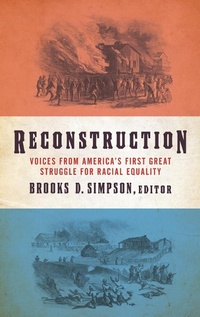
Reconstruction: Voices from America's First Great Struggle for Racial Equality (LOA #303)
Published on 30. January 2018
807 pages
978-1-59853-563-1 (ISBN)
Description

The violent aftermath of the Civil War comes to dramatic life in this sweeping new collection of firsthand writing from the Reconstruction era-featuring pieces by Frederick Douglass, Frances Harper, and more
Few periods in American history are more consequential but less understood than Reconstruction, the tumultuous twelve years after Appomattox, when the battered nation sought to reconstitute itself and confront the legacy of two centuries of slavery.
This anthology brings together more than one hundred contemporary letters, diary entries, interviews, testimonies, and articles by ordinary men and women and well-known figures such as Frederick Douglass, Frances Ellen Watkins Harper, Andrew Johnson, Thaddeus Stevens, Ulysses S. Grant, Elizabeth Cady Stanton, Mark Twain, and Albion Tourgée.
Through their eyes readers experience the fierce contest between President Andrew Johnson and the Radical Republicans resulting in the nation's first presidential impeachment; the adoption of the revolutionary 14th and 15th Amendments; the first achievements of black political power; and the murderous terrorism of the Klan and other groups that, combined with northern weariness, indifference, and hostility, eventually resulted in the restoration of white supremacy in the South.
Throughout, Americans confront the essential questions left unresolved by the defeat of secession: What system of labor would replace slavery, and what would become of the southern plantations? Would the war end in the restoration of a union of sovereign states, or in the creation of a truly national government? What would citizenship mean after emancipation, and what civil rights would the freed people gain? Would suffrage be extended to African American men, and to all women?
Few periods in American history are more consequential but less understood than Reconstruction, the tumultuous twelve years after Appomattox, when the battered nation sought to reconstitute itself and confront the legacy of two centuries of slavery.
This anthology brings together more than one hundred contemporary letters, diary entries, interviews, testimonies, and articles by ordinary men and women and well-known figures such as Frederick Douglass, Frances Ellen Watkins Harper, Andrew Johnson, Thaddeus Stevens, Ulysses S. Grant, Elizabeth Cady Stanton, Mark Twain, and Albion Tourgée.
Through their eyes readers experience the fierce contest between President Andrew Johnson and the Radical Republicans resulting in the nation's first presidential impeachment; the adoption of the revolutionary 14th and 15th Amendments; the first achievements of black political power; and the murderous terrorism of the Klan and other groups that, combined with northern weariness, indifference, and hostility, eventually resulted in the restoration of white supremacy in the South.
Throughout, Americans confront the essential questions left unresolved by the defeat of secession: What system of labor would replace slavery, and what would become of the southern plantations? Would the war end in the restoration of a union of sovereign states, or in the creation of a truly national government? What would citizenship mean after emancipation, and what civil rights would the freed people gain? Would suffrage be extended to African American men, and to all women?
More details
Other editions
Additional editions
Brooks D. Simpson
Reconstruction: Voices from America's First Great Struggle for Racial Equality (LOA #303)
Book
01/2018
The Library of America
€37.50
Shipment within 3-4 weeks
Person
Brooks D. Simpson, editor, is Foundation Professor of History at Arizona State University. He is the author of Let Us Have Peace: Ulysses S. Grant and the Politics of War and Reconstruction, 1861-1868 and Ulysses S. Grant: Triumph over Adversity, 1822-1865, editor of The Civil War: The Third Year Told by Those Who Lived It, and co-editor of The Civil War: The First Year Told by Those Who Lived It and Sherman's Civil War: Selected Correspondence of William T. Sherman, 1860-65.
Content
- Cover
- Title
- Copyright
- Contents
- Introduction
- PRESIDENTIAL RECONSTRUCTION, 1865-1866
- Frederick Douglass: What the Black Man Wants, January 26, 1865
- Abraham Lincoln: Speech on Reconstruction, April 11, 1865
- Springfield Republican: Restoration of the Union, April 20, 1865
- Andrew Johnson: Interview with Pennsylvania Delegation, May 3, 1865
- Colored Men of North Carolina to Andrew Johnson, May 10, 1865
- Andrew Johnson: Reply to a Delegation of Colored Ministers, May 11, 1865
- Salmon P. Chase to Andrew Johnson, May 12, 1865
- Joseph Noxon to Andrew Johnson, May 27, 1865
- Delegation of Kentucky Colored People to Andrew Johnson, June 9, 1865
- Charles C. Soule and Oliver O. Howard: An Exchange, June 12 and 21, 1865
- Richard Henry Dana: Speech at Boston, June 21, 1865
- Charles Sumner to Gideon Welles, July 4, 1865
- Wendell Phillips to the National Anti-Slavery Standard, July 8, 1865
- Francis Preston Blair to Andrew Johnson, August 1, 1865
- Colored People of Mobile to Andrew J. Smith, August 2, 1865
- Jourdon Anderson to P. H. Anderson, August 7, 1865
- Carl Schurz to Andrew Johnson, August 29, 1865
- Christopher Memminger to Andrew Johnson, September 4, 1865
- Thaddeus Stevens: Speech at Lancaster, September 6, 1865
- Georges Clemenceau to Le Temps, September 28, 1865
- George L. Stearns: Interview with President Johnson, October 3, 1865
- Andrew Johnson: Speech to the 1st U.S. Colored Infantry, Washington, D.C., October 10, 1865
- Sarah Whittlesey to Andrew Johnson, October 12, 1865
- Edisto Island Freedmen to Andrew Johnson, October 28, 1865
- J. A. Williamson to Nathan A. M. Dudley, October 30, 1865
- Address of the Colored State Convention to the People of South Carolina, November 24, 1865
- Andrew J. Hamilton to Andrew Johnson, November 27, 1865
- Sidney Andrews: from The South Since the War
- Carl Schurz: from Report on the Condition of the South
- Ulysses S. Grant to Andrew Johnson, December 18, 1865
- Lewis Hayden: from Caste among Masons
- Harriet Jacobs to The Freedman, January 9 and 19, 1866
- Marcus S. Hopkins to James Johnson, January 15, 1866
- Andrew Johnson and Frederick Douglass: An Exchange, and Reply of the Colored Delegation to President Johnson, February 7, 1866
- Joseph S. Fullerton to Andrew Johnson, February 9, 1866
- Andrew Johnson: Veto of the Freedmen's Bureau Bill, February 19, 1866
- Andrew Johnson: Speech on Washington's Birthday, February 22, 1866
- Andrew Johnson: Veto of the Civil Rights Bill, March 27, 1866
- CONGRESSIONAL RECONSTRUCTION, 1866-1869
- Maria F. Chandler to Thaddeus Stephens, April 1, 1866
- Harper's Weekly: Radicalism and Conservatism, April 21, 1866
- Thaddeus Stevens: Speech in Congress on the Fourteenth Amendment, May 8, 1866
- Frances Ellen Watkins Harper: Speech at the National Woman's Rights Convention, May 10, 1866
- George Stoneman to Ulysses S. Grant, May 12, 1866
- The New York Times: An Hour With Gen. Grant, May 24, 1866
- Elihu B. Washburne to Thaddeus Stevens, May 24, 1866
- Cynthia Townsend: Testimony to House Select Committee, May 30, 1866
- Joint Resolution Proposing the Fourteenth Amendment, June 13, 1866
- Oliver P. Morton: from Speech at Indianapolis, June 20, 1866
- Philip H. Sheridan to Ulysses S. Grant, August 1 and 2, 1866
- Harper's Weekly: The Massacre in New Orleans
- Andrew Johnson: Speech at St. Louis, September 8, 1866
- Thaddeus Stevens: Speech at Lancaster, September 27, 1866
- Frederick Douglass: Reconstruction, December 1866
- Thaddeus Stevens: Speech in Congress on Reconstruction, January 3, 1867
- Mobile Daily Advertiser and Register: No Amendment-Stand Firm, January 9, 1867
- Albion W. Tourgée: To the Voters of Guilford, October 21, 1867
- Harper's Weekly: Impeachment, December 14, 1867
- Albion W. Tourgée: The Reaction, January 4, 1868
- New-York Tribune: The President Must Be Impeached, February 24, 1868
- Thaddeus Stevens: Speech in Congress on Impeachment, February 24, 1868
- Bossier Banner: White Men to the Rescue!
- The Nation: The Result of the Trial, May 21, 1868
- Frank P. Blair to James O. Broadhead, June 30, 1868
- Frederick Douglass: The Work Before Us, August 27, 1868
- Elizabeth Cady Stanton: Gerrit Smith on Petitions, January 14, 1869
- Joint Resolution Proposing the Fifteenth Amendment, February 27, 1869
- "LET US HAVE PEACE," 1869-1873
- Ulysses S. Grant: First Inaugural Address, March 4, 1869
- Frederick Douglass and Susan B. Anthony: Exchange on Suffrage, May 12, 1869
- Mark Twain: Only a Nigger. The Buffalo Express, August 26, 1869
- Georges Clemenceau to Le Temps, November 3, 1869
- The New York Times: Reconstruction Nationalized, February 21, 1870
- William W. Holden to Ulysses S. Grant, March 10, 1870
- Ulysses S. Grant: Message to Congress on the Fifteenth Amendment, March 30, 1870
- Albion W. Tourgée to Joseph C. Abbott, May 24, 1870
- Robert K. Scott to Ulysses S. Grant, October 22, 1870
- Horace Greeley and Robert Brown Elliott: Exchange on Amnesty, March 16-17, 1871
- Joseph H. Rainey: Speech in Congress on the Enforcement Bill, April 1, 1871
- James A. Garfield: from Speech in Congress on the Enforcement Bill, April 4, 1871
- Maria Carter: Testimony to the Joint Select Committee, Atlanta, Georgia, October 21, 1871
- Horace Greeley: Reply to Committee of the Liberal Republican Convention, May 20, 1872
- Frederick Douglass: Speech at New York City, September 25, 1872
- James S. Pike: South Carolina Prostrate, March 29, 1873
- Ulysses S. Grant: Second Inaugural Address, March 4, 1873
- THE END OF RECONSTRUCTION, 1873-1877
- Levi Nelson and Benjamin Brim: Testimony in the Colfax Massacre Trial, New Orleans, February 27 and March 3, 1874
- Robert Brown Elliott: Speech in Congress on the Civil Rights Bill, January 6, 1874
- New York Herald: General Grant's New Departure, January 20, 1874
- Richard Harvey Cain: Speech in Congress on the Civil Rights Bill, January 24, 1874
- James T. Rapier: Speech in Congress on the Civil Rights Bill, June 9, 1874
- William Lloyd Garrison to the Boston Journal, September 3, 1874
- Eugene Lawrence to Harper's Weekly, October 31, 1874
- Isaac Loveless to Ulysses S. Grant, November 9, 1874
- Ulysses S. Grant: from Annual Message to Congress, December 7, 1874
- Philip H. Sheridan to William W. Belknap, January 4 and 5, 1875
- Carl Schurz: from Speech in the Senate on Louisiana, January 11, 1875
- William Lloyd Garrison to the Boston Journal, January 12, 1875
- Ulysses S. Grant: Message to the Senate on Louisiana, January 13, 1875
- John R. Lynch: from Speech in Congress on the Civil Rights Bill, February 3, 1875
- Thomas Whitehead: from Speech in Congress on the Civil Rights Bill, February 3, 1875
- Charles A. Eldredge: Speech in Congress on the Civil Rights Bill, February 4, 1875
- James A. Garfield: from Speech in Congress on the Civil Rights Bill, February 4, 1875
- Hinds County Gazette: How to Meet the Case, August 4, 1875
- Ulysses S. Grant to Edwards Pierrepont, September 13, 1875
- Edwards Pierrepont to Adelbert Ames, September 14, 1875
- Sarah A. Dickey to Ulysses S. Grant, September 23, 1875
- Margaret Ann Caldwell: Testimony to the Select Senate Committee, June 20, 1876
- Albion W. Tourgée: Root, Hog, or Die, c. 1876
- John R. Lynch: Speech in Congress on Mississippi, February 10, 1876
- Ulysses S. Grant to Daniel H. Chamberlain, July 26, 1876
- The Nation: The South in the Canvass. The Nation, July 27, 1876
- Robert G. Ingersoll: from Speech at Indianapolis, September 21, 1876
- David Brundage to Ulysses S. Grant, October 14, 1876
- Rutherford B. Hayes: Diary, November 12, 1876
- Abram Hewitt: Memorandum of Conversation with Ulysses S. Grant, December 3, 1876
- Chicago Tribune: The Court of Arbitration, January 21, 1877
- St. Louis Globe Democrat: The Warning, March 31, 1877
- The Nation: The Political South Hereafter, April 5, 1877
- CODA, 1879
- John Russell Young: from Around the World With General Grant
- Joseph H. Rainey: From Remarks in Congress on South Carolina Elections, March 3, 1879
- Chronology
- Biographical Notes
- Note on the Texts
- Notes
- Index
