

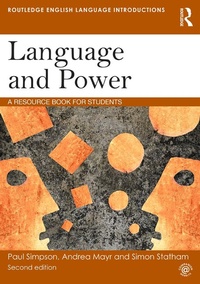
Language and Power
A Resource Book for Students
2nd Edition
Published on 7. December 2018
310 pages
978-0-429-88913-4 (ISBN)
Description

Routledge English Language Introductions cover core areas of language study and are one-stop resources for students.
Assuming no prior knowledge, books in the series offer an accessible overview of the subject, with activities, study questions, sample analyses, commentaries and key readings - all in the same volume. The innovative and flexible 'two-dimensional' structure is built around four sections - introduction, development, exploration and extension - which offer self-contained stages for study. Each topic can also be read across these sections, enabling the reader to build gradually on the knowledge gained.
Language and Power, Second Edition has been completely revised and updated and includes:
a comprehensive survey of the ways in which language intersects and connects with the social, cultural and political aspects of power;
an introduction to the history of the field, covering all the major approaches, theoretical concepts and methods of analysis in this important and developing area of academic study;
coverage of all the 'traditional' topics, such as race, gender and institutional power, but also newer topics such as the discourse of post-truth, and the power of social media;
readings from works by seminal figures in the field, such as Robin Lakoff, Deborah Cameron and Teun van Dijk;
real texts and examples throughout, including advertisements from cosmetics companies; newspaper articles and headlines; websites and internet media; and spoken dialogues such as political and presidential speeches;
a supporting companion website that aims to challenge students at a more advanced level and which features extra reading, exercises, follow-up activities, and suggestions for further work.
Language and Power will be essential reading for students studying English language or linguistics.
Assuming no prior knowledge, books in the series offer an accessible overview of the subject, with activities, study questions, sample analyses, commentaries and key readings - all in the same volume. The innovative and flexible 'two-dimensional' structure is built around four sections - introduction, development, exploration and extension - which offer self-contained stages for study. Each topic can also be read across these sections, enabling the reader to build gradually on the knowledge gained.
Language and Power, Second Edition has been completely revised and updated and includes:
a comprehensive survey of the ways in which language intersects and connects with the social, cultural and political aspects of power;
an introduction to the history of the field, covering all the major approaches, theoretical concepts and methods of analysis in this important and developing area of academic study;
coverage of all the 'traditional' topics, such as race, gender and institutional power, but also newer topics such as the discourse of post-truth, and the power of social media;
readings from works by seminal figures in the field, such as Robin Lakoff, Deborah Cameron and Teun van Dijk;
real texts and examples throughout, including advertisements from cosmetics companies; newspaper articles and headlines; websites and internet media; and spoken dialogues such as political and presidential speeches;
a supporting companion website that aims to challenge students at a more advanced level and which features extra reading, exercises, follow-up activities, and suggestions for further work.
Language and Power will be essential reading for students studying English language or linguistics.
Reviews / Votes
"This new edition is an invaluable resource for students of language and power. It gives a clear and concise introduction to theoretical issues of language and power, a full range of tools for analysing texts and discourse, and excellent examples which illustrate how to apply these tools. The new sections on 'tweeting politics', 'truth' and 'mediated relations' and the inclusion of a new reading on 'Populism and post-truth politics' by Robin Lakoff are welcome additions which bring the book right up to date with contemporary concerns."Michael Farrelly, University of Hull, UK
"The addition of new chapters on the language of social media and the discourse of post-truth, as well as the revamping of many of the example texts, all packaged in the innovative four strand 2D structure, make this an outstanding textbook for students of language and discourse studies... a much-needed toolkit for critically analysing many of the important national and international issues of the day."
Paul McIlvenny, Aalborg University, Denmark
More details
Series
Edition
2nd edition
Language
English
Place of publication
London
United Kingdom
Publishing group
Taylor & Francis Ltd
Target group
College/higher education
Illustrations
2 Tables, black and white; 2 Line drawings, black and white; 10 Halftones, black and white; 12 Illustrations, black and white
File size
4,80 MB
ISBN-13
978-0-429-88913-4 (9780429889134)
Copyright in bibliographic data and cover images is held by Nielsen Book Services Limited or by the publishers or by their respective licensors: all rights reserved.
Schweitzer Classification
Other editions
Additional editions
Book
11/2018
2nd Edition
Routledge
€206.90
Shipment within 10-20 days
Book
11/2018
2nd Edition
Routledge
€61.70
Shipment within 10-20 days
Persons
Paul Simpson is Professor of English Language and Head of English at the University of Liverpool, UK, where he teaches and researches in stylistics, pragmatics, critical linguistics and related fields of study.
Andrea Mayr is Lecturer in Modern English Language and Linguistics at Queen's University Belfast, UK, where she teaches and researches in media discourse and in multimodal critical discourse analysis.
Simon Statham is Lecturer in English Language and Linguistics at Queen's University Belfast, UK, where he teaches and researches in stylistics, critical linguistics and language and the law.
Andrea Mayr is Lecturer in Modern English Language and Linguistics at Queen's University Belfast, UK, where she teaches and researches in media discourse and in multimodal critical discourse analysis.
Simon Statham is Lecturer in English Language and Linguistics at Queen's University Belfast, UK, where he teaches and researches in stylistics, critical linguistics and language and the law.
Content
Contents cross-referenced
List of illustrations
Transcription conventions
Acknowledgements
A Introduction: Key topics in the study of language and power
1 Language and power
2 The discourse of institutions and organisations
3 Power and talk
4 Language and gender
5 Language and race
6 Humour, language and power
7 Language and the law
8 Language and advertising
9 Language in the new capitalism
10 Language and politics
11 The discourse of social media
12 The discourse of 'post-truth'
B Development: Approaches to the study of language and power
1 Critical Linguistics and Critical Discourse Analysis
2 Registers of discourse
3 Studying spoken discourse
4 Gender and power: using the transitivity model
5 The representation of social actors
6 The discourse of humour and irony
7 Developments in forensic discourse analysis
8 Advertising discourse: methods for analysis
9 Language and new capitalism: developments
10 Studying political discourse: developments
11 The language of a social media campaign
12 Post-truth and Critical Linguistics
C Exploration: Analysing language and power
1 Beginning analysis
2 Exploring register and ideology
3 Power and resistance in spoken discourse
4 Analysing gender
5 A workshop on the representation of social actors
6 Analysing humour and power
7 Exploring forensic texts
8 Analysing advertisements
9 Analysing the language of new capitalism
10 Analysing political discourse
11 Tweeting politics
12 'Truth' and Mediated Reactions
D Extension: Readings in language and power
1 Critical Linguistics (Roger Fowler and Gunther Kress)
2 Bureaucracy and social control (Srikant Sarangi and Stefaan Slembrouck)
3 Power and resistance in police interviews (Kate Haworth)
4 Masculinity and men's magazines (Bethan Benwell)
5 Discourse and the denial of racism (Teun van Dijk)
6 Humour and hatred (Michael Billig)
7 Forensic Linguistics (Malcom Coulthard)
8 Language, style and lifestyle (David Machin and Theo van Leeuwen)
9 Language in the global service economy (Deborah Cameron)
10 Critical metaphor analysis (Jonathan Charteris-Black)
11 Social media online campaigns (Innocent Chiluwa and Presley Ifukor)
12 Populism and post-truth politics (Robin Lakoff)
Further reading
References
Author index
Glossarial index
List of illustrations
Transcription conventions
Acknowledgements
A Introduction: Key topics in the study of language and power
1 Language and power
2 The discourse of institutions and organisations
3 Power and talk
4 Language and gender
5 Language and race
6 Humour, language and power
7 Language and the law
8 Language and advertising
9 Language in the new capitalism
10 Language and politics
11 The discourse of social media
12 The discourse of 'post-truth'
B Development: Approaches to the study of language and power
1 Critical Linguistics and Critical Discourse Analysis
2 Registers of discourse
3 Studying spoken discourse
4 Gender and power: using the transitivity model
5 The representation of social actors
6 The discourse of humour and irony
7 Developments in forensic discourse analysis
8 Advertising discourse: methods for analysis
9 Language and new capitalism: developments
10 Studying political discourse: developments
11 The language of a social media campaign
12 Post-truth and Critical Linguistics
C Exploration: Analysing language and power
1 Beginning analysis
2 Exploring register and ideology
3 Power and resistance in spoken discourse
4 Analysing gender
5 A workshop on the representation of social actors
6 Analysing humour and power
7 Exploring forensic texts
8 Analysing advertisements
9 Analysing the language of new capitalism
10 Analysing political discourse
11 Tweeting politics
12 'Truth' and Mediated Reactions
D Extension: Readings in language and power
1 Critical Linguistics (Roger Fowler and Gunther Kress)
2 Bureaucracy and social control (Srikant Sarangi and Stefaan Slembrouck)
3 Power and resistance in police interviews (Kate Haworth)
4 Masculinity and men's magazines (Bethan Benwell)
5 Discourse and the denial of racism (Teun van Dijk)
6 Humour and hatred (Michael Billig)
7 Forensic Linguistics (Malcom Coulthard)
8 Language, style and lifestyle (David Machin and Theo van Leeuwen)
9 Language in the global service economy (Deborah Cameron)
10 Critical metaphor analysis (Jonathan Charteris-Black)
11 Social media online campaigns (Innocent Chiluwa and Presley Ifukor)
12 Populism and post-truth politics (Robin Lakoff)
Further reading
References
Author index
Glossarial index
