

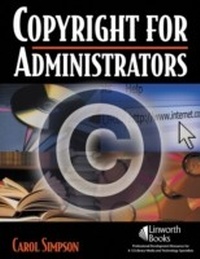
Copyright for Administrators
1st Edition
Published on 10. June 2008
128 pages
978-1-58683-352-7 (ISBN)
Description

Everything the school administrator needs to know to stay legal and in compliance with copyright law!
. Written by a well-known expert in the field of copyright law and schools
. Succinctly organized to allow you to answer all your copyright questions quickly
. Current, up-to-date, and clearly written so you don't have to wonder what is legal and what is not
. Includes a glossary of terms and an easy-to-use index
This ready-reference guide for school administrators is short, to-the-point, and factual. It includes a glossary to define terms like Public Performance and an index to help the administrator quickly find information as needed.
. Written by a well-known expert in the field of copyright law and schools
. Succinctly organized to allow you to answer all your copyright questions quickly
. Current, up-to-date, and clearly written so you don't have to wonder what is legal and what is not
. Includes a glossary of terms and an easy-to-use index
This ready-reference guide for school administrators is short, to-the-point, and factual. It includes a glossary to define terms like Public Performance and an index to help the administrator quickly find information as needed.
More details
Series
Edition
1. Auflage
Language
English
Place of publication
New York
United States
Target group
Professional and scholarly
ISBN-13
978-1-58683-352-7 (9781586833527)
Copyright in bibliographic data and cover images is held by Nielsen Book Services Limited or by the publishers or by their respective licensors: all rights reserved.
Schweitzer Classification
Other editions
Additional editions
Carol Simpson | Christine Weiser
Copyright for Administrators
Book
06/2008
Linworth Publishing, Incorporated
€49.00
Shipment within 3-4 weeks
Persons
Carol Simpson, JD, EdD, is associate professor in the College of Information, Library Science and Technologies of the University of North Texas, and practices school law.
Christine Weiser has been reporting on the education industry for over fifteen years.
Christine Weiser has been reporting on the education industry for over fifteen years.
Content
- Cover
- Title
- Copyright
- Table of Contents
- About the Author
- Acknowledgments
- Introduction
- CHAPTER 1: The Law
- Rights of a copyright holder
- Reproduction
- Adaptation
- Distribution
- What is "public?
- Public performance
- Public display
- Digital transmission of sound recordings
- Moral rights
- How does one get a copyright?
- What can't be protected by copyright?
- Work for hire
- Duration of copyright
- Recent laws
- NET Act
- Visual Artists Rights Act
- Digital Millennium Copyright Act
- Sonny Bono Copyright Term Extension Act
- Digital Performance Right in Sound Recordings Act
- TEACH Act
- Individuals with Disabilities Education Improvement Act of 2004
- Artists' Rights and Theft Prevention Act of 2005
- Family Movie Act of 2005
- Penalties for infringement
- Liability
- State copyright laws
- What's going to happen to us?
- How is a school prosecuted?
- What if there is no trial?
- Why worry, why bother?
- CHAPTER 2: Public Domain
- How long does public domain last?
- What can you do with public domain materials?
- How do you find public domain materials?
- What is the difference between "copyright free" and "royalty free?
- How can I use royalty-free materials?
- CHAPTER 3: Fair Use
- The Four Tests of Fair Use
- What is it?
- Difference between fair use and guidelines
- Examples of fair use analysis
- Factor 1: Purpose and character of use
- Factor 2: Nature of copyrighted work
- Factor 3: Amount of work used?
- Factor 4: Effect of use on market for or value of work
- Commercial use
- What would happen if everyone were to.
- Various types of guidelines
- General public vs. schools
- Schools vs. libraries
- CHAPTER 4: Print Materials in Schools
- What typical activities are covered?
- Photocopying-issues
- Phonorecords-issues
- Graphics-issues
- Murals-issues
- Scanning-issues
- What rights are affected?
- What guidelines affect print materials?
- Kastenmeier Report
- Single copies for teachers
- Multiple copies for classroom use
- Brevity
- Spontaneity
- Cumulative effect
- Copies for disabled students
- Print permission issues
- Consumable materials
- Periodicals
- Graphics
- Scanners
- CHAPTER 5: Audiovisual Materials in Schools
- What typical activities are covered?
- Movies-issues
- TV/cable/satellite-issues
- Web-issues
- Sound recordings-issues
- What rights are affected?
- What guidelines affect AV materials?
- Five yes/no questions
- Umbrella licenses
- Home use only
- Off-air taping guidelines
- Air" vs. cable vs. satellite
- Retention
- Home recording
- Copies of off-air recordings
- Recording in anticipation
- Public performance rights
- Archiving audiovisual works
- Closed captioning
- Video distribution
- Digital video servers
- Sound recordings
- Sampling
- The MP3 dilemma
- Resource sharing
- CHAPTER 6: Music Materials in Schools (print and recorded)
- What typical activities are covered?
- Reproduction of sheet music-issues
- Performances of sheet music-issues
- Reproduction of recorded music-issues
- Performances of recorded music-issues
- Adaptation of sheet music-issues
- What guidelines affect music?
- Print music
- Recorded music
- What rules/laws are different about recordings?
- Music in performance
- Performance rights organizations
- Permissions
- CHAPTER 7: Multimedia in Schools
- Multimedia guidelines
- Special definitions for multimedia
- Multimedia-covered or not?
- Retention and access
- Quantity limits
- How many copies?
- Other restrictions
- Attribution
- CHAPTER 8: Distance Learning in Schools
- TEACH Act
- Policymakers
- Information technology staff
- Instructors/developers
- CHAPTER 9: Internet in Schools
- What typical activities are covered?
- Special rules for the Internet
- Registered agent
- What guidelines affect the Internet?
- Application of fair use to Internet materials
- Special considerations for different Internet services
- Newsgroup and discussion list information
- Use of Web page information
- Chat
- Blogs and Wikis
- Copying Internet code
- CHAPTER 10: Computer Software in Schools
- What typical activities are covered?
- Types of infringement
- Direct infringement
- Indirect infringement
- What rights are affected?
- Special rules that affect computer software
- License vs. copyright
- Legitimate copying vs. piracy
- Free software?
- Lending software
- Single-user programs
- Networking
- The software police
- Copyright infringement vs. plagiarism
- Software management tips
- CHAPTER 11: Copyright Policies
- Why have one?
- What should a policy contain?
- CHAPTER 12: Appendices
- Appendix A-Copyright compliance agreement
- Appendix B-Copyright do's and don'ts for schools
- Appendix C-Copyright warning notices
- Appendix D-Sample copyright policy
- Appendix E-Release form
- Appendix F-Copyright and plagiarism guidelines for students
- Appendix G-Important Internet links for copyright information
- Appendix H-Copyright Infringement Reporting Form
- Works Cited
- Index
- A
- B
- C
- D
- E
- F
- G
- H
- I
- K
- L
- M
- N
- O
- P
- Q
- R
- S
- T
- U
- V
- W
