

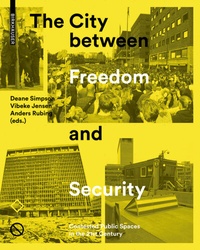
The City between Freedom and Security
Description

Preisträger DAM ARCHITECTURAL BOOK AWARD 2017
Das urbane Dilemma: den staatlichen Bestrebungen, den städtischen Raum sicherer zu machen, steht das Prinzip gegenüber, dass Städte ein Raum einer offenen Zivilgesellschaft und Demokratie mit Meinungs- und Versammlungsfreiheit sind. Wie lassen sich beide Interessen in eine Balance bringen?
Ausgehend von der viel diskutierten Sanierung des Regierungsviertels in Oslo nach den Anschlägen von 2011, bietet das Buch eine breite Diskussionsplattform für die unterschiedlichen Positionen an der Schnittstelle zwischen Architektur/Urbanismus und Sicherheit/Demokratie.
Interviews, Grafiken und Fotoessays dokumentieren Studien in UK, USA, Israel, Palestina und Spanien. Mit Beiträgen von S. Graham, M. Sorkin, D.Harvey, G. Agamben, Y. Yasky, L. Lambert, CPNI, R. V. Clarke, J. Coaffee and O. Newman.
More details
Other editions
Additional editions
Persons
Simpson , Bergen School of Architecture (2010-14), KADK; Jensen , Bergen School of Architecture; Rubing , Bergen School of Architecture
Content
- Intro
- Contents
- Introduction
- Foreword: BAS
- Foreword: NSM/PST
- Introduction: On urban Indefensibility: Friction Lines in the Production of the Open City
- The City Between Freedom and Security: Project Journal
- B ? Discursive Texts
- For a Theory of Destituent Power
- Protecting Vulnerable Cities from Terrorism: Enhancing the Resilience of Everyday Urban Infrastructure
- Photo Essay: Melilla, Spain
- The Fear Factor
- Defensible Space as a Crime Preventive Measure
- "Fortress Britain": High Security, Insecurity and the Challenge of Preventing Harm
- Photo Essay: Wall Street, New York, NY, USA
- Situational Crime Prevention: Theoretical Background and Current Practice
- When Life Itself Is War: The Urbanization of Military and Security Doctrine
- Securing the State: National Security and Secret Intelligence
- Designing Peace of Mind: Counterterrorism in Great Britain
- The Right to the City
- Photo Essay: Israel/Palestine
- C ? Contested Sites
- D ? Expert Interviews
- Photo Essay: Oslo, Norway
- Photo Essay: Occupy Wall Street, New York, NY, USA
- Photo Essay: Tahrir Square, Cairo, Egypt
- E ? Discursive Proposals
- Discursive Design Proposals
- Dystopian Scenario for Extreme Security
- Positive - Sum Game
- Mutual Concessions
- Grafting the Political to the Processional
- Participatory Adaptation
- In(tro)verted Security
- Decentralized Security
- Security through Urban Mixtures
- F ? Glossary
- G ? Notes and References
