

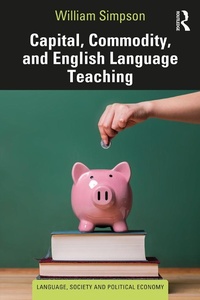
Capital, Commodity, and English Language Teaching
1st Edition
Published on 28. July 2022
232 pages
978-1-000-61269-1 (ISBN)
Description

Capital, Commodity, and English Language Teaching illustrates how the drive for profit in commercial ELT affects the manner in which language is taught. The book looks at education as a form of production, and asks how lessons are produced, and how the production of profit in addition to the production of the lesson affects the operation of educational institutions and their stakeholders.
Simpson delivers a theoretically rigorous conception of capital and builds from this an investigation into how the circulation of capital for profit interrelates with the teaching of language. Simpson discusses ELT at both a global level, in discussion of the ELT industry in the UK, the US, Ireland, Canada, Japan, Spain, and transnationally online, as well as at a more local level, where finer detailed descriptions of the work-lives of those within the Japanese eikaiwa ELT industry are given. Drawing on a synthesis of Marxist and Bourdieusian theory, the book outlines a dialectical approach to understanding capital, and to understanding how the drive for profit and language education interrelate with one another. Simpson concludes by showing how such an approach might open up areas for further research in a number of contexts across the globe, as well as in light of the Covid-19 pandemic.
Providing a model for addressing global issues of ELT, this book is of interest to advanced students, scholars and professionals within applied linguistics, TESOL, sociolinguistics, and linguistic anthropology, language economics and related areas.
Simpson delivers a theoretically rigorous conception of capital and builds from this an investigation into how the circulation of capital for profit interrelates with the teaching of language. Simpson discusses ELT at both a global level, in discussion of the ELT industry in the UK, the US, Ireland, Canada, Japan, Spain, and transnationally online, as well as at a more local level, where finer detailed descriptions of the work-lives of those within the Japanese eikaiwa ELT industry are given. Drawing on a synthesis of Marxist and Bourdieusian theory, the book outlines a dialectical approach to understanding capital, and to understanding how the drive for profit and language education interrelate with one another. Simpson concludes by showing how such an approach might open up areas for further research in a number of contexts across the globe, as well as in light of the Covid-19 pandemic.
Providing a model for addressing global issues of ELT, this book is of interest to advanced students, scholars and professionals within applied linguistics, TESOL, sociolinguistics, and linguistic anthropology, language economics and related areas.
Reviews / Votes
"Teaching eikaiwa (English conversation) in Japan constitutes a large commercial industry that pursues capitalist profitmaking. Focusing on this marketplace, Simpson's work uniquely illuminates teachers as precarious labourers being expected to produce Taylorised lessons and meet students' satisfaction. The book provides an original perspective on the alienation of English teachers."Ryuko Kubota, University of British Columbia, Canada
More details
Series
Edition
1. Auflage
Language
English
Place of publication
London
United Kingdom
Publishing group
Taylor & Francis Ltd
Target group
College/higher education
Illustrations
1 Tables, black and white
ISBN-13
978-1-000-61269-1 (9781000612691)
Copyright in bibliographic data and cover images is held by Nielsen Book Services Limited or by the publishers or by their respective licensors: all rights reserved.
Schweitzer Classification
Other editions
Additional editions
William Simpson
Capital, Commodity, and English Language Teaching
Book
07/2022
1st Edition
Routledge
€61.20
Shipment within 15-20 days
William Simpson
Capital, Commodity, and English Language Teaching
Book
07/2022
1st Edition
Routledge
€207.60
Shipment within 15-20 days
Person
William Simpson is a Junior Associate Professor of the Liberal Arts Department of Tokyo University of Science, Japan. He has published work on language education, ideology, and political economy in the Journal of Sociolinguistics, as well as in special issues of Language Sciences, and Language and Intercultural Communication.
Content
Acknowledgements
Chapter 1. Working in Commercial ELT
Chapter 2. Commodity and Capital
Chapter 3. A Dialectical Approach to Contradiction in Language Work
Chapter 4. Dialectically Defining Eikaiwa
Chapter 5. Work in Commercial Eikaiwa
Chapter 6. Asking Questions of Value
Chapter 7. The Production of the Eikaiwa Lesson
Chapter 8. The Distribution of Value within Eikaiwa
Chapter 9. 'Good Money for Someone, Not Teachers': Class and the Fetishisation of Capital
Chapter 10. Towards a Political Economy of ELT Globally, and through the Covid 19 Pandemic
Appendix
Appendix I Transcription Conventions
Index
Chapter 1. Working in Commercial ELT
Chapter 2. Commodity and Capital
Chapter 3. A Dialectical Approach to Contradiction in Language Work
Chapter 4. Dialectically Defining Eikaiwa
Chapter 5. Work in Commercial Eikaiwa
Chapter 6. Asking Questions of Value
Chapter 7. The Production of the Eikaiwa Lesson
Chapter 8. The Distribution of Value within Eikaiwa
Chapter 9. 'Good Money for Someone, Not Teachers': Class and the Fetishisation of Capital
Chapter 10. Towards a Political Economy of ELT Globally, and through the Covid 19 Pandemic
Appendix
Appendix I Transcription Conventions
Index
