

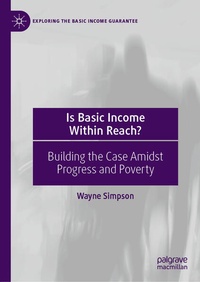
Is Basic Income Within Reach?
Description

This book examines the evolution of basic income policy and research in advanced economies and is divided into two parts. The first section considers the development of basic income as a social policy initiative in advanced (OECD) nations from the 1960s to today. It reviews what the negative income tax experiments accomplished, their limitations, and what they can lend to the design and implementation of basic income pilots or a full blown basic income program today. It also considers important developments and research in poverty and economic inequality and in technological change and labour market adjustment over the last half century. The second section focuses on the Canadian case, where the prospects for basic income are perhaps among the most promising. In addition to a review of Mincome and its lessons and limitations, this section considers important developments in poverty research by the Economic Council of Canada and the Canadian Senate in the 1960s,attempts at welfare reform, and the policy initiatives to develop a basic income for elderly Canadians that has endured to this day. Many of the important social and technological developments that are reviewed in the first part will be discussed in more detail with specific reference to the Canadian case. The evolution of the important policy innovations-the National Child Benefit and its successors and the Poverty Reduction Strategy-are outlined in detail and linked to other, more modest, income support initiatives such as the federal sales tax credit that provide a potential foundation for a comprehensive basic income plan in Canada. Research, including recent microsimulation studies of a basic income, are critically reviewed. Although the COVID-19 pandemic has increased interest in basic income to support those hardest hit, the book argues for careful design of basic income policies in its aftermath rather than simplistic adoption of emergency pandemic measures.
More details
Other editions
Additional editions
Person
Wayne Simpson is Professor in the Department of Economics at the University of Manitoba and a Research Fellow in the School of Public Policy at the University of Calgary, Canada. He received the 2014 Mike McCracken Award for Economic Statistics from the Canadian Economics Association and the 1999 John Vanderkamp prize for the best article in Canadian Public Policy . His recent research interests include balanced budget legislation, social assistance, and redistributive tax policies.
