

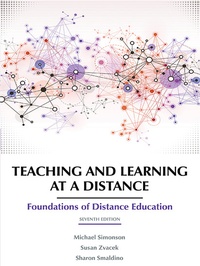
Teaching and Learning at a Distance
Foundations of Distance Education 7th Edition
1st Edition
Published on 7. January 2019
361 pages
978-1-64113-628-0 (ISBN)
Description

Teaching and Learning at a Distance is written for introductory distance education courses for preservice or in- service teachers, and for training programs that discuss teaching distant learners or managing distance education systems. This text provides readers with the basic information needed to be knowledgeable distance educators and leaders of distance education programs.
The teacher or trainer who uses this book will be able to distinguish between appropriate uses of distance education. In this text we take the following themes:
The first theme is the definition of distance education. Before we started writing the first edition of Teaching and Learning at a Distance we carefully reviewed the literature to determine the definition that would be at the foundation of our writing. This definition is based on the work of Desmond Keegan, but is unique to this book. This definition of distance education has been adopted by the Association for Educational Communications and Technology and by the Encyclopedia Britannica.
The second theme of the book was the importance of research to the development of the contents of the book. The best practices presented in Teaching and Learning at a Distance are validated by scientific evidence. Certainly there are "rules of thumb", but we have always attempted to only include recommendations that can be supported by research.
The third theme of Teaching and Learning at a Distance is derived from Richard Clark's famous quote published in the Review of Educational Research that states that media are mere vehicles that do not directly influence achievement. Clark's controversial work is discussed in the book, but is also fundamental to the book's advocacy for distance education - in other words, we authors did not make the claim that education delivered at a distance was inherently better than other ways people learn. Distance delivered instruction is not a "magical" approach that makes learners achieve more.
The fourth theme of the book is equivalency theory. Here we presented the concept that instruction should be provided to learners that is equivalent rather than identical to what might be delivered in a traditional environment. Equivalency theory helps the instructional designer approach the development of instruction for each learner without attempting to duplicate what happens in a face to face classroom.
The final theme for Teaching and Learning at a Distance is the idea that the book should be comprehensive - that it should cover as much of the various ways instruction is made available to distant learners as is possible. It should be a single source of information about the field.
The teacher or trainer who uses this book will be able to distinguish between appropriate uses of distance education. In this text we take the following themes:
The first theme is the definition of distance education. Before we started writing the first edition of Teaching and Learning at a Distance we carefully reviewed the literature to determine the definition that would be at the foundation of our writing. This definition is based on the work of Desmond Keegan, but is unique to this book. This definition of distance education has been adopted by the Association for Educational Communications and Technology and by the Encyclopedia Britannica.
The second theme of the book was the importance of research to the development of the contents of the book. The best practices presented in Teaching and Learning at a Distance are validated by scientific evidence. Certainly there are "rules of thumb", but we have always attempted to only include recommendations that can be supported by research.
The third theme of Teaching and Learning at a Distance is derived from Richard Clark's famous quote published in the Review of Educational Research that states that media are mere vehicles that do not directly influence achievement. Clark's controversial work is discussed in the book, but is also fundamental to the book's advocacy for distance education - in other words, we authors did not make the claim that education delivered at a distance was inherently better than other ways people learn. Distance delivered instruction is not a "magical" approach that makes learners achieve more.
The fourth theme of the book is equivalency theory. Here we presented the concept that instruction should be provided to learners that is equivalent rather than identical to what might be delivered in a traditional environment. Equivalency theory helps the instructional designer approach the development of instruction for each learner without attempting to duplicate what happens in a face to face classroom.
The final theme for Teaching and Learning at a Distance is the idea that the book should be comprehensive - that it should cover as much of the various ways instruction is made available to distant learners as is possible. It should be a single source of information about the field.
All prices
More details
Other editions
Additional editions
Michael Simonson | Susan Zvacek | Sharon Smaldino
Teaching and Learning at a Distance
Foundations of Distance Education
Book
07/2019
7th Edition
Information Age Publishing
€126.28
Article exhausted; check for reprint
Michael Simonson | Susan Zvacek | Sharon Smaldino
Teaching and Learning at a Distance
Foundations of Distance Education
Book
07/2019
7th Edition
Information Age Publishing
€81.90
Article exhausted; check for reprint
Content
- Intro
- ABOUT THE AUTHORS
- Brief Contents
- Part I n Foundations 1
- Part II n Teaching and Learning at a Distance 129
- Part III n Managing and Evaluating Distance Education 267
- Contents
- Preface xv
- Part I n Foundations 1
- Chapter 1 n Foundations of Distance Education 2
- Chapter 2 n Definitions, History, and Theories of Distance Education 31
- Chapter 3 n Research and Distance Education 62
- Chapter 4 n Technologies, the Internet, and Distance Education 79
- Part II n Teaching and Learning at a Distance 129
- Chapter 5 n Instructional Design for Distance Education 130
- Chapter 6 n Teaching and Distance Education 174
- Chapter 7 n The Student and Distance Education 198
- Chapter 8 n Support Materials and Visualization for Distance Education 216
- Chapter 9 n Assessment for Distance Education 237
- Part III n Managing and Evaluating Distance Education 267
- Chapter 10 n Intellectual Property: Ownership, Distribution, and Use 268
- Chapter 11 n Managing and Leading a Distance Education Organization 289
- Chapter 12 n Evaluating Teaching and Learning at a Distance 318
- Teaching and Learning at a Distance
- Foundations of Distance Education
- SEVENTH Edition
- Michael Simonson
- Nova Southeastern University
- Susan Zvacek
- SMZTeaching.com
- Sharon Smaldino
- Northern Illinois University
- Preface
- ORGANIZATION OF THE TEXT
- FEATURES OF THIS EDITION
- ADDITIONAL RESOURCES
- Support Materials for Teaching and Learning at a Distance: Foundations of Distance Education
- Chapter 1: Foundations of Distance Education
- Chapter 2: Definitions, History, and Theories of Distance Education
- Chapter 3: Research and Distance Education
- Chapter 4: Technologies, the Internet, and Distance Education
- Chapter 5: Instructional Design for Distance Education
- Chapter 6: Teaching and Distance Education
- Chapter 7: The Student and Distance Education
- Chapter 8: Support Materials and Visualization for Distance Education
- Chapter 9: Assessment for Distance Education
- Chapter 10: Intellectual Property: Ownership, Distribution, and Use
- Chapter 11: Managing and Leading a Distance Education Organization
- Chapter 12: Evaluating Teaching and Learning at a Distance
- ACKNOWLEDGMENTS
- P A R T
- 1
- CHEMISTRY AT A DISTANCE? A TRUE STORY
- DISTANCE EDUCATION TODAY AND TOMORROW
- THE EFFECTIVENESS OF DISTANCE EDUCATION-IN CASE YOU WONDER
- WHAT IS DISTANCE EDUCATION?
- FACTS ABOUT DISTANCE EDUCATION
- Distance Education as a Disruptive Technology
- MEDIA IN EDUCATION: EARLIER DEBATES
- STATUS OF DISTANCE EDUCATION
- Worldwide Examples
- 2. The Open University of Hong Kong opened in 1989 to serve residents of that huge metropolitan area. Recently, the university has begun to market itself to learners in China, and it has thousands of students from the mainland (Cohen, 2000). Unlike H...
- 3. In sub-Saharan Africa, political instability and economic depression have caused a decline in educational standards in some countries. As the population increased in these countries, a tremendous classroom shortage emerged, and both the number of ...
- 4. China developed a national higher distance education program in the late 1970s and early 1980s in response to a growth in population and a high cost per capita for the craft like approach to regular higher education in the country. Because China c...
- 5. Distance education has had a long history in European countries. The continuation of this tradition is evident in the vast array of programs offered by European Union countries. In some countries, open distance teaching universities offer the majo...
- United States
- 2. Will institutions embrace online education as a delivery method?
- 3. Will faculty embrace online education as a delivery method?
- 4. Will the quality of online education match that of face-to-face instruction?
- How Much Distance Education Is Too Much Distance Education?
- TELEMEDICINE
- 2. Use of telecommunications technologies
- 3. Interaction between individuals and/or resources
- and
- 4. Medical or health care.
- Background
- Applications
- Impediments to Telemedicine
- CHARACTERISTICS OF DISTANCE EDUCATION: TWO VISIONS
- The First Scenario-Distance Education in Schools
- The Second Scenario- Distance Education in the Corporation
- SUMMARY
- CASE STUDY
- DISCUSSION QUESTIONS
- 2. What is the fundamental characteristic of distance education? Discuss what this means. What are the various kinds of distance?
- 3. Learners prefer not to learn at a distance. Explain.
- 4. Richard Clark says media are "mere vehicles that deliver instruction but do not influence student achievement." Discuss Clark's analogy and decide if it is accurate. Are media vehicles? What does the word mere imply?
- 5. What do stirrups and distance education have in common? Discuss the concept of innovations and how they are used or not used. Has distance education changed teaching and learning?
- 6. Write a vision for a school 10 years from today-include a section on school security and distance education.
- REFERENCES
- SUGGESTED READINGS
- Foundations
- 1. Explain why students demand to learn at a distance even though they may prefer to learn in the classroom with the teacher and their classmates.
- 2. Define distance education.
- 3. Explain Coldeway's quadrants.
- 4. Discuss Richard Clark's "mere vehicles" quote as it relates to distance education.
- 5. Explain how Jim Finn might compare stirrups to distance education.
- 6. Give examples of how distance education is being used in several locations of the world and in the United States.
- 7. Discuss telemedicine and relate the topic to distance education. Explain a vision for education and schooling in the future.
- 8. Define disruptive technology and relate distance education to this concept.
- chapter 1
- Foundations of Distance Education
- DEFINING DISTANCE EDUCATION
- Related Terms
- 1. The quasi-permanent separation of teacher and learner throughout the length of the learning process (this distinguishes it from conventional, face-to-face education).
- 2. The influence of an educational organization both in the planning and preparation of learning materials and in the provision of student support services (this distinguishes it from private study and teach-yourself programs).
- 3. The use of technical media-print, audio, video, or computer-to unite teacher and learner and carry the content of the course.
- 4. The provision of two-way communication so that the student may benefit from or even initiate dialogue (this distinguishes it from other uses of technology in education).
- 5. The quasi-permanent absence of the learning group throughout the length of the learning process so that people are usually taught as individuals and not in groups, with the possibility of occasional meetings for both didactic and socialization pur...
- 1. Distance education implies that the majority of educational communication between (among) teacher and student(s) occurs noncontiguously.
- 2. Distance education must involve two-way communication between (among) teacher and student(s) for the purpose of facilitating and supporting the educational process.
- 3. Distance education uses technology to mediate the necessary two-way communication.
- EMERGING DEFINITIONS
- A BRIEF HISTORY OF DISTANCE EDUCATION
- Correspondence Study
- Electronic Communications
- Distance Teaching Universities
- Massive Open Online Courses (MOOCs)
- Educational Colonialism
- THEORY AND DISTANCE EDUCATION
- The Need for Theory
- Theory of Independent Study-Charles Wedemeyer
- 1. Be capable of operation anyplace where there are students-or even only one student-whether or not there are teachers at the same place at the same time
- 2. Place greater responsibility for learning on the student
- 3. Free faculty members from custodial-type duties so that more time can be given to truly educational tasks
- 4. Offer students and adults wider choices (more opportunities) in courses, formats, and methodologies
- 5. Use, as appropriate, all the teaching media and methods that have been proved effective
- 6. Mix media and methods so that each subject or unit within a subject is taught in the best way known
- 7. Cause the redesign and development of courses to fit into an "articulated media program"
- 8. Preserve and enhance opportunities for adaptation to individual differences
- 9. Evaluate student achievement simply, not by raising barriers concerned with the place, rate, method, or sequence of student study
- and
- 10. Permit students to start, stop, and learn at their own pace.
- 1. The student and teacher are separated.
- 2. The normal processes of teaching and learning are carried out in writing or through some other medium.
- 3. Teaching is individualized.
- 4. Learning takes place through the student's activity.
- 5. Learning is made convenient for the student in his or her own environment.
- 6. The learner takes responsibility for the pace of his or her own progress, with freedom to start and stop at any time.
- Theory of Independent Study and Theory of Transactional Distance-Michael Moore
- 1. Is the selection of learning objectives in the program the responsibility of the learner or of the teacher? (autonomy in setting of objectives)
- 2. Is the selection and use of resource persons, of bodies and other media, the decision of the teacher or the learner? (autonomy in methods of study)
- 3. Are the decisions about the method of evaluation and criteria to be used made by the learner or the teacher? (autonomy in evaluation)
- Theory of Industrialization of Teaching-Otto Peters
- Theory of Interaction and Communication- Börje Holmberg
- 1. The core of teaching is interaction between the teaching and learning parties
- it is assumed that simulated interaction through subject-matter presentation in preproduced courses can take over part of the interaction by causing students to conside...
- 2. Emotional involvement in the study and feelings of personal relation between the teaching and learning parties are likely to contribute to learning pleasure.
- 3. Learning pleasure supports student motivation.
- 4. Participation in decision making concerning the study is favorable to student motivation.
- 5. Strong student motivation facilitates learning.
- 6. A friendly, personal tone and easy access to the subject matter contribute to learning pleasure, support student motivation, and thus facilitate learning from the presentations of preproduced courses (i.e., from teaching in the form of one-way tra...
- 7. The effectiveness of teaching is demonstrated by students' learning of what has been taught.
- 1. Distance education serves individual learners who cannot or do not want to make use of face-to-face teaching. These learners are very heterogeneous.
- 2. Distance education means learners no longer have to be bound by decisions made by others about place of study, division of the year into study terms and vacations, timetables, and entry requirements. Distance education thus promotes students' fr...
- 3. Society benefits from distance education, on the one hand, from the liberal study opportunities it affords individual learners, and, on the other hand, from the professional/occupational training it provides.
- 4. Distance education is an instrument for recurrent and lifelong learning and for free access to learning opportunities and equity.
- 5. All learning concerned with the acquisition of cognitive knowledge and cognitive skills as well as affective learning and some psychomotor learning are effectively provided for by distance education. Distance education may inspire metacognitive ap...
- 6. Distance education is based on deep learning as an individual activity. Learning is guided and supported by noncontiguous means. Teaching and learning rely on mediated communication, usually based on preproduced courses.
- 7. Distance education is open to behaviorist, cognitive, constructivist, and other modes of learning. It has an element of industrialization with division of labor, use of mechanical devices, electronic data processing, and mass communication, usuall...
- 8. Personal relations, study pleasure, and empathy between students and those supporting them (tutors, counselors, etc.) are central to learning in distance education. Feelings of empathy and belonging promote students' motivation to learn and infl...
- Andragogy-Malcolm Knowles
- 1. The establishment of a climate conducive to adult learning, which includes a physical environment that is conducive to the physical well-being of the adult learner, and a psychological environment that provides for a feeling of mutual respect, col...
- 2. The creation of an organizational structure for participatory learning that includes planning groups where learners provide input about what is to be learned and options regarding learning activities.
- 3. The diagnosis of needs for learning that includes differentiating between felt needs and ascribed needs.
- 4. The formulation of directions for learning that includes objectives with terminal behaviors to be achieved and directions for improvement of abilities.
- 5. The development of a design for activities that clarifies resources and strategies to accomplish objectives.
- 6. The development of a plan that provides evidence when objectives are accomplished.
- 7. The use of quantitative and qualitative evaluation that provides a rediagnosis of needs for learning.
- A Synthesis of Existing Theories-Hilary Perraton
- Equivalency Theory: An American Theory of Distance Education
- A Theoretical Framework for Distance Education- Desmond Keegan
- 1. Is distance education an educational activity? Keegan's answer was that although distance education institutions possess some of the characteristics of businesses, rather than of traditional schools, their educational activities are dominant. Di...
- 2. Is distance education a form of conventional education? Keegan thought that because distance education is not based on interpersonal communication and is characterized by a privatization of institutionalized learning (as is conventional education)...
- However, Keegan considered virtual systems based on teaching face to face at a distance to be a new cognate field of study to distance education. He thought that a theoretical analysis of virtual education still needed to be addressed.
- 3. Is distance education possible, or is it a contradiction in terms? Keegan pointed out that if education requires intersubjectivity-a shared experience in which teacher and learner are united by a common zeal-then distance education is a contra...
- 1. The industrialization of teaching
- 2. The privatization of institutional learning
- 3. Change of administrative structure
- 4. Different plant and buildings
- and
- 5. Change of costing structures.
- 1. Distance students have a tendency to drop out of those institutions in which structures for the reintegration of the teaching acts are not satisfactorily achieved.
- 2. Distance students have difficulty achieving quality of learning in those institutions in which structures for the reintegration of the teaching acts are not satisfactorily achieved.
- 3. The status of learning at a distance may be questioned in those institutions in which the reintegration of the teaching acts is not satisfactorily achieved.
- Fordism, Neo-Fordism, Post-Fordism: A Theoretical Debate
- SUMMARY
- CASE STUDY
- DISCUSSION QUESTIONS
- 1. Why are there different definitions of distance education? Discuss and develop the definition that you feel is most appropriate.
- 2. Discuss Desmond Keegan's five main elements of the various definitions of distance education. Write a paragraph explaining which of the elements is most critical and which is least critical.
- 3. Many think that in the near future the concept of distance will become relatively unimportant. What do you think this means?
- 4. Correspondence study is a form of distance education that developed during World War II. Is correspondence study still important today?
- 5. What might be the reasons for the founding of special distance teaching universities. Why is there no national distance learning university in the United States?
- 6. Distance education has a long history in European countries. Why is distance learning more commonplace in Europe than in the United States?
- 7. Keegan writes that the lack of an accepted theory of distance education has weakened the field. Discuss the importance of theory and how theory helps the practitioner of distance education.
- 8. Wedemeyer has six characteristics of independent study systems. Why would Wedemeyer's perspective be important to American educators?
- 9. Explain the concept of the assembly line as it relates to the industrialization of teaching. Will industrialized education ever be important in American education? Explain.
- 10. Simonson proposed an emerging theory of distance education. What learning experiences are different for local and distant learners.
- REFERENCES
- 1. Discuss the reason for different definitions of distance education.
- 2. Describe the various definitions of distance education that have been offered.
- 3. List and explain the five main elements of the various definitions of distance education given by Keegan.
- 4. Give the emerging definition of distance education that is appropriate for the United States.
- 5. Outline the general history of distance education, explaining how it began with correspondence study and evolved into the use of electronic communications media.
- 6. Discuss the emergence of distance teaching universities.
- 7. Explain the various theoretical approaches to distance education, including theories of independence, industrialization, and interaction and communication.
- 8. Synthesize the various theories of distance education.
- 9. Describe the emerging theory of distance education that relates to equivalence of learning experiences.
- 10. Explain Fordism, neo-Fordism, and post-Fordism.
- chapter 2
- Definitions, History, and Theories of Distance Education
- Distance Education Research: Setting a Foundation
- THE FOCUS OF DISTANCE EDUCATION RESEARCH
- 1. The Council of Regional Accrediting Commissions (C-RAC, 2000). Statement of the regional accrediting commissions on the evaluation of electronically offered degree and certificate programs (www.wiche.edu/telecom/Guidelines.htm).
- 2. The Institute for Higher Education Policy (IHEP, 2000). Quality on the line: Benchmarks for success in Internet-based distance education (www.ihep.com/quality.pdf).
- 3. The American Council on Education (ACE, 1997). Guiding principles for distance learning in learning society (www.acenet.edu/calec/dist_learning/ dl_principlesIntro.cfm).
- 4. The American Distance Education Consortium (ADEC, n.d.a., n.d.b). Guiding principles for distance learning and Guiding principles for distance teaching and learning (www.adec.edu/admin/papers/distance-teaching_principles.html).
- 5. The American Federation of Teachers (AFT, 2000). Distance education: Guidelines for good practice (www.aft.org/higher_ed/downloadable/distance.pdf).
- 6. Open and Distance Learning Quality Council (ODLQC, 2001). Standards in open and distance education (www.odlqc.org.uk/st-int.htm).
- Trends in Distance Education Research
- LEARNING OUTCOMES
- A Recent Summary of the Research
- Research Reported
- LEARNER PERCEPTIONS
- LEARNER ATTRIBUTES
- INTERACTION
- BARRIERS TO DISTANCE EDUCATION
- 1. Increased time commitment
- 2. Lack of money to implement distance education programs
- 3. Organizational resistance to change
- 4. Lack of shared vision for distance education in the organization
- 5. Lack of support staff to help course development
- 6. Lack of strategic planning for distance education
- 7. Slow pace of implementation
- 8. Faculty compensation/incentives
- 9. Difficulty keeping up with technological changes
- 10. Lack of technology-enhanced classrooms, labs, or infrastructure
- 54. Competition with on-campus courses
- 55. Lack of personal technological expertise
- 56. Lack of acceptable use policy
- 57. Lack of transferability of credits
- 58. Problems with vast distances and time zones
- 59. Technology fee
- 60. Tuition rate
- 61. Local, state, or federal regulations
- 62. Ethical issues
- 63. Existing union contracts
- 64. Lack of parental involvement
- TELEMEDICINE/TELEHEALTH
- Cost Effectiveness of Telemedicine
- Telemedicine and Quality of Care
- Patient Satisfaction With Telemedicine
- MYTHS REGARDING DISTANCE EDUCATION RESEARCH
- SUMMARY
- Best Practices in Distance Education: A Summary of Findings Reported in This Chapter
- 1. Distance education works
- the literature clearly indicates that students learning in some type of distance learning environment will learn as much and as effectively as students learning in traditional, face-to-face environments. Advocates who say...
- 2. Student retention in distance education courses and programs is often lower than in traditional environments.
- 3. Instructor attitude toward teaching and learning at a distance is an important component of effectiveness.
- 4. Course quality is critical-quality is strongly related to student satisfaction.
- 5. A student's computer anxiety must be low or effectiveness suffers.
- 6. Course flexibility is an important characteristic of an effective distance delivered course.
- 7. Learning communities are important in distance education-instructors should encourage, even facilitate the development of learning communities.
- 8. Interaction in distance education is important-student to student and student to content interaction are most important, followed by student to instructor and instructor to student interaction.
- 9. Learner control and involvement in distance delivered instruction is important, not just a convenience.
- 10. Training of students and instructors learning and teaching at a distance is related to effectiveness and satisfaction.
- 11. Technical support for students and instructors is critical.
- 12. Distance education can be advocated because of the convenience afforded and the autonomy provided to learners.
- 13. Instructor expertise in distance education and instructor support are strong predictors of student learning and satisfaction.
- 14. Quality instruction delivered at a distance should be equivalent not identical to instruction delivered traditionally in a classroom when learning and satisfaction are measured.
- 15. Computer competency is related to student success in distance education.
- 16. Retention is related to student satisfaction in distance education courses and programs.
- 17. Frequency and quality of interaction is a key to effectiveness in distance education.
- 18. What works effectively in traditional education is a starting point for what works in distance education
- equivalency should be the goal.
- 19. Class size for one instructor in a distance education class should be about 20 students, plus or minus five, if effectiveness and satisfaction are outcome measures.
- 20. A one semester credit, college-level course delivered at a distance should require approximately 2,250 minutes of time (45, 50-minute hours) for the typical student- studying, reading, viewing, listening, writing, interacting, and producing.
- 21. Telemedicine/telehealth practices reduce healthcare costs significantly, and produces a high level of patient satisfaction.
- 22. Online students report they spend more time on their coursework than traditionally taught students.
- CASE STUDY
- DISCUSSION QUESTIONS
- 1. If only one conclusion could be made from the research about leaning at a distance, what would it be?
- 2. What is the trend of learner perceptions about learning at a distance?
- 3. Why is the recent meta-analysis report from the U.S. Department of Education important, and why might the results be suspect?
- REFERENCES
- 1. Explain research dealing with learning outcomes in distance education environments.
- 2. Explain research on learner perceptions concerning distance education.
- 3. Explain research on learner attributes and other variables in distance education situations.
- 4. Describe research related to interaction in distance education.
- 5. Summarize research on distance education.
- chapter 3
- Research and Distance Education
- A TRUE STORY
- A MODEL OF COMMUNICATION
- THE CONE OF EXPERIENCE
- A TAXONOMY OF DISTANCE EDUCATION TECHNOLOGIES
- Correspondence study
- Correspondence Study
- Prerecorded Media
- A podcast is a single idea that can be explained verbally, or if necessary with audio and appropriate still or motion pictures (not a face talking).
- 1. Listen. Few of us have access to recording studios for our podcasts, but the environment that you are recording in should be as quiet as possible. Turn off that fan, close the windows, tell your cubicle neighbor to turn off the radio, and so on. C...
- 2. Rehearse first, but record the rehearsal as well. Oftentimes, delivery during the rehearsal take is more lively and spontaneous than the "final" version. You may want to edit together the best parts of both attempts.
- 3. Provide the URLs for resources on a website or, even better, on a companion blog site, rather than tediously spelling out every underscore, dash, and dot verbally.
- 4. Keep it short. While there are podcasts that last for an hour or more, that is asking a lot of your audience? If you have more content to cover than that time will allow, give the listeners the option to download the show in multiple segments.
- 5. Don't go it alone. Find a colleague with an engaging personality, sense of humor, and clear speaking voice to join you during your recording sessions. Dialogue is more interesting to listen to than monologue, and it also takes some of the pressu...
- 6. Get feedback from your listeners. In order to ensure that you are meeting your audience's information needs, you should provide them with multiple methods of providing feedback on the show. Have them tweet you.
- Two-Way Audio
- Two-Way Audio With Visuals
- One-Way Live Video
- Two-Way Audio, One-Way Video
- Two-Way Audio/Video
- Local control of the distance education curriculum
- Desktop Two-Way Audio/Video
- A Look at Best Practice Issues
- Wireless Canopies
- DISTANCE EDUCATION CLASSROOMS
- Two-Way Video/Audio Classrooms
- Classroom Technologies for Online Instruction
- Selecting Appropriate Technologies for Online Instruction
- THE INTERNET-WHY DOES IT MATTER?
- Architecture of the Internet
- Are the Terms "Internet" and "World Wide Web" Interchangeable?
- FOUNDATIONS OF INTERNET-BASED DISTANCE EDUCATION
- Student-Centered Learning
- From lecturing to coaching
- Distance Learning Versus Distributed Learning
- Advantages and Limitations of Online Learning
- TECHNOLOGIES OF INTERNET-BASED DISTANCE EDUCATION
- WEB 2.0
- A Look at Best Practices-Web 2.0
- PEDAGOGIES OF INTERNET-BASED DISTANCE EDUCATION
- E-Learning Adoption Cycles
- Fundamentals of Teaching Online
- Stated purpose of the assignment.
- FUTURE OF ONLINE EDUCATION
- Growth of Virtual Schools and Universities
- Development of Standards and Learning Objects
- 1. Interoperability-can the system work with any other system?
- 2. Reusability-can courseware (learning objects, or "chunks") be reused?
- 3. Manageability-can a system track the appropriate information about the learner and the content?
- 4. Accessibility-can a learner access the appropriate content at the appropriate time?
- 5. Durability-will the technology evolve with the standards to avoid obsolescence?
- Potential Impact of Open Source
- A New Technology-Drones
- Another True Story
- Summary
- CASE STUDY
- DISCUSSION QUESTIONS
- 1. According to Dale's cone of experience, which is the most realistic, a video of a museum, or a field trip to the museum. What would make one experience more appropriate than the other?
- 2. Define noise and explain how noise influences the communication process. Put noise in the context of an online course.
- 3. Should traditional classrooms also be equipped to be distance classrooms? Why?
- 4. What are the most significant advantages of Internet-based instruction? Why?
- 5. Explain how an online course can be structured to be student centered. Give specific strategies.
- 6. What is one significant trend in online learning? Why?
- REFERENCES
- Best Practices
- Podcasting . or "Seeds Floated Down From the Sky"
- A podcast is a single idea that can be explained verbally, or if necessary with audio and appropriate still or motion pictures (not a face talking)
- And Finally, MOOC Madness
- 1. Describe systems for categorizing media used for distance education.
- 2. Explain the technologies used to connect teachers and learners for distance education, including correspondence, audio, video, and desktop systems.
- 3. Explain the configuration of a modern distance education classroom.
- 4. Understand the Internet and the World Wide Web and the relationship of both to the growth of distance education.
- chapter 4
- Technologies, the Internet, and Distance Education
- P A R T
- 2
- "Signal Fires?"
- WHY PLAN FOR TEACHING AT A DISTANCE?
- A Look at Best Practice Issues
- PRINCIPLES OF INSTRUCTIONAL DESIGN SYSTEMS
- Systematic Process
- Planning for Instruction at a Distance
- ISSUES TO ADDRESS IN THE PLANNING PROCESS
- Who Are the Learners?
- What Is Essential Content?
- What Teaching Strategies and Media Should Be Used?
- What Is the Learning Environment?
- A Look at Best Practice Issues
- Assumptions Made by Instructional Designers
- 1. Learners
- 2. Structure
- 3. Communication
- 4. Technology
- 5. Interaction
- 6. Literacy-visual and verbal learning
- 1. Assumptions About Online Learners
- 2. Assumptions About Online Course Structure
- 3. Assumptions About Communication
- 4. Assumptions About Technology
- 5. Assumptions About Interaction
- 6. Assumptions About Literacy-Visual and Verbal
- 7. Assumptions About Learning
- Course Management Systems
- Proprietary Versus Open Source
- Planning to Teach at a Distance
- How Do You Determine the Quality of the Instruction?
- A Look at Best Practice Issues
- What the Accreditation Community Is Saying About Quality in Distance Education
- OTHER ISSUES TO BE CONSIDERED
- Student Handouts
- Distribution of Materials
- MODELS FOR DESIGNING ONLINE COURSES
- 1. Linear-designed instruction (Figure 5-2)
- 2. Branched-designed instruction (Figure 5-3)
- 3. Hypercontent-designed instruction (Figure 5-4)
- 4. Learner-directed design (Figure 5-5)
- BEST PRACTICES IN COURSE DESIGN FOR DISTANCE EDUCATION
- 1. Good teaching matters. Quality design of learning activities is important for all delivery methods.
- 2. Each medium has its own aesthetic. Therefore, professional design is important.
- 3. Education technologies are flexible. They have their own unique characteristics but successful teaching can be achieved with any technology.
- 4. There is no "super-technology." Each has its strengths and weaknesses
- therefore, they need to be combined (an integrated mix).
- 5. Make multiple media available to teachers and learners. Print, audio, video, and computers should all be available.
- 6. Balance variety with economy. Using many technologies makes design more complex and expensive
- therefore, limit the range of technologies in a given circumstance.
- 7. Interaction is essential.
- 8. Student numbers are critical. The choice of a medium will depend greatly on the number of learners reached over the life of a course.
- 9. New technologies are not necessarily better than old ones.
- 10. Teachers need training to use technology effectively.
- 11. Teamwork is essential. No one person has all the skills to develop and deliver a distance learning course
- therefore, subject-matter experts, instructional designers, and media specialists are essential on every team.
- 12. Technology is not the issue. How and what we want the learners to learn is the issue and technology is a tool (p. 833).
- 1. They are based on clearly established learning needs and built around succinct statements of outcome.
- 2. They are based on a variety of teaching and learning strategies and methods that are activity based.
- 3. Effective distance learning materials are experiential they address the learner's life experience.
- 4. Quality distance learning programs are participatory in that they emphasize the involvement of the learner in all facets of program development and delivery.
- 5. Successful distance learning programs are interactive and allow frequent opportunities for participants to engage in a dialogue with subject-matter experts and other learners.
- 6. Learner support systems are an integral part of any successful distance learning program (p. 832).
- 1. Instructors should provide clear guidelines for interaction with students.
- 2. Well-designed discussion assignments facilitate meaningful cooperation among students.
- 3. Students should present course projects.
- 4. Instructors need to provide two types of feedback: information feedback and acknowledgment feedback.
- 5. Online courses need deadlines.
- 6. Challenging tasks, sample cases, and praise for quality work communicate high expectations.
- 7. Allowing students to choose project topics incorporates diverse views into online courses. (http://ts.mivu.org/default.asp?show+article&id=839)
- RECOMMENDATIONS FOR DISTANCE DELIVERED INSTRUCTION-THE UNIT-MODULE-TOPIC MODEL
- Organizational Guidelines
- Assessment Guidelines
- Content Guidelines
- Instruction/Teaching Guidelines
- COURSE MANAGEMENT SYSTEMS
- Components of a Course Management System
- Online Courses Have Three Critical Components (and Course Management Systems are Not One of Them)
- Products for Enhancing Course Management Systems
- Other Tools Supporting the Management of Online Courses
- A Look at Best Practices
- Designing an Online Program
- 1. First, an academic technology/distance education plan is needed. This plan includes the following components:
- 2. Next, a process for diffusion and implementation of distance education is needed. This process includes these components:
- SUMMARY
- DISCUSSION QUESTIONS
- 1. Why is the concept of instructional design so important to the field of distance education?
- 2. Why is it important to write performance objectives using the three components described in this chapter?
- 3. Discuss the building blocks for an online course-starting with units, then progressing to modules, and finishing with topics-the U-M-T approach.
- REFERENCES
- Best Practices for Distance Education: Designing the "Perfect*" Online Course
- Teaching and Learning at a Distance
- 1. Explain why it is important to plan ahead when teaching at a distance.
- 2. Describe a systematic design process for instructional design.
- 3. Describe the types of learner information to be collected for planning.
- 4. Explain the decisions about content that need to be made.
- 5. Explain why it is important to examine teaching strategies and media.
- 6. Discuss how technology and resources influence the distance learning environment.
- 7. Discuss the literature dealing with "best practices."
- 8. Design a course using the Unit-Module-Topic model.
- 9. Describe the process for assessment of learning.
- chapter 5
- Instructional Design for Distance Education
- Quality Instruction at a Distance
- TEACHING THE DISTANT LEARNER
- From Teacher-Centered to Student-Centered Learning
- Creating Communities of Learners
- Just-in-Time Teaching
- Distance Learning Versus Distributed Learning
- ASPECTS OF INSTRUCTION
- Structuring Instruction
- Instructional Methods
- Addressing Student Issues
- TECHNOLOGY CONSIDERATIONS
- Course Management Systems
- MOOCs
- Blogs and Wikis
- Managing Distance Learning Courses
- POLICY ISSUES RELATED TO TEACHING AT DISTANCE
- Faculty Issues
- Intellectual Freedom and Ownership/Property Rights
- Course Integrity
- Student Support
- 1. Equipment available for student use, such as computers with sufficient memory, scanners, video equipment, et cetera.
- 2. Available computer software and resource people to assist students at a distance
- 3. Communication resources students can access, such as e-mail, toll-free phone numbers, fax machines
- 4. Library and course resources for assignments and out-of-class work
- 5. Assignment distribution and collection options
- Institutional Aspects
- Legal Issues
- Technical Policies
- TEACHING AND DISTANCE EDUCATION- THE TIME COMMITMENT
- SUMMARY
- DISCUSSION QUESTIONS
- 1. What are some of the institutional factors that an instructor must consider when preparing to teach at a distance?
- 2. What strategies might be used to facilitate introductions among students?
- 3. What elements of class structure need to be included when preparing to teach at a distance?
- 4. Why is it necessary to determine resources available at distant sites when preparing to teach a distance course?
- 5. How is the instructor's role affected in a distance education environment?
- CASE STUDIES
- REFERENCES
- Books, Real and Otherwise
- 1. Describe the responsibilities of the instructor in distance education.
- 2. Explain the importance of creating a learning community.
- 3. Discuss issues related to course organization.
- 4. Identify ways to enhance delivery of instruction.
- 5. Discuss policy issues important to the instructor of distant learners.
- 6. Estimate the time needed to teach a course delivered at a distance.
- chapter 6
- Teaching and Distance Education
- An Emphasis on the Student
- TRAITS OF THE DISTANCE LEARNER
- Adult Learners
- K-12 Learners
- FACTORS INFLUENCING LEARNER SUCCESS
- Attitude Factors
- Experience
- Elements of Success
- LEARNER RESPONSIBILITIES
- Differences in Settings
- Time for Class
- Communication
- ENGAGEMENT
- Class Participation
- Assignments
- Assuming Responsibility for Own Learning
- Equipment Requirements and Use
- GENERATIONS OF LEARNERS
- Social Media and Online Learning-Pros and Cons
- 1. There is a greediness dimension to the use of social media. In other words, users want likes and expect repeated and rapid interaction.
- 2. Gluttony is another of the cons of social media in online learning. There is a need to know everything related to what is being examined and discussed.
- 3. There is a level of lustfulness when social media are used. I want this or that or everything. These three deadly sins-greed, gluttony, and lust-are related and harmful in the extreme.
- 4. Pleasure seeking is a documented consequence of social media use. Learners look for what makes them happy and contented, and this is often not what instructors want. Education must sometimes hurt a little.
- 5. Some students are afraid of social media uses in online instruction. They do not want to interact so often or in the level of detail that others in their class might want. Research shows that if someone is positive in social media, readers perceiv...
- 6. Unfortunately, instructional design, while important and even critical in any online instruction, is often ignored when social media are used. Social media are so easy that systematic planning is often ignored.
- 7. Feeling left out happens. If instructors and classmates do not respond in the manner of social media users, some wonder what has happened, or what did I do, or what did I miss.
- SUMMARY
- DISCUSSION QUESTIONS
- 1. Describe some characteristics of the distant learner. Discuss why these characteristics are important and how they relate to the characteristics of the traditional-setting learner.
- 2. Why is it important for an instructor to obtain information about distant students?
- 3. What are some responsibilities of the distant student in a synchronous distance education class? Why are these responsibilities important?
- 4. What are some responsibilities of the distant student in an asynchronous distance education class? How are these different from those in a synchronous distance class?
- CASE STUDIES
- 1. As Tracy Nelson prepares for her first online course, Introduction to Teaching, she discovers that there are a number of things being expected of her. She notes that are technical expectations, assignments with specific due dates, and the use of a...
- 2. Ruth Downer and Phyllis Alderman are middle school state history students who have been included in a special invitation-only videoconference class for accelerated students. This is their first time to take this type of class. They are good friend...
- 3. Carl Morris has been enrolled in a program at a nearby university. His program has taken on a blended approach with some courses offered only face to face, although others are totally online. His is aware that because he is a part-time student it ...
- REFERENCES
- The Home Office
- 1. A modern computer with monitor
- 2. Software-MS Office at a minimum
- 3. A desk
- 4. A chair
- 5. Lighting-ceiling and desktop
- 6. A high speed Internet connection-a cable modem for example
- 7. A wireless router
- 8. Telephone with speaker and cordless handset
- 9. Electrical outlets with surge protectors
- 10. An all-in-one printer (copier, printer, fax, scanner)
- 11. Back up drive
- 12. Uninterruptable power supply
- 13. File cabinet
- 14. Storage
- 15. Firesafe
- 16. Paper shredder
- 17. USB webcamera with built-in microphone
- 18. HDTV connected to cable
- 19. Supplies
- 20. Bookshelves
- 1. Identify the characteristics of the distant student.
- 2. Explain the responsibilities of the instructor for ensuring student participation.
- 3. Discuss the factors that ensure student success.
- 4. Describe the responsibilities of the student.
- chapter 7
- The Student and Distance Education
- Printed Media
- Best Practices-e-Books
- DISTANCE EDUCATION SYLLABUS
- Course Logistics
- Course Policies
- Instructional Activities
- Assessment Information
- Additional Information
- THE INTERACTIVE STUDY GUIDE
- GRAPHIC DESIGN PRINCIPLES
- Elements of Design
- Principles of Design
- 1. Use pointers, such as arrows.
- 2. Use color to emphasize.
- 3. Use large objects at the center of interest.
- 4. Use different shapes for the center of interest.
- 5. Use more elements of design to create the center of interest for a graphic and fewer for less important elements.
- WORD PICTURES
- 1. Emphasis should be placed on the types of symbols used.
- 2. They should cover chunks of information rather than entire documents.
- 3. Student attention can be maintained through the use of fill-ins.
- 4. They emphasize the logical sequence of the class presentation.
- 5. They provide a complete review of the class content.
- 6. They can also be used for display by overhead video cameras.
- 7. They are inexpensive to produce and duplicate.
- 8. They condense ideas into a few key words.
- 9. They should be designed to fit the format of television.
- 10. They apply principles of graphic design.
- 11. They emphasize communication via the visual sense.
- 12. They require the instructor to think visually rather than verbally.
- 1. The main ideas are clearly defined and placed in the center of the graphic.
- 2. The relative importance of a subidea is indicated by its proximity to the main idea.
- 3. Links between ideas are clearly indicated.
- 4. New information is easily added to a mind map because of its nonlinear structure.
- 1. Problem Solution. In this situation, students are presented with a real or contrived problem with elements provided about the situation that caused or have an impact on the problem. Students are then asked, often in online collaborative groups, to...
- 2. Time Sequence. This presentation involves organizing information in a list or sequence of events that unfold chronologically. The sequence can be presented by the instructor, or the elements of the sequence can be presented visually and students c...
- 3. Definitions. When a presentation is based on definitions, there is usually a statement of the concept to be defined
- a listing of its attributes
- and examples of how the term, phrase, or item is used. For example, terms in a chemistry laboratory e...
- 4. Cause and Effect. In this approach an event and its causes or antecedents are presented (Figure 8-14). For example, the heavy rains in California would be discussed and would be followed by an exploration of why the rains occurred, such as the i...
- VISUAL ANALOGIES
- WHAT ABOUT THE FLIPPED CLASSROOM?
- SUMMARY
- DISCUSSION QUESTIONS
- 1. Define visual analogy. Why are analogies important?
- 2. Develop a visual mnemonic or word picture for these concepts:
- 3. Write an analogy for these ideas:
- 4. Why are interactive study guides are important to the distance educator?
- REFERENCES
- 1. Develop a distance education course syllabus.
- 2. Use interactive study guides.
- 3. Apply graphic design principles.
- 4. Develop word pictures.
- 5. Develop visual mnemonics.
- chapter 8
- Support Materials and Visualization for Distance Education
- INTRODUCTION
- 1. What will students be able to do as a result of this instruction?
- 2. How might students demonstrate their progress toward (or mastery of) those goals?
- 3. What activities could they engage in to advance toward those goals?
- Purposes for Assessment
- Assessment and Instructional Design
- Formative and Summative Assessment
- The Affective Domain
- Feedback
- Assessment and Grading
- Characteristics of Useful Assessments
- Assessment Strategies
- Online Quizzes and Tests
- Asynchronous Communication
- Synchronous Communication
- Portfolios
- Graphic Organizers
- Lab Work
- Design Considerations
- Objective and Subjective Measures
- Rubrics
- Authenticity
- Structuring Assessments
- Facilitating Student Collaboration
- Academic Misconduct
- Plagiarism
- Cheating
- Deterring Academic Misconduct
- Trends in Assessment
- Automated Feedback and Scoring
- Adaptive Assessment
- Games for Assessment
- Summary
- Discussion Questions
- 1. Although instructional design models prescribe the development of assessment instruments or activities prior to instruction, many (if not most) teachers wait until after instruction to do this. What are some reasons this occurs, and how might it a...
- 2. An assignment that incorporates peer feedback can be an excellent instructional strategy when used appropriately. How would you structure such an activity to ensure that it's a learning experience for both the giver and receiver of the feedback?
- 3. Although scoring rubrics are generally considered useful for grading subjective assessments, they are not used as frequently as they might be because of the difficult of creating instruments that are reliable and fair. Why is this so difficult and...
- 4. Academic misconduct is considered a critical problem in education today. What measures might you undertake to deter cheating, plagiarism, or other unethical practices?
- References
- 1. Discuss the role of assessment in the instructional design process, especially for distance education.
- 2. Describe the characteristics of several types of assessment activities and the appropriate uses of each within a distance education environment.
- 3. Implement practical strategies for assessing learner progress in a distance education course.
- 4. Discuss issues related to academic misconduct and describe how cheating, plagiarism, and other forms of unethical behavior may be preempted or alleviated in a distance education course.
- 5. Describe assessment trends that are relevant to distance education.
- chapter 9
- Assessment for Distance Education
- P A R T
- 3
- Misconceptions About Copyright
- History of Copyright
- Exclusive Rights of Copyright Holders
- Reproduce the copyrighted work
- "The purpose and character of the use, including whether such use is of a commercial nature or is for nonprofit educational purposes.." Uses in a nonprofit, educational setting are more likely to be fair use than those in a corporate training o...
- Duration of Copyright
- Public Domain
- Digital Millennium Copyright Act
- A designated agent must be registered with the Copyright Office to receive copyright infringement complaints and respond appropriately. Instructions for registration of an agent and a list of agents may be found at the Copyright Office website. Proce...
- Technology, Education, and Copyright Harmonization (TEACH) Act
- Access to the digitized materials must be restricted to students enrolled in the course.
- User Training
- Printed Materials
- Video
- Photographs and Digital Images
- Only lawfully acquired analog images may be digitized.
- E-Mail, Websites, and Other Internet Resources
- 1. Begin by identifying who holds the copyright for the work. In most cases this is not difficult, but it's important to keep in mind that the original creator of the work might not be the copyright owner. It may be necessary to search online for i...
- 2. Contact the copyright owner by e-mail or telephone and describe the circumstances of your request. You should provide your name and contact information, identifying details of the work in question (title, URL, author, etc.), the reason for your re...
- 3. Get the permission in writing. The copyright holder may give an informal okay, but it is important to have an official record of your communications, the date permission was granted, and any conditions.
- Copyrighted Materials and Course Management Systems
- 1. What did you read in this chapter that alerted you to copyright infringements you have witnessed, either in the workplace or at your own educational setting? What was the most blatant copyright violation you've ever seen, and what was done about it
- 2. What did you read in this chapter that will change the way in which you use the IP of others?
- 3. You have been appointed chair of a committee to develop a copyright policy for your organization. This policy will cover employee and student use of IP for which ownership rests outside the organization (i.e., your organization does not own the co...
- 4. In order to comply with the requirements of the Digital Millennium Copyright Act, an educational organization must provide copyright training to its membership on a regular basis. What do you think would be the most effective means of providing th...
- 5. What are the potential advantages and disadvantages of promoting the use of open educational resources? Might some content creators feel that this devalues the work put into developing instructional materials?
- Copyright Law
- Fair Use
- Intellectual Property
- Copyright Clearances
- Open Educational Resources
- Managing and Evaluating Distance Education
- 1. Describe what is meant by "intellectual property" and explain why laws are necessary to protect it and how those laws evolved.
- 2. Explain the basic tenets of copyright law, including the rights granted to copyright holders in the United States, the four criteria for determining fair use, when and how a work might enter the public domain, and guidelines for use of others' w...
- 3. Request permission from a copyright holder to use his/her work for a distance education course. and
- 4. Describe the licensing options available via Creative Commons and how to identify open educational resources available for use in a distance education course.
- chapter 10
- Intellectual Property: Ownership, Distribution, and Use
- The Distance Learning Leader
- Management within the Context of Readiness
- Organizational Readiness
- Leadership and Direction for the Distance Education Program
- Planning for Distance Education
- Scope of Task in Developing Distance Courses and Programs
- Student Support
- Readiness of the Technology Infrastructure
- Institutional Policies
- Distance Education Policy
- Accessibility
- Quality Control
- Regulatory Issues
- Cost Issues
- Faculty Readiness
- Faculty Support
- Student Readiness
- Assessing Readiness
- Student Orientation to the Distance Education Program
- LOOKING FORWARD
- Microcredentials
- Learning Analytics
- The Future of Distance Learning Administration?
- The Road Ahead
- Discussion Questions
- 1. What would be your highest priorities in getting the program off the ground, and where would you start? Why are these the highest priority for you?
- 2. Specifically, how would you approach the planning issues related to faculty? Assume that instructors for the program would be drawn from existing faculty in the organization. What issues do you need to address, and how would you address them?
- 3. Assume that you would be the person responsible for selecting and training the program's faculty. What specific characteristics would you look for in these individuals, and why?
- 4. What procedures will you follow to effectively train the program faculty? What topics would you include and how would you structure the training, and why would you do it this way?
- 5. How would you approach the planning issues related to student support services for the new program? In other words, how would you determine if the existing student support infrastructure is sufficient for the program? If it isn't, what would you...
- 6. What steps would you take to ensure quality control of the new program?
- References
- 1. Describe the typical job functions of a distance education administrator.
- 2. Discuss the major areas of interest during the planning stage for distance education programs.
- 3. Identify the major distance education readiness issues related to the educational organization, faculty training, technology infrastructure, and policy development.
- 4. Discuss the procedures that can help ensure quality control of a distance education program.
- 5. Identify and discuss the regulatory issues that can affect a distance education program.
- 6. Describe the most critical issues related to the support of students enrolled in a distance education program.
- chapter 11
- Managing and Leading a Distance Education Organization
- RESEARCH AND EVALUATION
- EVALUATION AND DISTANCE EDUCATION-FIVE STEPS
- Level 1-Reactions (Did They Like It)
- Level 2-Learning
- Level 3-Transfer
- Level 4-Results
- Level 5-Return on Investment
- 1. First, it is necessary to collect Level 4 data to determine if there is a change in job or educational performance that is positive and also measurable? This assumes that there were evaluation data collected concerning the first four levels of the...
- 2. Second, evaluators need to identify the training that contributed to the change in performance. Testing can be used, as can control groups that receive different training, or no training at all.
- 3. Third, it is necessary to convert the results of training or education into monetary values. This often means a relatively subjective process must be undertaken to quantify outcomes related to the training.
- 4. Next, the evaluation process requires the determination of the total cost of training. This includes trainer costs, facilities expenses, materials purchased and other expenses.
- 5. Fifth, return on investment, or ROI, is determined by comparing the monetary benefits to the costs. In this manner, it is possible to quantify the impact of training, the effectiveness of education and the value of the instruction.
- EVALUATION AND THE OPEN UNIVERSITY
- 1. Measures of Activity. These measures are counts of the numbers of events, people, and objects. Administrative records often provide data for activity questions. Activity questions are ones such as:
- 2. Measures of Efficiency. Measures of efficiency are closely related to measures of activity, and often administrative records can be the source of efficiency information. Efficiency questions often asked are ones such as:
- 3. Measures of Outcomes. Measures of adequate learning are usually considered the most important measures of outcomes of distance education activities. Often, interviews with learners are used to supplement course grades in order to find students' ...
- 4. Measures of Program Aims. Some distance teaching programs specify their aims in terms of what and whom they intend to teach, and evaluation information is collected to establish the extent to which these aims were met. One common aim of distance e...
- 5. Measures of Policy. Evaluation in the policy area often takes the form of market research. Surveys of prospective students and employers can be used to determine the demand for distance education activities.
- 6. Measures of Organizations. Sometimes it is important to evaluate a distance education institution in terms of its internal organization and procedures. Evaluators sometimes are asked to monitor the process of course development or program delivery...
- QUALITY SCORECARD AND QUALITY MATTERS
- Evaluating Programs and Courses
- 1. Course Introduction
- 2. Course Organization and Accessibility
- 3. Learning Activities and Interaction
- 4. Assessment
- THE AEIOU APPROACH
- Component 1-Accountability
- Component 2-Effectiveness
- Component 3-Impact
- Component 4-Organizational Context
- Component 5-Unanticipated Consequences
- PROGRAM EVALUATION: EXAMPLES
- South Dakota
- Iowa
- STUDENT EVALUATION OF DISTANCE EDUCATION COURSES
- SUMMARY
- REFERENCES
- SUGGESTED READING
- 1. Differentiate between research and evaluation.
- 2. Define evaluation.
- 3. Explain the six categories of evaluation information: in measures of activity, efficiency, outcomes, program aims, policy, and organizations.
- 4. Describe the AEIOU approach to evaluation and its five levels- accountability, effectiveness, impact, organizational context, and unanticipated consequences.
- chapter 12
- Evaluating Teaching and Learning at a Distance
- Index

