

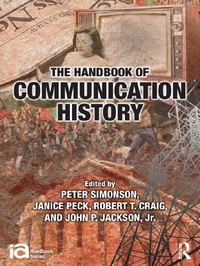
The Handbook of Communication History
1st Edition
Published on 3. January 2013
528 pages
978-1-136-51430-2 (ISBN)
Description

The Handbook of Communication History addresses central ideas, social practices, and media of communication as they have developed across time, cultures, and world geographical regions. It attends to both the varieties of communication in world history and the historical investigation of those forms in communication and media studies. The Handbook editors view communication as encompassing patterns, processes, and performances of social interaction, symbolic production, material exchange, institutional formation, social praxis, and discourse. As such, the history of communication cuts across social, cultural, intellectual, political, technological, institutional, and economic history.
The volume examines the history of communication history; the history of ideas of communication; the history of communication media; and the history of the field of communication. Readers will explore the history of the object under consideration (relevant practices, media, and ideas), review its manifestations in different regions and cultures (comparative dimensions), and orient toward current thinking and historical research on the topic (current state of the field). As a whole, the volume gathers disparate strands of communication history into one volume, offering an accessible and panoramic view of the development of communication over time and geographical places, and providing a catalyst to further work in communication history.
The volume examines the history of communication history; the history of ideas of communication; the history of communication media; and the history of the field of communication. Readers will explore the history of the object under consideration (relevant practices, media, and ideas), review its manifestations in different regions and cultures (comparative dimensions), and orient toward current thinking and historical research on the topic (current state of the field). As a whole, the volume gathers disparate strands of communication history into one volume, offering an accessible and panoramic view of the development of communication over time and geographical places, and providing a catalyst to further work in communication history.
Reviews / Votes
"The Handbook of Communication History is an important contribution to valuing ideas, social practices and media communication as they have developed over time, past cultures and the history of world geographical regions. The comparative aspects of many of the chapters also add genuine value to the editorial aim of shifting our gaze not only into history but across national and international borders and is highly commendable."- Simon Cross, Nottingham Trent University, UK, in European Journal of Communication
"This book is a unique collection of research on a critical part of the communication field. It suggests that unless we become more reflexive on what research we are doing, the field will continue to grow without direction... I recommend the book for all researchers in the field."
- Emile McAnany, Santa Clara University, Communication Research Trends
More details
Series
Edition
1. Auflage
Language
English
Place of publication
London
United Kingdom
Publishing group
Taylor & Francis Ltd
Target group
College/higher education
Professional and scholarly
Product notice
Reflowable
File size
3,91 MB
ISBN-13
978-1-136-51430-2 (9781136514302)
Copyright in bibliographic data and cover images is held by Nielsen Book Services Limited or by the publishers or by their respective licensors: all rights reserved.
Schweitzer Classification
Other editions
Additional editions
Peter Simonson | Janice Peck | Robert T. Craig
The Handbook of Communication History
Book
12/2012
1st Edition
Routledge
€488.90
Shipment within 15-20 days
Peter Simonson | Janice Peck | Robert T. Craig
The Handbook of Communication History
Book
12/2012
1st Edition
Routledge
€170.20
Shipment within 15-20 days
Persons
Peter Simonson is an Associate Professor in the Department of Communication at the University of Colorado at Boulder.
Janice Peck is Associate Professor in the School of Journalism and Mass Communication at UC Boulder.
Robert T. Craig is Professor in the Department of Communication at UC Boulder.
John P. Jackson, Jr., is Associate Professor in the Department of Communication at UC Boulder.
Janice Peck is Associate Professor in the School of Journalism and Mass Communication at UC Boulder.
Robert T. Craig is Professor in the Department of Communication at UC Boulder.
John P. Jackson, Jr., is Associate Professor in the Department of Communication at UC Boulder.
Content
Series Editor's ForewordRobert T. Craig
IntroductionPeter Simonson, Janice Peck, Robert T. Craig, and John P. Jackson, Jr.
1. FieldThe History of Communication History. Peter Simonson, Janice Peck, Robert T. Craig, and John P. Jackson, Jr.Media. David Crowley and Paul HeyerCommunication Research. Jefferson D. Pooley and David W. Park2. ModesAudiences: Publics, Crowds, Mass. Richard ButschRhetoric in Cross-Cultural Perspectives. C. Jan SwearingenConversation. Peter BurkeVisual Communication. Michael GriffinCommunication in Music. Christian Kaden
3. Media Print Culture. Ronald J. Zboray and Mary Saracino ZborayJournalism. John NeroneTelecommunications. Gabriele BalbiRadio Broadcasting. Christopher H. SterlingTelevision. Andreas FickersNew Media. Benjamin Peters and Rasmus Kleis Nielsen
4. Society The City. Juraj KittlerScience Communication. Joan LeachPolitics. Josef SeethalerLabor. Nathan GodfriedWar. Mette MortensenGender and Media: A Very Short Herstory. Karen RossRace. Murali Balaji and Letrell D. CrittendenOrganizing. Karen Lee Ashcraft and Pushkala Prasad
5. World Rhetoric in Latin America. Susan Romano'Cultural Imperialism' Revisited: The Case of Broadcasting in Latin America, India, and China. John SinclairCommunication in Colonial and Post-Colonial Southern Africa. Donal P. McCracken and Ruth E. Teer-TomaselliIslam, Mediation and Technology. Nabil EchchabiJewish Media and Communication in the Modern Age. Gideon KoutsEast Asian Communication Studies. Guo-Ming Chen, Akira Miyahara, and Min-Sun Kim
Epilogue: The Futures of Communication. Lucien Sfez
IntroductionPeter Simonson, Janice Peck, Robert T. Craig, and John P. Jackson, Jr.
1. FieldThe History of Communication History. Peter Simonson, Janice Peck, Robert T. Craig, and John P. Jackson, Jr.Media. David Crowley and Paul HeyerCommunication Research. Jefferson D. Pooley and David W. Park2. ModesAudiences: Publics, Crowds, Mass. Richard ButschRhetoric in Cross-Cultural Perspectives. C. Jan SwearingenConversation. Peter BurkeVisual Communication. Michael GriffinCommunication in Music. Christian Kaden
3. Media Print Culture. Ronald J. Zboray and Mary Saracino ZborayJournalism. John NeroneTelecommunications. Gabriele BalbiRadio Broadcasting. Christopher H. SterlingTelevision. Andreas FickersNew Media. Benjamin Peters and Rasmus Kleis Nielsen
4. Society The City. Juraj KittlerScience Communication. Joan LeachPolitics. Josef SeethalerLabor. Nathan GodfriedWar. Mette MortensenGender and Media: A Very Short Herstory. Karen RossRace. Murali Balaji and Letrell D. CrittendenOrganizing. Karen Lee Ashcraft and Pushkala Prasad
5. World Rhetoric in Latin America. Susan Romano'Cultural Imperialism' Revisited: The Case of Broadcasting in Latin America, India, and China. John SinclairCommunication in Colonial and Post-Colonial Southern Africa. Donal P. McCracken and Ruth E. Teer-TomaselliIslam, Mediation and Technology. Nabil EchchabiJewish Media and Communication in the Modern Age. Gideon KoutsEast Asian Communication Studies. Guo-Ming Chen, Akira Miyahara, and Min-Sun Kim
Epilogue: The Futures of Communication. Lucien Sfez
