

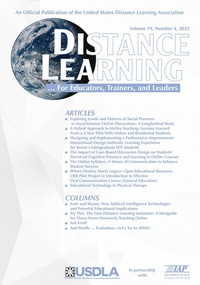
Distance Learning
Volume 19 #4
1st Edition
Published on 1. December 2022
127 pages
979-8-88730-235-5 (ISBN)
Description

Distance Learning is for leaders, practitioners, and decision makers in the fields of distance learning, e-learning, telecommunications, and related areas. It is a professional journal with applicable information for those involved with providing instruction to all kinds of learners, of all ages, using telecommunications technologies of all types. Stories are written by practitioners for practitioners with the intent of providing usable information and ideas. Articles are accepted from authors--new and experienced--with interesting and important information about the effective practice of distance teaching and learning.Distance Learning is published quarterly. Each issue includes eight to ten articles and three to four columns, including the highly regarded And Finally... column covering recent important issues in the field and written by Distance Learning editor, Michael Simonson. Articles are written by practitioners from various countries and locations, nationally and internationally.
More details
Other editions
Additional editions

Michael Simonson
Distance Learning Vol 19 Issue 4
Book
05/2023
Information Age Publishing
€47.00
Article not available at the moment
Content
- Intro
- Articles
- Exploring Levels and Patterns of Social Presence in Asynchronous Online Discussions: A Longitudinal Study
- 19
- A Hybrid Approach to HyFlex Teaching: Lessons Learned From a 2-Year Pilot With Online and Residential Students
- 39
- Designing and Implementing a Performance Improvement/ Instructional Design Authentic Learning Capstone Experience
- 51
- The Impact of Case-Based Discussion Design on Students' Perceived Cognitive Presence and Learning in Online Courses
- 69
- The Online Syllabus: A Means of Communication to Enhance Student Success
- 81
- Where Destiny Meets Legacy: Open Educational Resource, OER Pilot Project in Introduction to Effective Oral Communication Course (General Education)
- Short Paper
- Educational Technology in Physical Therapy
- Columns
- Get Your Copy Today- Information Age Publishing www.infoagepub.com
- Exploring Levels and Patterns of Social Presence in Asynchronous Online Discussions
- A Longitudinal Study
- Qi Wu, Tiffany A. Koszalka, and Zhijuan Niu
- A positive online learning community fosters active social interaction and deep social connectedness among learners. Social presence in asynchronous online discussions (AODs) is critical to forming an active learning community. Observation techniques...
- Introduction
- Literature Review
- Social Interaction in Asynchronous Online Discussions
- Social Presence in Asynchronous Online Discussions
- The Current Study
- Table 1. Summary of Fall 2020 and Spring 2021 Courses
- Research Questions
- 1. What were the patterns of SP identified within a single cohort of students in AODs across two online courses over two semesters?
- 2. What were the levels of SP noted within a single cohort of students in AODs across two online courses over two semesters?
- 3. How did social interaction and SP emerge in AODs across two online courses over two semesters? Did they remain consistent or appear different?
- Methodology, Data Collection, and Analysis
- Results
- Participants
- Learner Participation
- Table 2. Summary of Students' Participation for Fall 2020 and Spring 2021 AODs
- 12
- 12
- 276 (2,054)
- 289 (1,698)
- 63 (467)
- 60 (316)
- 46 (331)
- 52 (253)
- 46 (383)
- 67 (369)
- 50 (332)
- 55 (325)
- 71 (541)
- 55 (435)
- 55 (411)
- 58 (340)
- Table 3. Descriptive Statistics of Social Presence for Fall 2020 and Spring 2021 AODs
- 188
- 37.6
- 11.87
- 257
- 51.4
- 16.17
- 58
- 11.6
- 7.77
- 82
- 16.4
- 4.28
- 30
- 6
- 3.39
- 14
- 2.8
- 2.17
- 20
- 4
- 1.58
- 21
- 4.2
- 2.95
- 80
- 16
- 7.58
- 140
- 28
- 13.45
- 451
- 90.2
- 17.12
- 380
- 76.0
- 14.02
- 129
- 25.8
- 4.76
- 127
- 25.4
- 7.64
- 87
- 17.4
- 7.09
- 63
- 12.6
- 2.97
- 61
- 12.2
- 9.88
- 35
- 7
- 3.74
- 174
- 34.8
- 9.73
- 155
- 31
- 6.4
- 493
- 98.6
- 24.55
- 506
- 101.2
- 27.66
- 27
- 5.4
- 2.97
- 13
- 2.6
- .55
- 234
- 46.8
- 4.91
- 248
- 49.6
- 13.69
- 214
- 42.8
- 18.83
- 245
- 49
- 15.44
- 18
- 3.6
- 5.86
- 0
- 0
- 0
- 1,132
- 226.4
- 30.45
- 1,143
- 228.6
- 36.61
- Social Presence Category Pattern
- Social Presence Indicator Pattern
- Levels of Social Presence Categories
- Table 4. Levels of Social Presence Across Fall 2020 and Spring 2021 Courses
- 188
- 0.091
- 257
- 0.151
- 0.061
- 58
- 0.028
- 82
- 0.048
- 0.02
- 30
- 0.014
- 14
- 0.008
- -0.006-
- 20
- 0.009
- 21
- 0.012
- 0.003
- 80
- 0.039
- 140
- 0.082
- 0.043
- 451
- 0.220
- 380
- 0.223
- 0.003
- 129
- 0.063
- 127
- 0.075
- 0.012
- 87
- 0.042
- 63
- 0.037
- -0.005-
- 61
- 0.030
- 35
- 0.021
- -0.009-
- 174
- 0.085
- 155
- 0.091
- 0.006
- 493
- 0.240
- 506
- 0.300
- 0.060
- 27
- 0.013
- 13
- 0.008
- -0.005-
- 234
- 0.113
- 248
- 0.150
- 0.037
- 214
- 0.104
- 245
- 0.144
- 0.040
- 18
- 0.009
- 0
- 0
- -0.009-
- 1,132
- 0.551
- 1,143
- 0.673
- 0.122
- Levels of Social Presence Indicators
- Levels of Social Presence by Each AOD
- Levels of Social Presence by Each Student
- Student Interaction and Relationship Patterns
- Table 5. Level of Social Presence Categories by Individual
- 185
- 170
- 82
- (0.44)
- 112
- (0.66)
- 12
- (0.06)
- 24
- (0.14)
- 36
- (0.19)
- 42
- (0.25)
- 34
- (0.18)
- 46
- (0.27)
- 156
- 88
- 72
- (0.46)
- 54
- (0.61)
- 3
- (0.02)
- 17
- (0.19)
- 37
- (0.24)
- 9
- (0.10)
- 32
- (0.21)
- 28
- (0.32)
- 117
- 118
- 80
- (0.68)
- 84
- (0.71)
- 26
- (0.22)
- 33
- (0.28)
- 23
- (0.20)
- 17
- (0.14)
- 31
- (0.26)
- 34
- (0.29)
- 174
- 116
- 142
- (0.82)
- 94
- (0.81)
- 50
- (0.29)
- 41
- (0.35)
- 47
- (0.27)
- 11
- (0.09)
- 45
- (0.26)
- 42
- (0.36)
- 162
- 171
- 107
- (0.66)
- 130
- (0.76)
- 10
- (0.06)
- 22
- (0.13)
- 43
- (0.27)
- 44
- (0.26)
- 54
- (0.33)
- 64
- (0.37)
- 93
- 179
- 61
- (0.66)
- 119
- (0.67)
- 11
- (0.12)
- 17
- (0.09)
- 18
- (0.19)
- 50
- (0.28)
- 32
- (0.34)
- 52
- 0.29)
- 151
- 76
- 50
- (0.33)
- 40
- (0.53)
- 9
- (0.06)
- 8
- (0.11)
- 18
- (0.12)
- 10
- (0.13)
- 23
- (0.15)
- 22
- (0.29)
- 188
- 145
- 100
- (0.53)
- 96
- (0.66)
- 13
- (0.07)
- 14
- (0.10)
- 50
- (0.27)
- 47
- (0.32)
- 37
- (0.20)
- 35
- (0.24)
- 81
- 86
- 63
- (0.78)
- 67
- (0.78)
- 2
- (0.02)
- 9
- (0.10)
- 29
- (0.36)
- 28
- (0.33)
- 32
- (0.40)
- 30
- (0.35)
- 246
- 251
- 119
- (0.48)
- 174
- (0.69)
- 14
- (0.06)
- 37
- (0.15)
- 53
- (0.22)
- 62
- (0.25)
- 52
- (0.21)
- 75
- (0.30)
- 184
- 149
- 100
- (0.54)
- 82
- (0.55)
- 18
- (0.10)
- 16
- (0.11)
- 29
- (0.16)
- 27
- (0.18)
- 53
- (0.29)
- 39
- (0.26)
- 278
- 96
- 141
- (0.51)
- 61
- (0.64)
- 19
- (0.07)
- 8
- (0.08)
- 57
- (0.21)
- 21
- (0.22)
- 65
- (0.23)
- 32
- (0.33)
- 39
- 55
- 15
- (0.38)
- 30
- (0.55)
- 1
- (0.02)
- 11
- (0.2)
- 11
- (0.28)
- 12
- (0.22)
- 3
- (0.08)
- 7
- (0.13)
- Discussion
- Instruction Stages
- Social Interaction and Social Presence
- Instructor Involvement
- Conclusion
- References
- Appendix: Coding Schemes
- A Hybrid Approach to HyFlex Teaching
- Lessons Learned From a 2-Year Pilot With Online and Residential Students
- Matthea Marquart, Elise Verdooner, Martin Englisher, Joanne Standlee, and Valerie Samuel
- Colleges and universities are exploring the possibilities of teaching residential and online students simultaneously, within one course, via a modality commonly known as hybrid flexible, or HyFlex, and known by other names, including blended, blended...
- Keywords: blended, blended synchronous learning, blendflex, gxLearning, hybrid, Hyflex, hyhlex blended, online teaching, remote live participation, SLIDE, synchromodal, synchronous hybrid learning
- Literature Review
- Table 1. A Reference of Schools, the Teaching Model Used, and Unique Characteristics of the Model
- Table 1. Continued
- Intro to Columbia University School of Social Work's Remote Live Participation Pilot
- Logistics During the Pilot: Year 1
- Logistics During the Pilot: Year 2
- The Instructor Experience and Advice for Instructors: Year 1
- The Instructor Experience and Advice for Instructors: Year 2
- The Associate Experience and Advice for Associates: Year 1
- The Associate Experience and Advice for Associates: Year 2
- The Student Experience and Advice for Students: Year 1
- Conclusion
- References
- Designing and Implementing a Performance Improvement/ Instructional Design Authentic Learning Cohort Experience
- Anthony Tolson and Holley Handley
- Providing authentic learning experiences to connect theory to practice is a principal component of effective distance/online education. Authentic learning prepares students for the workforce. This article will describe the process of designing, deliv...
- Keywords: process improvement, capstone course, senior, students, authentic learning, problem-solving
- Opportunity for Improvement
- Review of Relevant Research
- 1. effectively communicate orally,
- 2. work effectively with differing perspectives in a team dynamic,
- 3. Effectively communicate through writing,
- 4. perform ethical judgment and decision-making,
- 5. critically think and utilize analytical reasoning skills, and
- 6. apply knowledge and skills to a real- world setting.
- High Impact Practices
- Connecting Research, Education, and Practice
- Design
- Project Execution
- Table 1. Project Timeline
- Outcomes
- Future Considerations
- Author Note
- References
- The Impact of Case-Based Discussion Design on Students' Perceived Cognitive Presence and Learning in Online Courses
- Ayesha Sadaf, Stella Y Kim, and Leonardo Herrera
- This study examined the impact of online case-based discussions on students' perceived cognitive presence and learning outcomes and the design elements that contribute to students' learning. Eighty graduate students enrolled in an online instruc...
- Keywords: online case-based discussion, cognitive presence, perceived learning, online case-based discussion design, learning outcomes
- Introduction
- Literature Review
- Cognitive Presence in Online Discussions
- Perceived Learning and Grades
- Online Case-Based Discussions
- Online Case-Based Discussion Design
- Purpose of Study
- 1. What is the impact of OCBD on students' perceived cognitive presence and learning?
- 2. What is the relationship between perceived cognitive presence, learning, and grades in OCBD?
- 3. What is the relationship between each indicator of perceived cognitive presence levels in OCBD and the course grade?
- 4. What are student perceptions of the design elements of OCBD that contribute to their cognitive presence and learning?
- Methods
- Participants
- Context of the Study
- Data Collection
- Data Analysis
- Validity and Reliability
- Results
- Table 1. Students' Level of Cognitive Presence and Learning in OCBD (n = 80)
- 4.17
- 0.62
- 4.13
- 0.66
- 4.19
- 0.71
- 4.29
- 0.67
- 4.15
- 0.80
- Table 2. Pearson Correlation Coefficients Between Cognitive Presence, Learning, Discussion Grades, and Course Grade (N = 80)
- 0.020
- 0.085
- 0.491**
- Table 3. Pearson Correlation Coefficients Between Course Grade and Each Indicator of Cognitive Presence
- 0.351
- 0.389
- 0.138
- 0.108
- 0.044
- 0.176
- 0.311
- 0.052
- 0.098
- 0.029
- 0.061
- 0.333
- Discussion Task
- Initial Questions
- Embedded Peer Interaction
- Relevant Topic
- Well-Structured Activities
- Discussion
- Conclusion and Implications
- Limitations and Future Research
- References
- Appendix: Online Survey
- m
- m
- m
- m
- m
- m
- m
- m
- m
- m
- m
- m
- m
- m
- m
- m
- m
- m
- m
- m
- m
- m
- m
- m
- m
- m
- m
- m
- m
- m
- m
- m
- m
- m
- m
- m
- m
- m
- m
- m
- m
- m
- m
- m
- m
- m
- m
- m
- m
- m
- m
- m
- m
- m
- m
- m
- m
- m
- m
- m
- m
- m
- m
- m
- m
- m
- m
- m
- m
- m
- Demographic questions:
- The Online Syllabus
- A Means of Communication to Enhance Student Success
- Tricia M. Mikolon, Brooke Nelson Murphy, and Erin Justice
- The syllabus has consistently provided educators and students with a foundation for their courses. The change in higher education brought on by COVID-19 highlights many necessary changes in the syllabus to communicate more effectively between educato...
- Keywords: syllabus, communication, online learning, student success
- History of the Syllabus: Synchronous Versus Asynchronous
- The Evolution of the Syllabus
- Changes in the Online Student Profile
- Understanding Technology in the Classroom
- Institutional Responsibilities for Technology
- Implications for the Educator
- Understanding Online Education
- What Is the Syllabus?
- Importance of Communication in Online Education
- Means to Increase Accountability of the Student
- A Brief Overview of the Content to Include Unique to Online
- Liability Coverage for Educators
- Summary
- References
- Where Destiny Meets Legacy
- Open Educational Resource, OER Pilot Project in Introduction to Effective Oral Communication Course (General Education)
- Kekeli Kwabla Nuviadenu
- Introduction
- Literature Review
- Methodology
- Findings
- Table 1. ELOA Pre-OER 2014-2017
- 2017-2018
- 644
- 510
- 480
- 94%
- Met
- 2016-2017
- 609
- 438
- 397
- 91%
- Met
- 2015-2016
- 289
- 165
- 162
- 98%
- Met
- 2014-2015
- 769
- 519
- 500
- 96%
- Met
- Table 2. ELOA OER Pilot Project Fall 2018
- Fall 2018
- 5
- 5
- 5
- 100%
- Met
- Table 3. ELOA OER Pilot Project Online Sections Spring 2019
- Academic Year
- Enrolled
- Students
- ELOA
- ELOA%
- Met or Unmet
- Spring 2019
- 69
- 46
- 46
- 100%
- Met
- Table 4. ELOA OER All Sections 2018-2022
- 2021-2022
- 430
- 370
- 353
- 95%
- Met
- 2020-2021
- 480
- 371
- 328
- 88%
- Unmet
- 2019-2020
- 559
- 502
- 440
- 88%
- Unmet
- 2018-2019
- 668
- 483
- 434
- 90%
- Met
- Conclusions
- References
- Educational Technology in Physical Therapy
- Cynthia Slomowitz
- Setting the Stage
- Implementation of Strategies
- Telehealth
- References
- New Artificial Intelligence Technologies and Potential Educational Implications
- Ryan Watkins, Natalie B. Milman, and Michael Corry
- What Happened?
- Implications
- First Do No Harm (Primum Non Nocere)
- Recommendations
- 1. Test drive the tools for yourself. You can best understand the potentials (positive and negative) if you first understand the capabilities of the tools.
- 2. Take time to reflect on the ethical implications of using AI tools. Discuss these reflections with colleagues and students.
- 3. Consider how AI tools might impact educational policies currently in place or ones that should be developed.
- 4. Provide ethics and plagiarism resources to your students to ensure that they are knowledgeable of the context for the expectations you set.
- 5. Do not panic and avoid "knee jerk reactions."
- 6. Be careful not to anthropomorphize these technologies (e.g., avoid "chatGPT knows .", or "the AI thinks .").
- 7. Remain flexible since your policies and practices will likely have to change as AI tools evolve.
- 8. Look for opportunities. Though changes (to your course assignments, for instance) will require work, there are going to be opportunities to use AI technologies to achieve teaching/ research goals that you could not achieve before.
- References
- Get Your Copy Today-Information Age Publishing
- Get Your Copy Today-Information Age Publishing
- The New Distance Learning Instructor
- A Miniguide for Those Never Previously Teaching Online
- Errol Craig Sull
- Get to Know Training (If Applicable)
- Ask These Instructors for Online Areas of Weakness and Strength
- Have a Detailed Checklist
- Be Sure There Is a Veteran "Shadow" in the First Two Courses
- Have a Phone Call Every 2 Weeks
- Offer a Minievaluation at the End of First Course
- Be Sure to Have a "We Are so Glad You Are Here!" Personality
- Have the New Instructor Keep a List of Questions, Problems, Et Cetera During the First Class
- Include a Session on Language and "Political Correctness"
- Make Available Important Contacts
- Encourage the Personalization of the New Online Educator's Course-As Much as Is Allowed
- Ask Errol!
- Errol Craig Sull
- Interacting With an ESL Student Where No ESL Course Exists
- Giving a Crucial Boost to a Conference Proposal
- Overkill of Engagement Efforts
- Get Your Copy Today-Information Age Publishing
- Evaluation- Let's Try to AEIOU
- Michael Simonson
- Component 1-Accountability
- Component 2-Effectiveness
- Component 3-Impact
- Component 4- Organizational Context
- Component 5- Unanticipated Consequences
- References
