

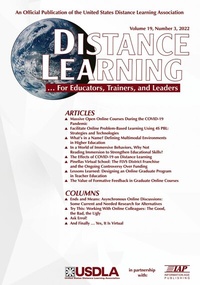
Distance Learning
Volume 19 #3
1st Edition
Published on 1. November 2022
99 pages
979-8-88730-197-6 (ISBN)
Description

Distance Learning is for leaders, practitioners, and decision makers in the fields of distance learning, e-learning, telecommunications, and related areas. It is a professional journal with applicable information for those involved with providing instruction to all kinds of learners, of all ages, using telecommunications technologies of all types. Stories are written by practitioners for practitioners with the intent of providing usable information and ideas. Articles are accepted from authors--new and experienced--with interesting and important information about the effective practice of distance teaching and learning.Distance Learning is published quarterly. Each issue includes eight to ten articles and three to four columns, including the highly regarded And Finally... column covering recent important issues in the field and written by Distance Learning editor, Michael Simonson. Articles are written by practitioners from various countries and locations, nationally and internationally.
More details
Other editions
Additional editions
Michael Simonson
Distance Learning Vol 19 Issue 3
Book
04/2023
Information Age Publishing
€47.00
Shipment within 10-20 days
Content
- Intro
- Contents - Articles
- 01
- Massive Open Online Courses During the COVID-19 Pandemic
- 07
- Facilitate Online Problem-Based Learning Using 4S PBL: Strategies and Technologies
- 25
- What's in a Name? Defining Multimodal Environments in Higher Education
- 39
- In a World of Immersive Behaviors, Why Not Reading Immersion to Strengthen Educational Skills?
- 43
- The Effects of COVID-19 on Distance Learning
- 47
- Pinellas Virtual School: The FLVS District Franchise and the Ongoing Controversy Over Funding
- 57
- Lessons Learned: Designing an Online Graduate Program in Teacher Education
- 73
- The Value of Formative Feedback in Graduate Online Courses
- Contents - Columns
- In Upcoming Issues
- Massive Open Online Courses During the COVID-19 Pandemic
- Sabine Jean Dantus
- Massive open online courses (MOOCs) are open online courses available to any learner who wants to enroll. Many traditional educational institutions were forced to close their doors temporarily during the COVID-19 pandemic. Before the pandemic in 2020...
- Early Beginnings
- Bringing MOOCs Into the Mainstream
- MOOCs During the COVID-19 Pandemic
- Conclusion
- References
- Facilitate Online Problem-Based Learning Using 4S PBL
- Strategies and Technologies
- Ke Zhang and Meina Zhu
- In response to the increasing implementations of online problem-based learning (PBL), this paper presents a new framework, 4S PBL, with a wide range of strategies and technologies to empower instructors and learners. Based on a critical synthesis of ...
- Keywords: Online learning, facilitation, learning technology, problem-based learning, PBL, self-regulation, socially shared regulations
- Purpose
- Theoretical Foundations
- A New Framework: 4S PBL
- 4S PBL: The Launching Stage
- 4S PBL: Concluding the Project
- Facilitate Online PBL: Technologies
- Conclusion
- References
- What's in a Name?
- Defining Multimodal Environments in Higher Education
- Brooke Marton McGowin and Barbara B. Lockee
- As higher education institutions begin to reemerge from the global pandemic, they are reimagining how multimodal learning environments (MMLE) can be used to help shape future delivery modes. This article explores definitions for multimodal learning e...
- Keywords: blended learning, hybrid learning, online learning, HyFlex, BlendFlex
- Introduction
- Literature Review
- Defining Multimodal Learning Environments
- 1. Quadrant 1: Synchronous online virtual space
- 2. Quadrant 2: Synchronous F2F in-person classroom space
- 3. Quadrant 3: Asynchronous online space
- and
- 4. Quadrant 4: Asynchronous shared space (lab, studio, workshop).
- Methods
- Findings
- Findings From the Literature
- Table 1. Multimodal Definitions From the Literature
- Findings From the Universities and Colleges
- Table 2. Research-Focused Universities (R1 & R2)
- Table 3. Master's Colleges/Universities
- Table 4. Baccalaureate Colleges
- Table 5. Associate's Colleges
- Table 6. Types of Multimodal Environments
- 5. F2F synchronous + online asynchronous
- 6. Shared space asynchronous + online asynchronous
- 7. Online sync + online asynchronous
- 8. Synchronous online + shared space asynchronous
- 1. Attending F2F classroom synchronous
- 2. Attending online synchronous
- 3. Attending online asynchronous
- Synthesis of Definitions
- Table 7. Synthesis of Definitions of Different Multimodal Learning Environments
- Table 8. Modality Combination Matrix
- Yes
- Yes
- Yes
- Yes
- No
- No
- No
- Yes
- Yes
- Yes
- Yes
- Yes
- Yes
- Yes
- No
- Yes
- Conclusion
- Resources
- In a World of Immersive Behaviors, Why Not Reading Immersion to Strengthen Educational Skills?
- Michelle S. Hall
- Introduction
- What Is Immersion?
- Art and Language Immersion
- Art Immersion
- Language Immersion
- Learning Across the Curriculum
- What Would Reading Immersion Look Like?
- Conclusion
- References
- The Effects of COVID-19 on Distance Learning
- Marilyn Orta
- Negative Outlook
- Contingency Planning
- Unexpected Solution
- Gained Popularity
- References
- Pinellas Virtual School
- The FLVS District Franchise and the Ongoing Controversy Over Funding
- Karen M. Whitehurst
- Introduction
- Funding for District Schools
- Funding for Virtual Instructional Programs (VIP)
- Pinellas Virtual School: The District Franchise
- New Challenges With Funding
- References
- Lessons Learned
- Designing an Online Graduate Program in Teacher Education
- Valerie Ooka Pang, Lynne A. Bercaw, Eric J. Ginsberg, Andrea Saltzman Martin, Dan McDowell, Luke Duesbery, Al R. Schleicher, and Edward R. Dial
- This research is a narrative which explains the development of a fully online master's program in education at a major public university. It was established in 2014, more than 6 years prior to the COVID pandemic. We asked our teachers and online fa...
- Keywords: online education, diversity/multicultural education, professional development, remote learning, virtual teaching, inclusion, critical thinking
- Introduction
- 1. How did the program develop?
- 2. What do teachers want from their online graduate program?
- 3. What characteristics made the program successful?
- Theoretical framework and principles
- The early story
- 1. Teachers foster and create a culturally/ linguistically diverse and inclusive community based on social justice and democratic values.
- 2. Teachers know the principles of inquiry education and can apply them in their classrooms.
- 3. Teachers apply educational research and theories building upon the knowledge of students and their families in the learning process.
- 4. Teachers demonstrate abilities in creating and implementing curriculum and instruction that focus on student development of critical thinking skills needed in a democracy.
- 5. Teachers learn the principles and practices of virtual learning for their teaching.
- Method
- 1. What are the most important accomplishments of the program?
- 2. What were the most vital needs of teachers we addressed in the program?
- 3. What recommendations do you have for the program as it goes forward?
- 4. What surprises did you encounter in the program?
- 1. What were the strengths of the program?
- 2. Would you recommend the program to other teachers? Why or why not?
- 3. What were the three most important skills/knowledge/concepts you learned in the program?
- 4. What would make the program stronger?
- Results: The Good, the Bad, and the Ugly
- Guiding Question 1: How Did the Program Develop?
- Guiding Question 2: What Do Teachers Want From Their Online Graduate Program?
- Guiding Question 3: What Characteristics Made the Program Successful?
- Table 1. Strengths of the Program (N = 22)
- 12
- 9
- 6
- 6
- 4
- 4
- 3
- 3
- 3
- 2
- 2
- 1
- 1
- 1
- Table 2. Most Important Skills/Constructs Teachers Learned (N = 22)
- 13
- 10
- 9
- 4
- 2
- 2
- 1
- 1
- 1
- 1
- 1
- 1
- 1
- 1
- 1
- Discussion and Implications for Program Stability and Enhancement
- What We Learned About Ourselves
- Note
- References
- The Value of Formative Feedback in Graduate Online Courses
- Rebecca Spady and Belinda Dunnick Karge
- As the number of online educational courses continues to grow, it is imperative that we also incorporate effective research-based practices such as the use of formative assessment. This study aimed to examine the relationship of formative self- asses...
- Setting and Participants
- Instrumentation
- 1. Are you required to complete formative self-assessments in your online graduate courses? If so, how is that conducted? If not, do you believe that this would be a benefit to you academically?
- 2. Even if not required, do you conduct any form of formative self-assessment?
- 3. Do you conduct any form of peer- reviewed assessment?
- 4. Do you believe that formative assessment builds confidence in your ability to complete your online graduate course assignments successfully?
- 5. What would be the most effective form of formative assessment to be conducted during your online graduate courses?
- Data Collection and Analysis
- Results and Discussion
- Table 1. Sample Responses to Interview Question #1: Are you required to complete formative self-assessments in your online graduate courses?
- Table 2. Sample Responses to Interview Question #1 Follow-Up Question: If not, do you believe that this would be a benefit to you academically if it were required?
- Table 3. Interview Responses: Question #2: Do you conduct any form of formative self-assessment on your own if not required?
- Table 4. Interview Responses: Question #3: Do you conduct any form of peer-reviewed assessment?
- Table 5. Frequency: Interview Question #4: Do you believe that formative assessment builds your confidence in your ability to complete your online graduate course assignments successfully?
- 38
- 1
- 1
- 4
- Table 6. Interview Responses: Question #4: Do you believe that formative assessment builds your confidence in your ability to complete your online graduate course assignments successfully?
- Table 7. Frequency: Interview Question #5: What do you believe would be the most effective form of formative assessment to be conducted during your online graduate courses?
- 24
- 7
- 2
- 1
- 1
- 5
- 2
- 2
- 1
- 1
- Table 8. Interview Responses: Question #5: What do you believe would be the most effective form of formative assessment to be conducted during your online graduate courses?
- Conclusions
- Recommendations
- References
- Ends and Means Asynchronous Online Discussions
- Some Current and Needed Research for Alternatives
- Natalie B. Milman
- What Are Some Key Research Findings About AODs?
- What Are Suggestions for Future Research?
- References
- Try This: Working With Online Colleagues
- The Good, the Bad, the Ugly!
- Errol Craig Sull
- The Good
- The Bad
- The Ugly
- Ask Errol!
- Errol Craig Sull
- The Best Approach to Creating Online Course Resources
- How to Write for Professional Journals
- Best Practices for Calling Students
- Get Your Copy Today-Information Age Publishing
- And Finally ... Yes, It Is Virtual!
- Michael Simonson
- 1. Knowledge
- 2. Persuasion
- 3. Decision
- 4. Implementation
- AND
- 5. Confirmation.
- Reference
