

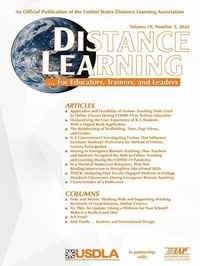
Distance Learning
Volume 19 #2
1st Edition
Published on 1. October 2022
147 pages
979-8-88730-079-5 (ISBN)
Description

Distance Learning is for leaders, practitioners, and decision makers in the fields of distance learning, e-learning, telecommunications, and related areas. It is a professional journal with applicable information for those involved with providing instruction to all kinds of learners, of all ages, using telecommunications technologies of all types. Stories are written by practitioners for practitioners with the intent of providing usable information and ideas. Articles are accepted from authors--new and experienced--with interesting and important information about the effective practice of distance teaching and learning.Distance Learning is published quarterly. Each issue includes eight to ten articles and three to four columns, including the highly regarded And Finally... column covering recent important issues in the field and written by Distance Learning editor, Michael Simonson. Articles are written by practitioners from various countries and locations, nationally and internationally.
More details
Other editions
Additional editions

Michael Simonson
Distance Learning Vol 19 Issue 2
Book
12/2022
Information Age Publishing
€47.00
Shipment within 10-20 days
Content
- Front Cover
- Articles
- 1
- Application and Feasibility of Various Teaching Tools Used in Online Classes During COVID-19 in Tertiary Education
- 23
- Demystifying the User Experience of K-5 Students With a Digital Book Application
- 31
- The Relationship of Scaffolding, Time, and Page Views, on Grades
- 41
- Is it Convenience? Investigating Factors That Influence Graduate Students' Preference for Method of Online Lecture Participation
- 55
- Moving to Emergency Remote Teaching: How Teachers and Students Navigated the Shift to Online Teaching and Learning During the COVID-19 Pandemic
- 101
- In a World of Immersive Behaviors, Why Not Reading Immersion to Strengthen Educational Skills
- 105
- TPACK: Analyzing How Faculty Engaged Students in College Mandarin Classrooms During Emergency Remote Teaching
- 119
- Characteristics of a Profession
- Columns
- Get Your Copy Today-Information Age Publishing
- Application and Feasibility of Various Teaching Tools Used in Online Classes During COVID-19 in Tertiary Education
- Sumie Chan
- The study compares the effectiveness, popularity, and ease of applicability of different learning tools in virtual classrooms among university teachers and students regarding the users' technological literacy and training, as well as equipment supp...
- Introduction
- Literature Review
- Methodology
- Table 1. Academic Background of Student Respondents in Questionnaires
- Year 1
- 27.5
- Year 2
- 37.7
- Year 3
- 26.1
- Years 1 to 2
- 8.7
- Table 2. Proportion of Student and Teacher Respondents
- 90.7%
- 9.3%
- Results and Findings
- Learners' Perception and Attitude Toward Gamification Among Universities and Colleges in Hong Kong
- Students' Recount of University Teachers' Experience in Using Game-Based Platforms and Other Innovative Digital Tools in Online Classrooms and Face-To-Face Classrooms for English language Subjects
- Kahoot Is Favored as the Most Popular Game-Based Platform in Digital Learning Among University Students and Teachers in Hong Kong
- University Students' Comparison of the Effectiveness of Gamification in Online Classrooms During the Pandemic Versus Face-To-Face Classrooms Before the Pandemic
- Implications
- The Necessity and Need for Gamification in Online University Classrooms During the Pandemic and the Possibility of Transformation From Traditional Teaching Practice to Game-Based Learning
- Students' Preference for Various Gaming Tools and Perception of the Reasons for English language Teachers not Adopting the Gamification Approach
- University Students' Perception and Attitude Toward Gamification in General in English language Teaching Classrooms in Hong Kong
- University Teachers' Perception and Attitude toward Gamification in Virtual English Language Teaching Classrooms in Hong Kong During the Pandemic
- University Teachers' Comparison of the Effectiveness of Gamification in Online Classrooms During the Pandemic Versus Face-To-Face Classrooms Before the Pandemic
- Limitations of Gamification in Remote and Face-To-Face Classrooms
- The Gap Between University Teachers' Acknowledgment of the Vitality of Gamification in Classrooms and the Frequency of its Usage in Practicality
- Effectiveness And Practicality of Incorporating Games in Online Classrooms Versus Face-To-Face Classrooms
- Conclusion and Limitations
- References
- Demystifying the User Experience of K-5 Students With a Digital Book Application
- Dalal Alfageh
- Digital technologies have, over the past few decades, brought significant changes to the learning tools that are available to teachers and students. One of the reading interventions that has contributed to enhancing the reading ability of elementary ...
- Keywords: user experience, K5 students, usability testing, digital book application
- Introduction
- Background
- Digital Book Library
- Digital Reading Program (MyON)
- Usability Evaluation of MyON
- 1. How effectively do participants complete predefined tasks on MyON?
- 2. How efficiently do participants complete the predefined tasks on MyON?
- 3. What is the satisfaction level of the users with the MyON?
- 4. What is the difference in effectiveness and efficiency rates between the experienced and nonexperienced MyON users?
- Method
- Predefined Tasks
- Results
- Effectiveness-Task Completion Success Rates
- Efficiency-Task Completion Time
- The Difference Between Experienced And Nonexperienced Users in Terms Of Effectiveness And Efficiency
- User Satisfaction Survey Results
- Interview Results
- Discussion
- Conclusion
- References
- The Relationship of Scaffolding, Time, and Page Views, on Grades
- John Griffith and Emily Faulconer
- Data from three sections of 200-level college statistics courses (student N = 85) were examined to evaluate the relationship between scaffolded assignments, time spent in the course, page views, and student performance. Strong positive correlations w...
- Keywords: STEM online learning, time in course, page views, scaffolding
- Purpose
- Significance of the Study
- Introduction and Literature Review
- The Importance of Scaffolding
- Time in Course and Page Views as Indicators of Student Performance
- Research Goals
- 1. Determine the relationships between summative and formative assignments. Additionally, we wanted to see if grouped/key assignments in the course were positively associated with the end-of-course grades. Strong correlations would indicate that the ...
- 2. Determine the relationships between the amount of time students spent in the course and grouped/key assignments in the course, as well as the end- of-course grades.
- 3. Determine the relationships between the number of student page views and grouped/key assignments in the course, as well as the end-of-course grades.
- Hypotheses
- Methods
- The Course Used in the Study
- Participants
- Demographic Data
- Design
- Treatment of the Data
- Results
- Scaffolding
- Relationship Between Homework And Quizzes on End of Course Grades
- Scaffolding: The Relationship Between Formative and Summative Assignments
- Relationship of Assignment Scores on End of Course Grades
- Relationship of Discussion Scores on End of Course Grades
- Relationship Between Time in the Course and Performance
- Student Time in the Course and Overall Course Grade
- Time Students Spent in the Course and Homework/Quizzes
- Time in the Course and Assignments
- Relationship Between Student Page Views and Performance
- Discussion
- Conclusions
- Limitations
- Recommendations
- References
- Is it Convenience?
- Investigating Factors That Influence Graduate Students' Preference for Method of Online Lecture Participation
- Adam Ladwig, Patti J. Berg-Poppe, Moses Ikiugu, and Brandon M. Ness
- This study aimed to identify factors that impact graduate health students' preference for synchronous or asynchronous online lecture participation. Constructive factors were proposed and then measured for each participant via the Motivated Strategi...
- Keywords: synchronous, asynchronous, online lecture, preference, distance learning, graduate health
- Introduction
- Background and Purpose
- Online Learning Versus Traditional Learning
- Synchronous Online Learning Versus Asynchronous Online Learning
- Determination of Factors Impacting Student Preference
- Assessing the Validity of the Proposed Factors
- Convenience
- Methods
- Design
- Participants
- Instruments
- Procedures
- Data Analysis
- Results
- Online Lecture Preference
- Table 1. Differences in MSLQ Scale Scores by Lecture Preference
- 45.17 (5.98)
- 45.70 (5.32)
- 44.70 (6.51)
- .379
- .166
- 45.53 (5.91)
- 46.53 (5.34)
- 44.66 (6.27)
- .091
- .320
- 14.11 (3.84)
- 15.02 (3.65)
- 13.33 (3.85)
- .018
- .450
- Table 2. Logistic Regression for Synchronous Preference by MSLQ Scale Scores
- -.001
- .035
- .000
- 1
- .985
- .999
- .933-1.070
- .059
- .037
- 2.614
- 1
- .106
- 1.061
- .987-1.140
- .124
- .055
- 5.193
- 1
- .023
- 1.133
- 1.018-1.261
- -4.585
- 2.077
- 4.872
- 1
- .027
- .010
- Table 3. Questions Pertaining to Online Lecture by Method of Participation
- 4 (1-6)
- 5 (2-7)
- .394
- 5 (2-7)
- 5 (2-7)
- .139
- 3 (1-6)
- 4 (1-7)
- .201
- 4 (1-6)
- 4 (2-7)
- .255
- 3 (1-6)
- 4 (1-7)
- .399
- Discussion
- Conclusion
- References
- Appendix: Survey
- Demographic
- 1
- 2
- 3
- 4
- 5
- 6
- 7
- Self-Efficacy for Learning and Performance
- 1. I believe I will receive an excellent grade.
- 2. I'm certain I can understand the most difficult material presented in the readings.
- 3. I'm confident I can understand the basic concepts taught.
- 4. I'm confident I can understand the most complex material presented by instructors.
- 5. I'm confident I can do an excellent job on assignments and tests.
- 6. I expect to do well.
- 7. I'm certain I can master the skills being taught.
- 8. Considering the difficulty of the courses, the teachers, and my skills, I think I will do well.
- Time and Study Environmental Management
- 9. I usually study in a place where I can concentrate on my course work.
- 10. I make good use of my study time.
- 11. I find it hard to stick to a study schedule. (REVERSED)
- 12. I have a regular place set aside for studying.
- 13. I make sure I keep up with the weekly readings and assignments.
- 14. I attend class regularly.
- 15. I often find that I don't spend very much time on courses because of other activities. (REVERSED)
- 16. I rarely find time to review my notes or readings before an exam. (REVERSED)
- 17. When studying, I often try to explain the material to a classmate or a friend.
- 18. I try to work with other students to complete course assignments.
- 19. When studying, I often set aside time to discuss course material with a group of students from the class.
- Additional Questions
- 20. I choose my method of online lecture participation based on my perception of convenience.
- 21. I choose my method of online lecture participation based on how I believe I will best learn.
- 22. I have other life demands that make scheduled sessions difficult to attend.
- 23. I have trouble concentrating during lecture.
- 24. I believe online learning should be a part of my graduate program.
- Multiple Choice
- 25. Do you prefer to participate in online lectures synchronously or asynchronously? Options: synchronously, asynchronously.
- Get Your Copy Today-Information Age Publishing
- Moving to Emergency, Remote Teaching
- How Teachers and Students Navigated the Shift to Online Teaching and Learning During the COVID-19 Pandemic
- Parama Chaudhuri
- Introduction and Problem Statement
- Theoretical Framework
- Research Purpose
- Research Question
- Significance of the Study
- Literature Review on Digital Divide in K-12
- Online Teaching Versus Emergency Online Teaching
- Digital Divide
- Levels of Digital Divide
- Method
- Sample
- Table 1. Research Participants
- 1
- 9/9
- 9
- 2
- 14/141
- 14
- 3
- 14/9
- 14
- 4
- 3 (BTA) + 1/ 1
- 2
- 5
- 9/4
- 4
- 6
- 7.5/6
- 6
- Research Context
- Table 2. Research Context
- 1
- 2
- 3
- 4
- Table 3. Aligning Research Questions to Interview Questions
- 7, 9, 10, 11, 12 and 17
- Data Collection
- Data Collection Instruments
- Table 4. Review of Lesson Plans, Teacher 3
- Data Collection Procedures
- Data Analysis
- Table 5. Thematic Analysis Example
- Validity, Reliability, and Transferability
- Table 6. Trustworthiness Criteria
- Findings and Discussion
- Emergency Online Teaching
- Concerns About Emergency Online Teaching
- Changes in Instructional Strategies
- Concerns About Emergency Online Teaching
- Issues With Access
- Student Technology Use
- Digital Citizenship
- Implications for Research
- Implications for Practice
- Limitations of the Study
- Conclusion
- References
- In a World of Immersive Behaviors, Why Not Reading Immersion to Strengthen Educational Skills
- Michelle S. Hall
- Introduction
- What Is Immersion?
- Art and Language Immersion
- Art Immersion
- Language Immersion
- Learning Cross the Curriculum
- What Would Reading Immersion Look Like?
- Conclusion
- References
- TPACK
- Analyzing How Faculty Engaged Students in College Mandarin Classrooms During Emergency Remote Teaching
- Ching-Hsuan Wu
- The purpose of the study was to investigate college language faculty's use of technologies to organize teaching and learning in language classrooms during emergency remote teaching (ERT) necessitated by the pandemic in the spring semester of 2020. ...
- Keywords: TPACK, student engagement, emergency remote teaching, ERT, Mandarin
- Introduction
- Literature Review
- TPACK Framework
- Student Engagement
- Methodology
- Participants
- Interview questionnaire instrument
- 1. Can you share an overview of the differences in how you engaged your students before and during ERT?
- 2. Technological knowledge: Please describe your experience in using educational technologies before and during ERT.
- 3. Content knowledge: Please describe your specialized areas in Mandarin teaching and the materials you used before and during ERT.
- 4. Pedagogical knowledge: Please describe your teaching rationale and how you purposefully presented the subject content and create an effective learning experience before and during ERT?
- Data Analysis
- Findings
- Discussions
- Frequent Communication
- ERT-Sustainable Materials
- Quick Turnaround Times for Interaction
- Conclusion
- References
- Get Your Copy Today-Information Age Publishing
- Characteristics of a Profession
- Marcia Lightsey-Tivoli
- The purpose of this article is to provide information describing the characteristics of a profession. The objective is to present documentation and an educated opinion of how these characteristics may relate to instructional technology and distance e...
- A Historical Perspective of ITDE
- Characteristics of a Profession
- Intellectual Technique
- Application to Practical
- Training Period
- Professional Association
- A High Level of Communication and Collaboration
- Standards and Ethics
- Expanding Intellectual Theory Based On Research
- Where Is ITDE Heading as a Profession?
- References
- Working With
- and Supporting Teaching Assistants of Asynchronous, Online Courses
- Courtney Harrington, Matt Myers, and Natalie B. Milman
- Background
- Insights and Recommendations
- Establishing a Strong Instructor-TA Relationship Prior to the Course
- Defining the TA's Role in the Course
- Coaching the TA for Specific Course Tasks
- Concluding Thoughts
- References
- An Update!
- Giving a Webinar for your School? Make it a Really Good One!
- Errol Craig Sull
- Notes
- 1. A few of the suggestions might seem obvious, but it is often the obvious, taken-for-granted steps that folks overlook, thus their inclusion.
- 2. This column is specifically focused on assisting individuals who will be giving online webinars. Some of the information, however, can also apply to face-to-face presentations or can be tweaked for use in face-to-face presentations.
- The Overriding Rule of Webinar Success
- Preparation
- A crucial Mindset: Wanting to Present
- Know the Learning Outcomes to be Achieved
- Understand the Audience Mix
- Preplanning: Do It
- The Presentation Environment: Make it Comfortable and Secure
- Be Certain the Online Meeting Software Is Fully Functional
- Know How to Create an Audience-Worthy PowerPoint or Prezi
- Presentation
- Own the Time Allotted
- Adjust the Presentation if Necessary
- Your Personality: It Must be Engaging and Outgoing
- Have Downloadable Handouts
- Be Cognizant of Speaking Speed, Tone, and Projection
- Give an Interactive Presentation
- Integrate humor, but With a Caveat
- Use Video and Audio if Helpful . Include Visuals
- Acknowledge Questions and Comments
- Be an educator first, a presenter second
- Ask Errol!
- Errol Craig Sull
- The Best Ways to Grab Students' Attention During a Live Webinar
- Fearful if Taking Time Off Might Hurt Future Course-Assignment Chances
- Does Not Like Supervisor- How to Handle It
- Get Your Copy Today-Information Age Publishing
- Systems and Instructional Design
- Michael Simonson
- 1. There should be a commitment to the science of systems, and the field of instructional design.
- 2. There should be expectations that those who hold the title of instructional designer are highly and formally prepared in instructional systems. The typical instructional designer holds at least a master's degree in the field.
- 3. There should be a requirement that when courses are planned, modified, improved, or updated that instructional designers are actively involved.
- References
- Back Cover
