

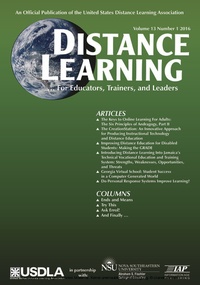
Distance Learning
Volume 13 #1
1st Edition
Published on 6. January 2016
65 pages
978-1-68123-559-2 (ISBN)
Description

Distance Learning is for leaders, practitioners, and decision makers in the fields of distance learning, e'learning, telecommunications, and related areas. It is a professional journal with applicable information for those involved with providing instruction to all kinds of learners, of all ages, using telecommunications technologies of all types. Stories are written by practitioners for practitioners with the intent of providing usable information and ideas. Articles are accepted from authors - new and experienced - with interesting and important information about the effective practice of distance teaching and learning.Distance Learning is published quarterly. Each issue includes eight to ten articles and three to four columns, including the highly regarded "e;And Finally..."e; column covering recent important issues in the field and written by Distance Learning editor, Michael Simonson. Articles are written by practitioners from various countries and locations, nationally and internationally.Distance Learning is an official publication of the United States Distance Learning Association, and is co?sponsored by the Fischler School of Education at Nova Southeastern University and Information Age Publishing.
All prices
More details
Other editions
Additional editions
Michael Simonson | Charles Schlosser | John G. Flores
Distance Learning Vol 13 Issue 1
For educators, Trainers, and Leaders
Book
06/2016
Information Age Publishing
€47.00
Shipment within 3-4 weeks
Content
1 - Front Cover [Seite Front Cover]
- 1 [Seite 1]
2 - Featured Articles [Seite 2]
2.1 - 1 [Seite 2]
2.2 - The Keys to Online Learning For Adults: The Six Principles of Andragogy, Part II [Seite 2]
2.2.1 - 7 [Seite 2]
2.3 - The CreationStation: An Innovative Approach for Producing Instructional Technology and Distance Education [Seite 2]
2.3.1 - 15 [Seite 2]
2.4 - Improving Distance Education for Disabled Students: Making the GRADE [Seite 2]
2.4.1 - 21 [Seite 2]
2.5 - Introducing Distance Learning Into Jamaica's Technical Vocational Education and Training System: Strengths, Weaknesses, Opportunities, and Threats [Seite 2]
2.5.1 - 33 [Seite 2]
2.6 - Georgia Virtual School: Student Success in a Computer-Generated World [Seite 2]
2.6.1 - 41 [Seite 2]
2.7 - Do Personal Response Systems Improve Learning? [Seite 2]
3 - Columns [Seite 2]
4 - The Keys to Online Learning for Adults [Seite 6]
4.1 - The Six Principles of Andragogy, Part II [Seite 6]
4.1.1 - Wendy Conaway and Barbara Zorn-Arnold [Seite 6]
4.1.1.1 - Introduction [Seite 6]
4.1.1.2 - Experience [Seite 6]
4.1.1.3 - Self-Directedness/Autonomy [Seite 8]
4.1.1.4 - Need to Know [Seite 9]
4.1.1.5 - Conclusion [Seite 10]
4.1.1.6 - References [Seite 11]
5 - The CreationStation [Seite 12]
5.1 - An Innovative Approach for Producing Instructional Technology and Distance Education Materials [Seite 12]
5.1.1 - Rafael Giraldo [Seite 12]
5.1.1.1 - Introduction [Seite 12]
5.1.1.2 - The Role of Technology in Instructional Media [Seite 13]
5.1.1.3 - The CreationStation [Seite 14]
5.1.1.4 - Media Types at the CreationStation [Seite 15]
5.1.1.4.1 - Text [Seite 15]
5.1.1.4.2 - Audio [Seite 15]
5.1.1.4.3 - Video [Seite 16]
5.1.1.4.4 - Graphics [Seite 17]
5.1.1.4.5 - Animation [Seite 17]
5.1.1.5 - Conclusion [Seite 18]
5.1.1.6 - References [Seite 18]
5.1.1.7 - Call for Papers [Seite 19]
5.1.1.7.1 - Publish in Distance Learning [Seite 19]
5.1.1.7.2 - The editors of Distance Learning would like to publish your paper. We are interested in papers dealing with practical applications of distance education in a variety of settings. Contact Michael Simonson, editor, if you have questions about your idea... [Seite 19]
6 - Improving Distance Education for Disabled Students [Seite 20]
6.1 - Making the GRADE [Seite 20]
6.1.1 - Marilyn A. Goodrich [Seite 20]
6.1.1.1 - Introduction [Seite 20]
6.1.1.2 - The Start of Something Profound [Seite 20]
6.1.1.3 - Making the GRADE [Seite 21]
6.1.1.4 - Just the Facts [Seite 21]
6.1.1.5 - Historical Perspective of Accessibility Law [Seite 21]
6.1.1.6 - Web Content Accessibility Guidelines [Seite 22]
6.1.1.7 - WCAG Recommendations [Seite 23]
6.1.1.8 - Second Generation Documents [Seite 24]
6.1.1.9 - Distance Learning Accessibility Indicators [Seite 24]
6.1.1.10 - Commitment [Seite 25]
6.1.1.11 - References [Seite 25]
7 - Introducing Distance Learning Into Jamaica's Technical Vocational Education and Training System [Seite 26]
7.1 - Strengths, Weaknesses, Opportunities, and Threats [Seite 26]
7.1.1 - Roxanne Hinds [Seite 26]
7.1.1.1 - Introduction [Seite 26]
7.1.1.2 - Jamaica: A Demographic Overview [Seite 27]
7.1.1.3 - TVET in Jamaica [Seite 27]
7.1.1.4 - Distance Education in TVET [Seite 28]
7.1.1.5 - Distance Education in the HEART Trust/NTA [Seite 30]
7.1.1.5.1 - Strengths [Seite 30]
7.1.1.5.2 - Weaknesses [Seite 31]
7.1.1.5.3 - Opportunities [Seite 33]
7.1.1.5.4 - Threats [Seite 34]
7.1.1.6 - Conclusion [Seite 34]
7.1.1.7 - References [Seite 35]
7.2 - Get Your Copy Today-Information Age Publishing [Seite 37]
8 - Georgia Virtual School [Seite 38]
8.1 - Student Success in a Computer- Generated World [Seite 38]
8.1.1 - Valencia H. Ingram [Seite 38]
8.1.1.1 - Introduction [Seite 38]
8.1.1.2 - History [Seite 39]
8.1.1.3 - What GAVS Offers [Seite 40]
8.1.1.4 - GAVS Student Success [Seite 41]
8.1.1.5 - Conclusion [Seite 42]
8.1.1.6 - References [Seite 44]
8.1.1.6.1 - Quarterly Review of Distance Education, Subscribe Today! www.infoagepub.com [Seite 45]
9 - Do Personal Response Systems Improve Learning? [Seite 46]
9.1 - Steven E. Gregor and Gregory B. Muscelli [Seite 46]
9.1.1 - Introduction [Seite 46]
9.1.2 - The Instructional Use of a PRS as Measured by NETS for Teachers [Seite 47]
9.1.3 - Conclusions [Seite 48]
9.1.4 - References [Seite 49]
10 - Resources and Factors to Consider When Designing New Online Programs [Seite 50]
10.1 - Natalie B. Milman [Seite 50]
10.1.1 - Starting a New Online Program: Where do you Begin? [Seite 51]
10.1.1.1 - How to Start an Online Learning Program: 10 Steps to Implementation [Seite 51]
10.1.1.1.1 - 1. Clarify goals [Seite 51]
10.1.1.1.2 - 2. Get to know your state policy [Seite 51]
10.1.1.1.3 - 3. Get/hire the best people [Seite 51]
10.1.1.1.4 - 4. Consider partners [Seite 51]
10.1.1.1.5 - 5. Pick a platform [Seite 51]
10.1.1.1.6 - 6. Leverage online learning tools and capacity to blend schools [Seite 51]
10.1.1.1.7 - 7. Staffing [Seite 51]
10.1.1.1.8 - 8. Provide guidance on self-blends [Seite 51]
10.1.1.1.9 - 9. Marketing [Seite 51]
10.1.1.1.10 - 10. Budget ("How to start an online program," n.d.) [Seite 51]
10.1.1.2 - Rovai's Composite Persistence Model [Seite 52]
10.1.2 - References [Seite 53]
10.1.2.1 - Your Advertisement or Announcement Could Be Here [Seite 53]
10.1.2.2 - USDLA 8 Winter Street, Suite 508 Boston, MA 02108 800-275-5162 [Seite 53]
11 - A Surging Education Sector [Seite 54]
11.1 - A Surging Education Sector [Seite 54]
11.1.1 - Errol Craig Sull [Seite 54]
11.1.1.1 - A-DEVELOPING THE PROGRAM [Seite 55]
11.1.1.2 - B-HAVING A SUCCESSFUL PROGRAM [Seite 56]
11.1.1.3 - Reference [Seite 58]
12 - Ask Errol! [Seite 60]
12.1 - Errol Craig Sull [Seite 60]
13 - Assumptions and Distance Education [Seite 65]
13.1 - Michael Simonson [Seite 65]
13.1.1 - 1. Learners [Seite 65]
13.1.2 - 2. Structure [Seite 65]
13.1.3 - 3. Communication [Seite 65]
13.1.4 - 4. Technology [Seite 65]
13.1.5 - 5. Interaction [Seite 65]
13.1.6 - 6. Literacy-visual and verbal [Seite 65]
13.1.7 - 7. Learning [Seite 65]
13.1.8 - 1. Assumptions About Online Learners [Seite 65]
13.1.9 - 2. Assumptions About Online Course Structure [Seite 63]
13.1.10 - 3. Assumptions About Communication [Seite 63]
13.1.11 - 4. Assumptions About Technology [Seite 63]
13.1.12 - 5. Assumptions About Interaction [Seite 63]
13.1.13 - 6. Assumptions About Literacy-Visual and Verbal [Seite 64]
13.1.14 - 7. Assumptions About Learning [Seite 64]
13.1.15 - References [Seite 64]
14 - Back Cover [Seite Back Cover]
- 66 [Seite 66]
- 1 [Seite 1]
2 - Featured Articles [Seite 2]
2.1 - 1 [Seite 2]
2.2 - The Keys to Online Learning For Adults: The Six Principles of Andragogy, Part II [Seite 2]
2.2.1 - 7 [Seite 2]
2.3 - The CreationStation: An Innovative Approach for Producing Instructional Technology and Distance Education [Seite 2]
2.3.1 - 15 [Seite 2]
2.4 - Improving Distance Education for Disabled Students: Making the GRADE [Seite 2]
2.4.1 - 21 [Seite 2]
2.5 - Introducing Distance Learning Into Jamaica's Technical Vocational Education and Training System: Strengths, Weaknesses, Opportunities, and Threats [Seite 2]
2.5.1 - 33 [Seite 2]
2.6 - Georgia Virtual School: Student Success in a Computer-Generated World [Seite 2]
2.6.1 - 41 [Seite 2]
2.7 - Do Personal Response Systems Improve Learning? [Seite 2]
3 - Columns [Seite 2]
4 - The Keys to Online Learning for Adults [Seite 6]
4.1 - The Six Principles of Andragogy, Part II [Seite 6]
4.1.1 - Wendy Conaway and Barbara Zorn-Arnold [Seite 6]
4.1.1.1 - Introduction [Seite 6]
4.1.1.2 - Experience [Seite 6]
4.1.1.3 - Self-Directedness/Autonomy [Seite 8]
4.1.1.4 - Need to Know [Seite 9]
4.1.1.5 - Conclusion [Seite 10]
4.1.1.6 - References [Seite 11]
5 - The CreationStation [Seite 12]
5.1 - An Innovative Approach for Producing Instructional Technology and Distance Education Materials [Seite 12]
5.1.1 - Rafael Giraldo [Seite 12]
5.1.1.1 - Introduction [Seite 12]
5.1.1.2 - The Role of Technology in Instructional Media [Seite 13]
5.1.1.3 - The CreationStation [Seite 14]
5.1.1.4 - Media Types at the CreationStation [Seite 15]
5.1.1.4.1 - Text [Seite 15]
5.1.1.4.2 - Audio [Seite 15]
5.1.1.4.3 - Video [Seite 16]
5.1.1.4.4 - Graphics [Seite 17]
5.1.1.4.5 - Animation [Seite 17]
5.1.1.5 - Conclusion [Seite 18]
5.1.1.6 - References [Seite 18]
5.1.1.7 - Call for Papers [Seite 19]
5.1.1.7.1 - Publish in Distance Learning [Seite 19]
5.1.1.7.2 - The editors of Distance Learning would like to publish your paper. We are interested in papers dealing with practical applications of distance education in a variety of settings. Contact Michael Simonson, editor, if you have questions about your idea... [Seite 19]
6 - Improving Distance Education for Disabled Students [Seite 20]
6.1 - Making the GRADE [Seite 20]
6.1.1 - Marilyn A. Goodrich [Seite 20]
6.1.1.1 - Introduction [Seite 20]
6.1.1.2 - The Start of Something Profound [Seite 20]
6.1.1.3 - Making the GRADE [Seite 21]
6.1.1.4 - Just the Facts [Seite 21]
6.1.1.5 - Historical Perspective of Accessibility Law [Seite 21]
6.1.1.6 - Web Content Accessibility Guidelines [Seite 22]
6.1.1.7 - WCAG Recommendations [Seite 23]
6.1.1.8 - Second Generation Documents [Seite 24]
6.1.1.9 - Distance Learning Accessibility Indicators [Seite 24]
6.1.1.10 - Commitment [Seite 25]
6.1.1.11 - References [Seite 25]
7 - Introducing Distance Learning Into Jamaica's Technical Vocational Education and Training System [Seite 26]
7.1 - Strengths, Weaknesses, Opportunities, and Threats [Seite 26]
7.1.1 - Roxanne Hinds [Seite 26]
7.1.1.1 - Introduction [Seite 26]
7.1.1.2 - Jamaica: A Demographic Overview [Seite 27]
7.1.1.3 - TVET in Jamaica [Seite 27]
7.1.1.4 - Distance Education in TVET [Seite 28]
7.1.1.5 - Distance Education in the HEART Trust/NTA [Seite 30]
7.1.1.5.1 - Strengths [Seite 30]
7.1.1.5.2 - Weaknesses [Seite 31]
7.1.1.5.3 - Opportunities [Seite 33]
7.1.1.5.4 - Threats [Seite 34]
7.1.1.6 - Conclusion [Seite 34]
7.1.1.7 - References [Seite 35]
7.2 - Get Your Copy Today-Information Age Publishing [Seite 37]
8 - Georgia Virtual School [Seite 38]
8.1 - Student Success in a Computer- Generated World [Seite 38]
8.1.1 - Valencia H. Ingram [Seite 38]
8.1.1.1 - Introduction [Seite 38]
8.1.1.2 - History [Seite 39]
8.1.1.3 - What GAVS Offers [Seite 40]
8.1.1.4 - GAVS Student Success [Seite 41]
8.1.1.5 - Conclusion [Seite 42]
8.1.1.6 - References [Seite 44]
8.1.1.6.1 - Quarterly Review of Distance Education, Subscribe Today! www.infoagepub.com [Seite 45]
9 - Do Personal Response Systems Improve Learning? [Seite 46]
9.1 - Steven E. Gregor and Gregory B. Muscelli [Seite 46]
9.1.1 - Introduction [Seite 46]
9.1.2 - The Instructional Use of a PRS as Measured by NETS for Teachers [Seite 47]
9.1.3 - Conclusions [Seite 48]
9.1.4 - References [Seite 49]
10 - Resources and Factors to Consider When Designing New Online Programs [Seite 50]
10.1 - Natalie B. Milman [Seite 50]
10.1.1 - Starting a New Online Program: Where do you Begin? [Seite 51]
10.1.1.1 - How to Start an Online Learning Program: 10 Steps to Implementation [Seite 51]
10.1.1.1.1 - 1. Clarify goals [Seite 51]
10.1.1.1.2 - 2. Get to know your state policy [Seite 51]
10.1.1.1.3 - 3. Get/hire the best people [Seite 51]
10.1.1.1.4 - 4. Consider partners [Seite 51]
10.1.1.1.5 - 5. Pick a platform [Seite 51]
10.1.1.1.6 - 6. Leverage online learning tools and capacity to blend schools [Seite 51]
10.1.1.1.7 - 7. Staffing [Seite 51]
10.1.1.1.8 - 8. Provide guidance on self-blends [Seite 51]
10.1.1.1.9 - 9. Marketing [Seite 51]
10.1.1.1.10 - 10. Budget ("How to start an online program," n.d.) [Seite 51]
10.1.1.2 - Rovai's Composite Persistence Model [Seite 52]
10.1.2 - References [Seite 53]
10.1.2.1 - Your Advertisement or Announcement Could Be Here [Seite 53]
10.1.2.2 - USDLA 8 Winter Street, Suite 508 Boston, MA 02108 800-275-5162 [Seite 53]
11 - A Surging Education Sector [Seite 54]
11.1 - A Surging Education Sector [Seite 54]
11.1.1 - Errol Craig Sull [Seite 54]
11.1.1.1 - A-DEVELOPING THE PROGRAM [Seite 55]
11.1.1.2 - B-HAVING A SUCCESSFUL PROGRAM [Seite 56]
11.1.1.3 - Reference [Seite 58]
12 - Ask Errol! [Seite 60]
12.1 - Errol Craig Sull [Seite 60]
13 - Assumptions and Distance Education [Seite 65]
13.1 - Michael Simonson [Seite 65]
13.1.1 - 1. Learners [Seite 65]
13.1.2 - 2. Structure [Seite 65]
13.1.3 - 3. Communication [Seite 65]
13.1.4 - 4. Technology [Seite 65]
13.1.5 - 5. Interaction [Seite 65]
13.1.6 - 6. Literacy-visual and verbal [Seite 65]
13.1.7 - 7. Learning [Seite 65]
13.1.8 - 1. Assumptions About Online Learners [Seite 65]
13.1.9 - 2. Assumptions About Online Course Structure [Seite 63]
13.1.10 - 3. Assumptions About Communication [Seite 63]
13.1.11 - 4. Assumptions About Technology [Seite 63]
13.1.12 - 5. Assumptions About Interaction [Seite 63]
13.1.13 - 6. Assumptions About Literacy-Visual and Verbal [Seite 64]
13.1.14 - 7. Assumptions About Learning [Seite 64]
13.1.15 - References [Seite 64]
14 - Back Cover [Seite Back Cover]
- 66 [Seite 66]

