

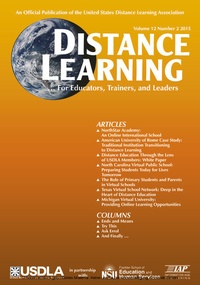
Distance Learning
Volume 12 #2
1st Edition
Published on 7. January 2015
69 pages
978-1-68123-214-0 (ISBN)
Description

Distance Learning is for leaders, practitioners, and decision makers in the fields of distance learning, e'learning, telecommunications, and related areas. It is a professional journal with applicable information for those involved with providing instruction to all kinds of learners, of all ages, using telecommunications technologies of all types. Stories are written by practitioners for practitioners with the intent of providing usable information and ideas. Articles are accepted from authors--new and experienced--with interesting and important information about the effective practice of distance teaching and learning.Distance Learning is published quarterly. Each issue includes eight to ten articles and three to four columns, including the highly regarded "e;And Finally..."e; column covering recent important issues in the field and written by Distance Learning editor, Michael Simonson. Articles are written by practitioners from various countries and locations, nationally and internationally.Distance Learning is an official publication of the United States Distance Learning Association, and is co-sponsored by the Fischler School of Education at Nova Southeastern University and Information Age Publishing.
All prices
More details
Other editions
Additional editions
Michael Simonson | Charles Schlosser
Distance Learning Magazine Vol 12 Issue 2
Book
08/2015
Information Age Publishing
€47.00
Shipment within 3-4 weeks
Content
- Front Cover
- Featured Articles
- 1
- NorthStar Academy: An Online International School
- 7
- American University of Rome Case Study: Traditional Institution Transitioning to Distance Learning
- 15
- Distance Education Through the Lens of USDLA Members: White Paper
- 23
- North Carolina Virtual Public School: Preparing Students Today for Lives Tomorrow
- 33
- The Role of Primary Students and Parents in Virtual Schools
- 39
- Texas Virtual School Network: Deep in the Heart of Distance Education
- 45
- Michigan Virtual University: Providing Online Learning Opportunities
- Columns
- Call for Papers
- Publish in Distance Learning
- The editors of Distance Learning would like to publish your paper. We are interested in papers dealing with practical applications of distance education in a variety of settings. Contact Michael Simonson, editor, if you have questions about your idea...
- NorthStar Academy
- An Online International School
- Kevin Arndt
- Introduction
- NorthStar Academy
- NorthStar's Flexibility
- Student Experience
- Technology and Course Design
- Future
- References
- Quarterly Review of Distance Education, Subscribe Today! www.infoagepub.com
- American University of Rome Case Study
- Traditional Institution Transitioning to Online Learning
- Frederick A. Ricci
- The Sabbatical
- Background: American University of Rome
- Beginnings at American University of Rome
- Focus: Distance Education
- Remedial Recommendations: First Task
- Recommendations of Three Options
- Option 1: Professional Book Publishing Companies Online
- Option 2: Online Learning Classes or MOOCs
- Option 3: In-House Course Development
- Board of Trustees Visit and Presentation
- Faculty Awareness and Interest
- Preparation of Target Audience Materials
- Motivational Incentive and Support
- Method of Creating Demand
- Results of Distance Education Offering
- Sabbatical Experience on Target
- Conclusions and Outcomes
- Focus on Distance Education
- Value of the Entire Sabbatical Experience
- References
- Distance Education Through the Lens of USDLA Members
- A White Paper
- Jude St. Phard, Jr.
- Executive Summary
- Overview
- Perception Gap
- Faculty Concerns
- Results
- Policy Recommendations
- Implications
- Summary
- References
- North Carolina Virtual Public School
- Preparing Students Today for Lives Tomorrow
- Holly Marshburn
- Introduction
- Background
- Mission and Vision Statements
- Three Instructional Pillars
- Funding
- Courses
- Success 101
- Course Design
- Teachers
- Teacher-in-Training Program
- Students
- Peer Tutoring Program
- Parental Involvement
- New Hanover County Schools
- Benefits
- Virtual Academy Coordinators
- Conclusion
- References
- Get Your Copy Today-Information Age Publishing
- The Role of Primary Students and Parents in Virtual Schools
- Allatesha Welch
- Introduction
- Advantages
- Disadvantages
- Role of Parents
- Role of Students
- Internet Safety
- Level of Readiness
- Students With Learning Exceptionalities
- Conclusion
- References
- Get Your Copy Today-Information Age Publishing
- Texas Virtual School Network
- Deep in the Heart of Distance Education
- Rolando R. Garza
- Introduction and History
- Provider Requirements
- Students Getting Started
- TxVSN Standards
- Online Teaching Professional Development
- Conclusion
- References
- Table 1. TxVSN Approved Professional Development
- Michigan Virtual University
- Providing Online Learning Opportunities
- Sophia Lafayette
- Introduction
- The Origins of Michigan Virtual University
- Historical Context
- Creation of Michigan Virtual University
- Organizational Structure of Michigan Virtual University
- Michigan Virtual School, a Division of Michigan Virtual University
- Michigan LearnPort, a Division of Michigan Virtual University
- Michigan Virtual Learning Research Institute, a Division of Michigan Virtual University
- 1. Michigan students accounted for 319,630 virtual enrollments in the 2013- 14 school year, an increase of over 134,577 virtual enrollments from the prior year. Only 5% of those enrollments were delivered by MVS.
- 2. Although almost 90% of enrollments were by secondary students (Grades 7- 12), elementary level students had the highest year-over-year percentage growth.
- 3. Fifty-seven percent of virtual enrollments from virtual students ended with a completion status of "completed/passed." Those same virtual students, however, passed their non- virtual courses 71% of the time. In contrast, non-virtual learners p...
- 4. Of the virtual learners taking courses, those taking courses through MVS had a passed/completed rate of 72%, while cyber schools had a rate of 54%, and local districts rate was 57%.
- 5. Students who tend to have lower levels of academic success are being directed to take virtual courses, primarily in core content areas.
- The Future of Michigan Virtual University
- References
- Table 1. Leadership Structure of Michigan Virtual University
- Table 2. Michigan Virtual School 2013-2014 Course Enrollments by Subject Area
- 21.4%
- 4,522
- 16.1%
- 3,396
- 14.7%
- 3,101
- 11.7%
- 2,473
- 7.8%
- 1,653
- Table 3. Michigan Virtual University Goals
- Do Forecasts for Change Repeat Past Predictions for Transformations of Postsecondary and P-12 Education?
- Natalie B. Milman
- References
- Ends and Means
- Errol's Miniguide
- Successfully Motivating Online Students to Complete Weekly Assignments- and On Time!
- Errol Craig Sull
- Try This
- Ask Errol!
- Errol Craig Sull
- One
- Two
- Three
- Four
- Ask Errol!
- Ethics
- Michael Simonson
- Reference
- And Finally .
- Back Cover

