

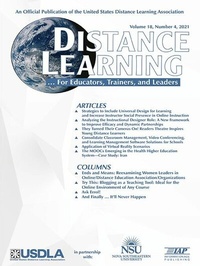
Distance Learning
Volume 18 #4
1st Edition
Published on 1. December 2021
61 pages
978-1-64802-887-8 (ISBN)
Description

Distance Learning is for leaders, practitioners, and decision makers in the fields of distance learning, e-learning, telecommunications, and related areas. It is a professional journal with applicable information for those involved with providing instruction to all kinds of learners, of all ages, using telecommunications technologies of all types. Stories are written by practitioners for practitioners with the intent of providing usable information and ideas. Articles are accepted from authors--new and experienced--with interesting and important information about the effective practice of distance teaching and learning.Distance Learning is published quarterly. Each issue includes eight to ten articles and three to four columns, including the highly regarded And Finally... column covering recent important issues in the field and written by Distance Learning editor, Michael Simonson. Articles are written by practitioners from various countries and locations, nationally and internationally.
All prices
More details
Other editions
Additional editions
Michael Simonson
Distance Learning Vol 18 Issue 4
Book
04/2022
Information Age Publishing
€47.00
Shipment within 3-4 weeks
Content
- Front Cover
- Articles
- 1
- Strategies to Include Universal Design for Learning and Increase Instructor Social Presence in Online Instruction
- 7
- Analyzing the Instructional Designer Role: A New Framework to Improve Efficacy and Dynamic Partnerships
- 19
- They Turned Their Cameras On! Readers Theatre Inspires Young Distance Learners
- 23
- Consolidate Classroom Management, Video Conferencing, and Learning Management Software Solutions for Schools
- 27
- Application of Virtual Reality Scenarios
- 31
- The MOOCs Emerging in the Health Higher Education System- Case Study: Iran
- Columns
- Get Your Copy Today-Information Age Publishing
- Strategies to Include Universal Design for Learning and Increase Instructor Social Presence in Online Instruction
- Régine Pellicer
- Instructor Social Presence
- Universal Design for Learning
- Starting the Course
- Discussion Boards
- Feedback on Projects
- Office Hours/Conferences
- Conclusion
- References
- Analyzing the Instructional Designer Role
- A New Framework to Improve Efficacy and Dynamic Partnerships
- Luke Bennett and Alyssa Albrecht
- As the demand for online and blended courses in higher education continues to increase, so too has the demand for and responsibilities placed upon instructional designers (ID). Through the analysis of round table discussions and relevant literature, ...
- Keywords: instructional design, collaboration, framework, faculty, higher education, online learning
- Introduction
- Literature Review
- Defining the Role of the ID
- Barriers to Fulfilling the Defined ID Role
- Faculty ID Collaborative Partnerships
- Summary
- CISSCO Framework
- Context Assessment
- Identification of Gaps
- Surrounding Barrier Identification
- Self-Applied Barrier Identification
- Creation of Action Plan
- Operational Implementation
- Action Plan
- Discussion
- References
- They Turned Their Cameras On!
- Readers Theatre Inspires Young Distance Learners
- Rosalind M. Flynn
- Short Scripts
- Casting the Speaking Roles
- Nonspeaking Roles
- Screen Acting Position
- Practicing Gestures
- Acting for the Camera
- Delivering Solo Lines
- The First Read Through
- Using Props
- Final Rehearsals
- Recording Rehearsals
- Recording the Performances
- Cameras on, Learners Engaged
- References
- Consolidate Classroom Management, Video Conferencing, and Learning Management Software Solutions for Schools
- Nadav Avni
- Challenges Faced by Teachers Managing Remote or Hybrid Classes
- Divided Attention Due to a Divided Class
- So Much Software, So Little Time
- Difficulty in Providing Individualized Instruction
- The Need for All-in-One Software Solutions For Schools
- Integrated Software Solutions for Schools Improve the Learning Experience
- Application of Virtual Reality Scenarios
- Jamie Anne Marcus
- The Application of Simulations
- Introducing Moral Injury
- Moral Injury to Soul Injury
- Historical Aspects of Variants and Viruses
- The Elephant in The Room
- Conclusion
- References
- The MOOCs Emerging in the Health Higher Education System
- Case Study: Iran
- Mohsen Keshavarz and Maryam Karimi
- Massive open online Courses, or MOOCs, are online courses that allow participants free access and unrestricted participation in any course at any time and place. With distinguished features of teaching, such as lectures, videos, and reading materials...
- Keywords: MOOCs, ARMAN, Virtual University of Medical Sciences, Iran
- Introduction
- Open Educational Resources
- 1. Medical university system and
- 2. Comprehensive higher education system.
- Superior Experience of Torbat Heydariyeh University of Medical Sciences With Arman National MOOCs
- Exploration Phase
- Planning Phase
- Action Phase
- Integration Phase
- Conclusion
- References
- Reexamining Women Leaders in Online/ Distance Education Associations/Organizations
- Natalie B. Milman and Ani Meliksetyan
- Table 1. 2015 Versus 2021Online/Distance Education Associations Leadership by Gender
- 1. African Council for Distance Education https://acde-afri.org/secretariat-staff/
- X
- X
- 2. American Distance Education Consortium/Apollidon Learning https://apollidon.com/about/leadership/
- X
- X
- 3. Asian Association of Open Universities https://www.aaou.org/past-presidents-and-secretaries-general/
- X
- X
- 4. Association for the Advancement of Computing in Education
- X
- X
- 5. Association for Distance Education and Independent Learning http://www.adeil.org/?q=node/11
- X
- X
- 6. Association for Educational Communications and Technology http://www.aect.org/newsite/
- X
- X
- 7. Australasian Council on Open, Distance and E-learning http://www.acode.edu.au/mod/page/view.php?id=18
- X
- X
- 8. Consortium for School Networking http://www.cosn.org/about/staff
- X
- X
- 9. Educause https://www.educause.edu/about/leadership
- X
- X
- 10. European Association for Distance Learning https://www.eadl.org/people/
- X
- X
- 11. European Distance and E-Learning Network http://www.eden-online.org/about-us/governance-and-management/
- X
- X
- 12. International Association for K-12 Online Learning/Aurora Institute https://aurora-institute.org/about-us/our-team/
- X
- X
- 13. International Council for Open and Distance Education https://www.icde.org/the-board
- X
- X
- 14. International Society for Technology in Education https://www.iste.org/about/board-of-directors
- X
- X
- 15. Online Learning Consortium (previously Sloan Consortium) https://onlinelearningconsortium.org/about/board-directors/
- X
- X
- 16. Open and Distance Learning Association of Australia http://odlaa.org/about/executive/
- X
- X
- 17. Presidents' Forum https://presidentsforum.org/who-we-are/
- X
- X
- 18. United States Distance Learning Association https://usdla.org/about/board-of-directors/
- X
- X
- 19. University Professional and Continuing Education Association https://upcea.edu/about/#staff
- X
- X
- 20. WCET https://wcet.wiche.edu/about/leadership/
- X
- X
- 21. World Association for Online Educators http://www.waoe.org/directors.html
- X
- X
- References
- Blogging as a Teaching Tool
- Ideal for the Online Environment of Any Course!
- Errol Craig Sull and Kurtis Clements
- The "What and "Why " of the Blog
- Blogs Offer On-Going Regular Practice in Writing
- A Blog Can Have a Great Place in Any Course
- Introduce Students to the Blog
- Blogs Offer Students a Creative Outlet
- What to Blog
- The "How" of the Blog
- Understand the Type of Writing in a Blog-And Use This as a "Teachable Moment"
- Recommend a Blog When a Writing Assignment Asks for Students to Seek Out Informal Writing
- A Blog Can Be a Great Example of Approaching A Problem and Offering a Solution
- A Blog Allows for Vested Interest in Topic
- Use Blogs as Examples of Good and Poor Writing
- Blogs Provide Greater Latitude in an Assignment Approach
- This Form of Writing Allows for Practice in Developing Authentic Context
- Have Students Contribute to a Blog-And Report on Their Efforts
- Challenge Students to Find Research to Make a Blog Stronger
- Ask Students for Takeaways From a Blog They Have Read With an Emphasis on Their Course and Future Careers
- Get Your Copy Today-Information Age Publishing
- Ask Errol!
- Errol Craig Sull
- How to Get Selected to Make a Presentation
- Using Virtual Visits to Augment Teaching
- Effectively Teaching Students With Dyslexia
- FOLLOW ERROL'S SIX GUIDELINES. THEY WORK!
- Get Your Copy Today-Information Age Publishing
- It'll Never Happen .
- Michael Simonson
- 1. organizational level
- 2. programmatic level
- and
- 3. individual level.
- 1. Identify the need for a contingency plan, and create a team to develop, maintain, and modify the plan.
- 2. Analyze the possibility of events that might have a major impact on the organization, program, or individual and determine the likelihood of these events.
- 3. Develop plans that deal with each significant event. Plans can be as detailed as step-by-step procedures manuals, or as general as emergency communications systems to bring together decisionmakers for emergency planning.
- Back Cover

