

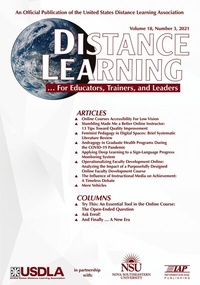
Distance Learning
Volume 18 #3
1st Edition
Published on 1. November 2021
89 pages
978-1-64802-743-7 (ISBN)
Description

Distance Learning is for leaders, practitioners, and decision makers in the fields of distance learning, e-learning, telecommunications, and related areas. It is a professional journal with applicable information for those involved with providing instruction to all kinds of learners, of all ages, using telecommunications technologies of all types. Stories are written by practitioners for practitioners with the intent of providing usable information and ideas. Articles are accepted from authors--new and experienced--with interesting and important information about the effective practice of distance teaching and learning.
Distance Learning is published quarterly. Each issue includes eight to ten articles and three to four columns, including the highly regarded "And Finally..." column covering recent important issues in the field and written by Distance Learning editor, Michael Simonson. Articles are written by practitioners from various countries and locations, nationally and internationally.
Distance Learning is published quarterly. Each issue includes eight to ten articles and three to four columns, including the highly regarded "And Finally..." column covering recent important issues in the field and written by Distance Learning editor, Michael Simonson. Articles are written by practitioners from various countries and locations, nationally and internationally.
More details
Other editions
Additional editions
Michael Simonson
Distance Learning Vol 18 Issue 3
Book
12/2021
Information Age Publishing
€47.00
Shipment within 3-4 weeks
Content
- Front Cover
- Articles
- 1
- Online Courses Accessibility For Low Vision
- 14
- Stumbling Made Me a Better Online Instructor: 13 Tips Toward Quality Improvement
- 23
- Feminist Pedagogy in Digital Spaces: Brief Systematic Literature Review
- 31
- Andragogy in Graduate Health Programs During the COVID-19 Pandemic
- 45
- Applying Deep Learning to a Sign-Language Progress Monitoring System
- 57
- Operationalizing Faculty Development Online: Analyzing the Impact of a Purposefully Designed Online Faculty Development Course
- SHORT PAPERS
- 67
- The Influence of Instructional Media on Achievement: A Timeless Debate
- 71
- Mere Vehicles
- Columns
- Get Your Copy Today-Information Age Publishing
- Online Courses Accessibility for Low Vision
- Asma Marghalani and Cindy S. York
- This qualitative study explores what accessibility design can be most important to facilitate learning in an online course for postsecondary students with low vision. The study was conducted in a U.S. public university offering online courses in the ...
- Introduction
- Literature Review
- Online Courses
- Online Courses for Students With Low Vision
- Accessibility
- Theoretical Framework
- Methodology
- Setting, Sample, and Participants
- Research Questions
- 1. What accessibility design did students with low vision who experienced online courses perceive to be helpful for their learning?
- 2. What accessible features would students with low vision want to exist in future online courses?
- Data Collection
- Data Analysis
- Findings
- 1. What accessibility design did students with low vision who experienced online courses perceive to be helpful for their learning?
- 2. What accessible features would students with low vision want to exist in future online courses?
- Discussion
- Accessibility
- Wish List for Students With Low Vision in Online Courses
- Recommendation, Implication, and Conclusion
- References
- Appendix: Semistructured Guiding Interview
- Part 1:
- 1. When were you diagnosed with low vision?
- 2. In which educational level did you recognize you needed more support and accommodations from the school or teachers/instructors?
- 3. Do you have other family members who have the same or a similar condition?
- 4. Do you learn from them? Or did you teach them how to deal with low vision in an academic setting?
- Part 2:
- 1. As a student with low vision, do you prefer online or face-to-face courses?
- 2. What are the information delivery methods (text such as pdf or word document, audio, video) that you find to be most beneficial with regard to your learning in the past online courses?
- 3. Which types of accommodations and assistive technologies could contribute better to your engagement, participation, and learning of the content of your online courses?
- 4. According to your experience, what accessibility accommodations in online courses were helpful to you, and how were they helpful (to navigate the online courses, to better understand online instruction, and/or to complete online activities?
- 5. What accessibility design did you need in online courses but did not help you understand the material?
- 6. What is your wish list regarding accessibility accommodations you would prefer in an online course? Can you describe a specific experience where you felt like you did not have access to services or accommodations that you thought would be helpful ...
- 7. Is there anything else you would like the researchers to know about your online course experience regarding your low vision?
- 8. What question should I have asked but did not?
- Stumbling Made Me a Better Online Instructor
- 13 Tips Toward Quality Improvement
- Marianne Bickle and Ryan Rucker
- Online teaching is becoming increasingly more important and prevalent worldwide as the needs of the environment change. Technological advances certainly play a significant role in the ability to reach learners beyond the physical classroom. Reaching ...
- Case Study
- Tip #1: Course Copy Is Effective in Providing You With Suggestions
- Tip #2: Do Not Underestimate the Amount of Time a Course Will Require
- Tip #3: Place Discussion Board Links Within the Learning Module for Easy Access
- Tip #4: Incorporate Universal Design for Learning Throughout the Course Is Not an Option
- Tip #5: Incorporate Mandatory Interaction Into the Syllabus
- Tip #6: Explain the Relationship Between Learning Outcomes and Assignments
- Tip #7: Complete an Assessment Regarding the Purpose of Each Assignment
- Tip #8: Make the Feedback Significant and Applicable to the Assignment
- Tip #9: Reach Out and Communicate
- Tip #10: Do Not Assume Learners Know How to Read a Grade Book
- Tip #11: Post Assignment Reminders on the Announcement Board and Send a Copy to Learners' University Email Account
- Tip #12: Be a Broken Record
- Tip #13: Follow Netiquette Rules While Presenting a Humanistic Tone of Voice
- Conclusion and Implications
- References
- TIPS-A BAKER'S DOZEN (13)!
- Feminist Pedagogy in Digital Spaces
- Brief Systematic Literature Review
- Chynar Amanova
- This paper presents a systematic, structured review of research that explicitly underscores teaching/learning aspects of online feminism. Feminist pedagogy was adopted as a theoretical framework in analyzing the content of the articles. This pedagogy...
- Feminist Pedagogy in Digital Spaces: Brief Systematic Literature Review
- Theoretical Framework
- Definitions of Feminist Pedagogy
- Mode of Inquiry
- 1. What is the focus of the research of the articles?
- 2. Which theoretical framework(s) did the studies use?
- 3. What methodologies did the studies employ?
- Summary of Findings
- Findings Concerning RQ1
- Findings Concerning RQ2
- Findings Concerning RQ3
- Conclusion
- Author Note
- References
- Quarterly Review of Distance Education, Subscribe Today! www.infoagepub.com
- Andragogy in Graduate Health Programs During the COVID-19 Pandemic
- Adam Ladwig, Patti J. Berg-Poppe, Moses Ikiugu, and Brandon M. Ness
- Accelerated by the COVID-19 pandemic, graduate health programs have undertaken greater utilization of online learning, utilizing synchronous and asynchronous online lectures as a replacement for traditional face-to-face instruction. Although supporte...
- Introduction
- The Status of Online Learning in Graduate Health Programs
- Online Learning Is Here to Stay
- Bringing Andragogy to Online Learning
- 1. need to know why they need to learn something (need to know).
- 2. should be given opportunities for self- direction (self-directedness).
- 3. tend to connect new learning to prior experience (experience).
- 4. need to be in a state of readiness to learn (readiness to learn).
- 5. learn best when real-life application is possible (problem-based).
- 6. respond best to internal motivation (motivation).
- Additional Factors Impacting Online Experience
- Transactional Distance
- Community of Inquiry
- The Six Assumptions of Andragogy in Current Literature
- Need to Know
- Self-Directedness
- Experience
- Readiness to Learn
- Problem Based
- Motivation
- Discussion
- Conclusion
- References
- "Adults learn best when they understand why, what, and how ."
- Applying Deep Learning to a Sign Language Progress Monitoring System
- Pakhi Agarwal, Jian Liao, Simon Hooper, and Rayne Sperling
- Progress monitoring is used to assess a student's performance during the early stages of literacy development. Computerized progress monitoring systems are capable of scoring some progress monitoring measures automatically. However, other measures,...
- Introduction
- Progress Monitoring and Deep Learning
- Deep Learning for Video Recognition and Classification
- Picture-Naming Tools and Interfaces
- PictureNaming: Student Interface
- PictureNaming: Manual Data Collection Tool and Data Chart
- Video-Recording Tool
- Deep-Learning Model
- Auto-Scoring Tool
- Discussion
- References
- Get Your Copy Today-Information Age Publishing
- Operationalizing Faculty Development Online
- Analyzing the Impact of a Purposefully Designed Online Faculty Development Course
- Mapopa W. Sanga
- This study investigated the process through which 32 university instructors went through as they took part in a year-long online excellence academy intended to improve their course delivery skills. For 3 years, the course enrolled a pilot cohort foll...
- Conceptual Framework
- Faculty Development in Online Learning Settings
- Purpose, Methods, and Questions
- Research Questions
- 1. What pedagogical benefits did participants gain from completing the online Excellence Academy?
- 2. What challenges did participants encounter while completing the Excellence Academy, and how were they addressed?
- 3. What implications did the process of offering the Excellence Academy online have on future faculty development initiatives?
- Data Collection
- Table 1. Pedagogical Benefits to Academy Participants
- Table 2. Challenges
- Table 3. Implications
- Discussion
- Conclusions
- References
- Get Your Copy Today-Information Age Publishing
- The Influence of Instructional Media on Achievement
- A Timeless Debate
- Susan Camillieri
- Introduction and Purpose
- The Argument
- The Counterargument
- Modern Applications
- Conclusions
- References
- Mere Vehicles
- Aniketh Chavan
- Introduction and Purpose
- Audience
- Clark's Stance
- Opponents' Stance
- Correlation With Physical Therapy Education
- Conclusion
- References
- An Essential Tool in the Online Course
- The Open-Ended Question
- Errol Craig Sull
- Understand What Is Meant by an "Open-Ended Question"
- Open-Ended Questions Are Especially Important in the Distance Learning Class
- Know when to Use "Close-Ended Questions"
- Correctly Structuring the Content of an Open-Ended Question Is Extremely Important
- Know Where and When to Include Open-Ended Questions
- Never Lead Students to Answer Open-Ended Questions
- Understand When to Avoid Open-Ended Questions
- Create a Bank of Open-Ended Questions
- Get Your Copy Today-Information Age Publishing
- Ask Errol!
- Errol Craig Sull
- Making Contact With School Administrators Although Not Asked
- A New Instructor Needs Guidelines in Working With a Mentor
- Clever Approaches Needed for Teaching Research
- 1. Use Kahoot. If you are not familiar with this it's a free online game where you develop a series of questions- usually 10-about a specific subject. The attendees-here it would be your students-press a button on their computer screen to r...
- 2. Have students create a Wikipedia page. Wikipedia is dissed by many educators as a source never to use for research papers. The reasons are often valid: unsubstantiated information
- information that can seemingly be added by on anyone
- accurate con...
- 3. Create and have students post to a blog on research. Blogs are simply fun! You can pick your subject-in this case research-and start it off with anything you'd like pertaining to research. Have students make their own posts and respond to po...
- FOLLOW ERROL'S SIX GUIDELINES. THEY WORK!
- A New Era .
- Michael Simonson
- Early Years = Hardware
- Middle Years = Expansion
- Recently = Impact
- Critical Element = Design!
- Back Cover
