

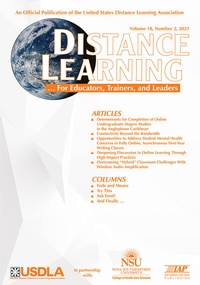
Distance Learning
Volume 18 #2
1st Edition
Published on 1. September 2021
61 pages
978-1-64802-651-5 (ISBN)
Description

Distance Learning is for leaders, practitioners, and decision makers in the fields of distance learning, e-learning, telecommunications, and related areas. It is a professional journal with applicable information for those involved with providing instruction to all kinds of learners, of all ages, using telecommunications technologies of all types. Stories are written by practitioners for practitioners with the intent of providing usable information and ideas. Articles are accepted from authors--new and experienced--with interesting and important information about the effective practice of distance teaching and learning.
Distance Learning is published quarterly. Each issue includes eight to ten articles and three to four columns, including the highly regarded 'And Finally...' column covering recent important issues in the field and written by Distance Learning editor, Michael Simonson. Articles are written by practitioners from various countries and locations, nationally and internationally.
Distance Learning is published quarterly. Each issue includes eight to ten articles and three to four columns, including the highly regarded 'And Finally...' column covering recent important issues in the field and written by Distance Learning editor, Michael Simonson. Articles are written by practitioners from various countries and locations, nationally and internationally.
More details
Other editions
Additional editions
Michael Simonson
Distance Learning Vol 18 Issue 2
Book
08/2021
Information Age Publishing
€47.00
Shipment within 3-4 weeks
Content
- Front Cover
- Articles
- 1
- Determinants for Completion of Online Undergraduate Degree Studies in the Anglophone Caribbean
- 15
- Connectivity Beyond the Bandwidth
- 23
- Opportunities to Address Student Mental Health Concerns in Fully Online, Asynchronous First-Year Writing Classes
- 35
- Deepening Discussion in Online Learning Through High-Impact Practices
- 41
- Overcoming "Hybrid" Classroom Challenges With Wireless Audio Amplification
- Columns
- Determinants for Completion of Online Undergraduate Degree Studies in the Anglophone Caribbean
- Pamela C. Dottin
- Online education increases in popularity for traditional and nontraditional undergraduate students, albeit some learners complete while others drop out. This case study focused on the experiences of 2 groups of Anglophone Caribbean students who enrol...
- Introduction
- Design
- Table 1. Sociodemographic Profile of Respondents
- 91
- 90
- 10
- 10
- 9
- 8.9
- 36
- 35.6
- 38
- 37.6
- 16
- 15.8
- 2
- 2
- 0
- 0
- 85
- 84
- 4
- 4.0
- 7
- 7.0
- 5
- 5.0
- 35
- 35
- 1
- 1
- 4
- 4
- 2
- 2
- 8
- 8
- 50
- 50
- 18
- 18
- 24
- 24
- 10
- 10
- 13
- 13
- 7
- 7
- 22
- 22
- 5
- 5
- Findings and Discussion
- Table 2. Years to Graduation, Dropouts, Graduates, Retention, and Cohort by Age Range
- 4
- 19
- 20
- 17
- 60
- 165
- 228
- 453
- 10
- 38
- 28
- 17
- 93
- 188
- 383
- 664
- 3
- 11
- 14
- 8
- 36
- 92
- 175
- 303
- 0
- 4
- 7
- 4
- 15
- 28
- 52
- 95
- 0
- 0
- 0
- 0
- 0
- 2
- 12
- 14
- Table 3. Cohort Dropout by End of Academic Year
- 428
- 41
- 1
- 4
- 0
- Key Factors Affecting Persistence
- Limitations of the Study
- Conclusions
- Note
- References
- Get Your Copy Today-Information Age Publishing
- Connectivity Beyond the Bandwidth
- Barbara Ann M. Messina
- The summer of 2020 in New York City COVID-19 caused the closure of onsite university classes necessitating the transition of the onsite post-baccalaureate undergraduate nursing program to an online synchronous distance mediated format. Failing to rec...
- Background
- Introduction
- State University of New York/ College of Nursing (SUNY Downstate/CON)
- Student Expectations
- First Unconscious Implicit Faculty Assumption
- Second Unconscious Implicit Faculty Assumption
- Transitioning to a Distance-Mediated Format
- Semester Commencement: Summer 2020
- The Student Perspective
- Student Expectations
- Connecting to the Faculty, Administration, and Staff: Virtual Pet Meet and Greet
- Connecting to the CON Staff: Staff Meet and Greet
- Establishing a Virtual Drop-in Office
- Conclusions and Future Recommendations
- References
- Call for Papers
- Publish in Distance Learning
- The editors of Distance Learning would like to publish your paper. We are interested in papers dealing with practical applications of distance education in a variety of settings. Contact Michael Simonson, editor, if you have questions about your idea...
- Opportunities to Address Student Mental Health Concerns in Fully Online, Asynchronous First-Year Writing Classes
- Charlotte Moore
- As online education's prevalence increases, postsecondary institutions have not met online learners' mental health needs. In-person learners benefit from accessible and robust campus services and activities to support well-being. However, many po...
- Introduction
- Current Solutions
- Identification of Unmet Needs
- Opportunities to Reduce Disparities
- Next Steps
- Conclusion
- References
- Deepening Discussion in Online Learning Through High-Impact Practices
- Amy Winger
- A central component of online learning, asynchronous discussions have the potential to positively impact distance learners in myriad ways. For discussion to be most impactful, best practices associated with online discussion should be implemented, ye...
- Background
- Deepening Discussion Through Bloom's Taxonomy
- Deepening Discussion Through Case-Based Discussions
- Deepening Discussion Through Text-Based Answers
- Deepening Discussion Through Unique Perspectives
- Deepening Discussion Through Small Groups
- Challenges
- Conclusion
- References
- Overcoming "Hybrid" Classroom Challenges With Wireless Audio Amplification
- Joe Martinez
- Reference
- Cultivating Swift Trust in Virtual Teams in Online Courses
- Natalie B. Milman
- What Is Swift Trust?
- Why Is Swift Trust Important to Online Learning?
- How Can Instructors Support Students as they Develop Swift Trust?
- 1. Icebreakers: Provide opportunities for students to get to know one another, particularly their teammates. Icebreakers can include simple activities like pairing up and introducing one another to more involved team building activities such as scave...
- 2. Team charter: Instructors can require or encourage virtual teams to develop a team charter. A team charter is a document that team members create collaboratively that outlines the goals, objectives, norms, roles, responsibilities, and deadlines fo...
- 3. Instructor-team check-ins: Schedule team check-ins or require some type of reporting for team members to communicate collectively and individually what is working well and what could be improved within their teams, as well as to share progress on ...
- 4. Require a project report: Instructors can require students document their work in the form of a project report. This might include who completed what work and how much time it took for them to completed it. This holds team members accountable for ...
- 5. Individual and peer review: Evaluation of each team member's contribution is another way for students to build accountability when working in virtual teams.
- References
- Responding to Multicultural Plagiarism in the Online Course
- Errol Craig Sull
- An Important Concluding Note
- Ask Errol!
- Errol Craig Sull
- Volunteering for Extra School Activities
- Giving Feedback an Assignment Rubric
- Balance of Information to Share With a Guest Instructor
- The Night Is Dark .
- Michael Simonson
- Back Cover
