

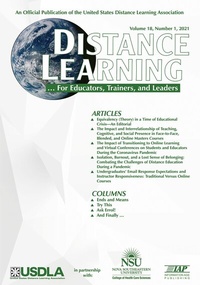
Distance Learning
Volume 18 #1
1st Edition
Published on 1. May 2021
75 pages
978-1-64802-539-6 (ISBN)
Description

Distance Learning is for leaders, practitioners, and decision makers in the fields of distance learning, e-learning, telecommunications, and related areas. It is a professional journal with applicable information for those involved with providing instruction to all kinds of learners, of all ages, using telecommunications technologies of all types. Stories are written by practitioners for practitioners with the intent of providing usable information and ideas. Articles are accepted from authors--new and experienced--with interesting and important information about the effective practice of distance teaching and learning.
Distance Learning is published quarterly. Each issue includes eight to ten articles and three to four columns, including the highly regarded "And Finally..." column covering recent important issues in the field and written by Distance Learning editor, Michael Simonson. Articles are written by practitioners from various countries and locations, nationally and internationally.
Distance Learning is published quarterly. Each issue includes eight to ten articles and three to four columns, including the highly regarded "And Finally..." column covering recent important issues in the field and written by Distance Learning editor, Michael Simonson. Articles are written by practitioners from various countries and locations, nationally and internationally.
More details
Other editions
Additional editions
Michael Simonson
Distance Learning Vol 18 Issue 1
Book
07/2021
Information Age Publishing
€47.00
Shipment within 3-4 weeks
Content
- Front Cover
- Table of Contents
- v
- Equivalency (Theory) in a Time of Educational Crisis -An Editorial
- Equivalency (Theory) in a Time of Educational Crisis
- An Editorial
- Michael Simonson
- Reference
- The Impact and Interrelationship of Teaching, Cognitive, and Social Presence in Face-to-Face, Blended, and Online Masters Courses
- Jennifer Courduff, HeeKap Lee, and Jessica Cannaday
- Global events have changed the fundamental way teachers teach and students learn in the 21st century. Teacher preparation programs have necessarily offered their programs through varied modalities. One specific framework for teaching in different mod...
- Introduction
- Review of the Literature
- Community of Inquiry
- Teaching Presence
- Cognitive Presence
- Social Presence
- Purpose Statement
- Research Methods
- Instrumentation and Data Collection
- Table 1. Demographic Characteristics of Participants (N = 121, One With Missing Information)
- 41
- 30
- 95
- 70
- 31
- 22.8
- 82
- 60.3
- 23
- 16.9
- 26
- 21.1
- 62
- 50.5
- 32
- 26.1
- 3
- 0.30
- 71
- 52.2
- 44
- 32.4
- 6
- 0.04
- 3
- 0.02
- 8
- 0.6
- 4
- 0.03
- Data Analyses and Preliminary Findings
- Table 2. Regression Analysis Summary
- .073**
- .043
- 1.69
- .09
- .026
- .042
- .63
- .53
- -.84*
- .046
- -1.82
- .07
- -1.09
- .680
- -1.60
- .11
- .31
- .641
- .48
- .63
- Table 3. Regression Analysis
- .11**
- .055
- 2.06
- .04
- .02
- .056
- .28
- .78
- -.07
- .057
- -1.28
- .20
- -1.35
- .912
- -1.49
- .14
- .44
- .841
- .52
- .61
- -.05
- .109
- -.49
- .06
- .08
- .084
- 1.00
- .33
- -.10
- .088
- -1.09
- .29
- -.13
- 1.33
- -.10
- .92
- .28
- 1.23
- .18
- .86
- -.20
- .204
- -1.00
- .033
- -.12
- .148
- -.79
- .44
- .30
- .273
- 1.10
- .29
- -1.62
- 2.06
- -.79
- .44
- -.21
- 2.24
- -.09
- .93
- Table 4. Regression Analysis Summary
- 4.59 (0.86)
- 4.71 (0.64)
- 4.64 (0.69)
- 4.57 (0.92)
- 4.36 (1.01)
- 4.41 (0.96)
- 4.35 (0.90)
- 4.32 (0.95)
- 4.41 (0.90)
- 4.49 (0.86)
- 4.44 (0.74)
- 4.54 (0.85)
- 4.45 (0.91)
- 4.55 (0.80)
- 4.50 (0.76)
- 4.49 (0.91)
- Multiple Regression Analysis Predicting Academic Perseverance
- Table 5. Regression Analysis: Students' Response at the End of the Semester
- .12**
- .056
- 2.14
- .03
- -.001
- .052
- -.03
- .98
- -.07
- .052
- -1.38
- .17
- -1.15
- .915
- -1.27
- .21
- .17
- .853
- .20
- .84
- Significance
- Table 6. Strategies to Promote Students' Learning Using the CoI Framework
- 1. Teaching presence is the valid and significant factor to contribute to students' academic success, especially in connection to course organization. As a result, emphasize course organization to increase teaching presence in ALL modalities.
- 2. Quantitatively, cognitive presence was found to have negatively influenced students' final grades, Although, qualitative data indicates that this may be due an interrelationship between the presences (i.e., cognitive was dependent on social and ...
- 3. Social presence was not a significant factor in either quantitative or qualitative data findings. This should be an area for future research.
- Conclusion
- References
- The Impact of Transitioning to Online Learning and Virtual Conferences on Students and Educators During the Coronavirus Pandemic
- Jia Borror, Sarah Ransdell, Jenna Binaco, and April Feeser
- Introduction
- References
- Appendix A
- Appendix B
- Appendix C
- Apps and Websites for Preschoolers
- For daily schedules
- Timer Countdowns
- Meditation and Calming Apps
- Websites for Teachers and Parents
- Psychological Bulletin about the importance of self-regulation across the lifespan
- Isolation, Burnout, and a Lost Sense of Belonging
- Combating the Challenges of Distance Education During a Pandemic
- Kelly L. Heider
- COVID-19 forced a rapid shift from in-person to online learning in both K-12 and postsecondary schools. Some teachers and students adapted well to the shift while others continue to struggle. Common complaints from teachers who struggle in the new ...
- Introduction
- Best Practices to Combat Teacher Isolation in Online Teaching
- Assistance From Colleagues
- Professional Development
- Podcasts
- Continuing Education Courses
- Webinars
- Educational Research
- Best Practices to Combat Teacher Burnout in Online Teaching
- Table 1. The Eight Dimensions of Wellness
- Best Practices to Create a Sense of Belonging in the Online Classroom
- Table 2. Creating a Sense of Belonging in Online Courses
- Final Thoughts
- References
- Call for Papers
- Publish in Distance Learning
- The editors of Distance Learning would like to publish your paper. We are interested in papers dealing with practical applications of distance education in a variety of settings. Contact Michael Simonson, editor, if you have questions about your idea...
- Undergraduates' Email Response Expectations and Instructor Responsiveness
- Traditional Versus Online Courses
- LeAnn Wilkie and Joseph A. Rosendale
- Instructors and students communicate via email in both online-only and traditional college coursework. Few institutions have guidelines regarding instructor- to-student or student-to-instructor response norms. This article discusses findings from a s...
- Introduction
- Literature Review
- Social Presence
- Transactional Distance and Online Communication
- Online Versus Traditional Course Delivery
- The Digital Student
- Faculty-to-Student Email Communication
- Student Email Response Expectations
- Rationale for the Study
- Methodology
- Participant Population and Site of Study
- Instrument
- Research Design
- Reliability Analysis
- Results
- Descriptive Statistical Analysis
- Research Hypotheses
- Table 1. Expected Response Rates-Traditional Versus Online Courses
- 41.9%
- 4.3%
- 0
- 12.9%
- 28%
- 0
- 0
- 8.6%
- 4.3%
- 40.8%
- 2.5%
- 6.1%
- 4.9%
- 32.1%
- 2.5%
- 2.5%
- 3.7%
- 4.9%
- 28.7%
- 2.2%
- 1%
- 13.2%
- 48.4%
- 2.2%
- 0
- 1%
- 3.3%
- 17.6%
- 3.4%
- 1%
- 16.5%
- 37.4%
- 2.2%
- 1%
- 7.7%
- 13.2%
- Table 2. Reported Response Rates-Traditional Versus Online Courses- General and Grade/Assignment-Related Messages
- 29%
- 8.6%
- 2.1%
- 5.4%
- 9.8%
- 18.3%
- 2.1%
- 3.2%
- 2.1%
- 9.8%
- 8.6%
- 1%
- 0
- 0
- 0
- 9.6%
- 32.1%
- 6.2%
- 3.7%
- 2.5%
- 3.7%
- 20.9%
- 11.1%
- 0
- 3.7%
- 6.2%
- 7.4%
- 2.5%
- 0
- 0
- 0
- 0
- Table 3. Reported Response Rates- Traditional Versus Online Courses-Weekend and Out-of-Town Messages
- 28.7%
- 2.2%
- 1%
- 13.2%
- 48.4%
- 2.2%
- 0
- 1%
- 3.3%
- 17.6%
- 3.4%
- 1%
- 16.5%
- 37.4%
- 2.2%
- 1%
- 7.7%
- 13.2%
- Table 4. Expected Versus Reported Response Rates- Traditional Courses-General and Grade/Assignment Related Email Messages
- 32.2%
- 8.6%
- 5.3%
- 9.6%
- 20.4%
- 10.7%
- 3.3%
- 4.3%
- 5.4%
- 35.8%
- 10%
- 3.7%
- 6.2%
- 22.2%
- 11.1%
- 2.4%
- 3.7%
- 4.9%
- Table 5. Expected Versus Reported Response Rates- Traditional Courses-Weekend and Out-of-Town Messages
- Weekend messages
- 8.8%
- 7.6%
- 5.4%
- 5.4%
- 21%
- 30%
- 1%
- 7.6%
- 13.2%
- 8.7%
- 7.7%
- 5.5%
- 5.5%
- 20.7%
- 30%
- 1%
- 7.7%
- 13.2%
- Table 6. Expected Versus Reported Response Rates- Online Courses-General and Grade/Assignment Related Email Messages
- 31.1%
- 14.5%
- 5.6%
- 5.6%
- 8.8%
- 18.8%
- 5.6%
- 5.6%
- 1.1%
- 1.1%
- 2.2%
- 0
- 30.1%
- 10.3%
- 2.3%
- 5.7%
- 5.7%
- 20.6%
- 8.1%
- 3.5%
- 1.1%
- 2.3%
- 10.3%
- 0
- Table 7. Expected Versus Reported Response Rates- Online Courses-Weekend and Out-of-Town Messages
- 28.6%
- 7.6%
- 5.5%
- 5.5%
- 27.5%
- 18.7%
- 0
- 1.1%
- 5.5%
- 10.9%
- 12%
- 12%
- 3.3%
- 15.4%
- 30%
- 0
- 1%
- 15.4%
- Discussion
- Response Expectations
- Perceived Instructor Responsiveness
- References
- Get Your Copy Today-Information Age Publishing
- Artificial Intelligence
- Evolving Conceptions and Considerations for Online Educators
- Jessa Henderson and Natalie B. Milman
- What Is Artificial Intelligence?
- How Is Education Conceptualizing AI?
- Why Do AI Definitions Matter for Online Educators?
- References
- A Miniguide to Revising an Online Course
- Errol Craig Sull
- Ask for Initial Input From a Supervisor or Dean
- Do a Thorough Check of the Previous Course for Changes
- Understand the Student Audience
- Develop and/or Change Course Objectives
- Do Research on What Is Trending/Current in Your Field
- Begin With Student Assignments
- Make Tweaks, Additions, Subtractions Built Around Assignments
- Incorporate Technology, Fun, and Interaction
- Ask for input from others
- Check, Double-Check, and Triple-Check Before Submitting
- Consider Feedback you Receive Very Carefully-And Never Take it Personally
- Get Your Copy Today-Information Age Publishing
- Ask Errol!
- Errol Craig Sull
- No-One Seems to Care- Unless Something Is Wrong
- What Are the Best Ways to Use Student Compliments and Praise?
- What Makes for an Email That Grabs Students' Attention?
- And Finally ... Crisis Planning
- Michael Simonson
- Back Cover
