

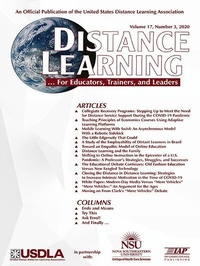
Distance Learning
Volume 17 #3
1st Edition
Published on 11. January 2020
121 pages
978-1-64802-402-3 (ISBN)
Description

Distance Learning is for leaders, practitioners, and decision makers in the fields of distance learning, e-learning, telecommunications, and related areas. It is a professional journal with applicable information for those involved with providing instruction to all kinds of learners, of all ages, using telecommunications technologies of all types. Stories are written by practitioners for practitioners with the intent of providing usable information and ideas. Articles are accepted from authors--new and experienced--with interesting and important information about the effective practice of distance teaching and learning.
Distance Learning is published quarterly. Each issue includes eight to ten articles and three to four columns, including the highly regarded "And Finally..." column covering recent important issues in the field and written by Distance Learning editor, Michael Simonson. Articles are written by practitioners from various countries and locations, nationally and internationally.
Distance Learning is published quarterly. Each issue includes eight to ten articles and three to four columns, including the highly regarded "And Finally..." column covering recent important issues in the field and written by Distance Learning editor, Michael Simonson. Articles are written by practitioners from various countries and locations, nationally and internationally.
All prices
More details
Other editions
Additional editions
Michael Simonson
Distance Learning Vol 17 Issue 3
Book
02/2021
Information Age Publishing
€47.00
Shipment within 3-4 weeks
Content
- Front Cover
- Featured Articles
- 1
- Collegiate Recovery Programs: Stepping Up to Meet the Need for Distance Service Support During the COVID-19 Pandemic
- 17
- Teaching Principles of Economics Courses Using Adaptive Learning Platforms
- 29
- Mobile Learning With Swivl: An Asynchronous Model With a Robotic Sidekick
- 33
- The Little Edgenuity That Could
- 39
- A Study of the Employability of Distant Learners in Brazil
- Short Articles
- 59
- Toward an Empathic Model of Online Education
- 63
- Distance Learning and the Family
- 67
- Shifting to Online Instruction in the Epicenter of a U.S. Pandemic: A Professor's Strategies, Struggles, and Successes
- 83
- The Educational Debate Continues: Old Fashion Education Versus New Fangled Technology
- 87
- Closing the Distance in Distance Learning: Strategies to Increase Intrinsic Motivation in the Time of COVID-19
- 91
- White Paper: Modern-Day Media Versus "Mere Vehicles"
- 95
- "Mere Vehicles:" An Argument for the Ages
- 99
- Moving on From Clark's "Mere Vehicles" Debate
- Columns
- Collegiate Recovery Programs
- Stepping Up to Meet the Need for Distance Service Support During the COVID-19 Pandemic
- Michelle R. Gould
- An investigation of collegiate recovery programs (CRPs) showcased CRPs as a vital student support service in traditional and online learning environments. Comparing standards for in-person versus online delivery showed equivalence in services consist...
- The Relevance of Collegiate Recovery Programs in Academic Life
- The Relevance of Online Support Services
- Composition and Components of Collegiate Recovery Programs
- Standards
- Abstinence Based
- Institutionally Based
- Nonprofit
- Paid Staff
- Recovery Support Services
- Collegiate Recovery Community
- Dedicated Space
- Services: Similarities and Differences
- Department
- Where and How They Start
- Membership Requirements
- Focus
- Funding
- Curriculum
- On-Campus Sober Housing
- Staff Background and Qualifications
- Purpose and Benefits
- Changes to Support Services Relative to the Pandemic
- Challenges
- Solutions
- Institutional Perspective
- Student Perspective
- Conclusion
- References
- Quarterly Review of Distance Education, Subscribe Today! www.infoagepub.com
- Teaching Principles of Economics Courses Using Adaptive Learning Platforms
- Michael Luzius
- Sea Change in Textbook Publishing Industry
- Transformation
- Intellipath, RealizeIT
- Flipped Approach and Student- Centered Learning
- Technology and Flipped Classroom
- Intellipath, RealizeIT
- The Interface and Learning Map
- The Learning Map View
- Individual Student Learning Map
- The graphic interfaces
- Useful Indicators
- Revisions and Practices
- Message Utility
- How to Use Information From Intellipath to Adjust Instructor Interactions With Students
- Summary
- Bibliography
- Mobile Learning With Swivl
- An Asynchronous Model With a Robotic Sidekick
- Daniel Perez
- References
- The Little Edgenuity That Could
- Thomas Vaughan
- The Why
- The What
- The How
- Credit Retrieval Labs
- ESE EBD Classrooms
- The Barriers
- Breaking the Barrier
- Is Edgenuity Working?
- COVID-19 and the Future
- References
- Call for Papers
- Publish in Distance Learning
- The editors of Distance Learning would like to publish your paper. We are interested in papers dealing with practical applications of distance education in a variety of settings. Contact Michael Simonson, editor, if you have questions about your idea...
- A Study of the Employability of Distant Learners in Brazil
- Vinicius Mascherini de Lima
- Projections show that in the next 5 years, Brazil will have 9 million students in higher education courses (a 50% increase in the period). This growth is concentrated in the distance learning modality, which is expected to triple until it reaches 4.5...
- Objectives
- Restraints
- Theoretical Framework
- The Distance Learning Evolution in Brazil
- Employability and the Brazilian Reality
- Methodological Procedures
- First Work Front- Executives' Interviews
- Second Work Front- Students' Interviews
- Third Work Front- Employability and Wages Analysis
- Data Procedures
- Table 1. Sample Size Drill Down for Qualitative Analysis
- Findings and Discussion
- Employability of DL Graduates
- Resistance to the DL Model
- Dealing With the Resistance
- Future Expectations
- Conclusions
- References
- Appendix A: Business Executives Interviewing Guide
- Appendix B: DL Students Interviewing Guide
- Appendix C: z Test for Proportion of Employed Graduates
- Appendix D-t Test for Wages Comparison
- Get Your Copy Today-Information Age Publishing
- Toward an Empathic Model of Online Education
- Paul A. Crutcher
- References
- Distance Learning and the Family
- Glenn H. Dakin
- Planning a practical learning process is essential for successful distance learning. Online learners may be motivated by convenience to participate. Reading, writing, listening, and time management are learning skills. Guiding a distance learner to i...
- Locus of Control and Learning
- The Self-fulling Prophecy and Learning Expectations
- Passive Learning Versus Active Learning
- Is it Training or Is it Learning?
- Learning Family Structure Process
- 1. Schedule a daily specific learning time for each subject.
- 2. Create a secluded learning area without interruption.
- 3. Do not include TV, cell phones, or radios.
- 4. If musically inclined, use an iPod with ear phones.
- 5. On the first day, review assignment details and clarify understanding.
- 6. Reach out to faculty for understanding assignment details.
- Learning Family Process Steps
- 1. Create a daily schedule with 90 to 120 minutes per course.
- 2. Make a copy for each family member.
- 3. Schedule a discussion at the kitchen table.
- 4. Explain that you are engaged with the online educational goal to improve family quality.
- 5. If you find individuals not onboard, then state you are borrowing 30 to 40 thousand dollars to do this now.
- 6. The discussion must reach a point where everyone agrees.
- 7. At this time, state, "Please, I need your help."
- 8. Distribute the schedule and ask for feedback.
- 9. When consensus is reached, thank them for their time.
- 10. Make no demands to conform to the plan
- instead, ask for support.
- 11. If you are a parent, create a reward system for tracking activity.
- 12. Hang a 3 x 5 grease board listing all family names.
- 13. After each week, mark the person with stars and reward them.
- Learning Family Plan Benefits
- References
- Shifting to Online Instruction in the Epicenter of a U.S. Pandemic
- A Professor's Strategies, Struggles, and Successes
- Danielle DiMarco
- The Epicenter
- A Trial Run?
- So This Is Really Happening
- A Move Away From Business as Usual
- Roadblocks
- Technical Issues
- Virtual Communication Anxiety
- Internal Struggle
- 1. demonstrates an understanding of the topic/purpose of the project
- 2. capable of answering questions asked by the professor and/or peers
- 3. holds the attention of the audience
- 4. emphasizes key points
- and
- 5. demonstrates enthusiasm.
- Now It's Real
- Be Mindful of Challenges
- Encouraging Staff and Student Contact
- Cooperation Among Students
- Giving Prompt Feedback
- Increasing Time on Task
- Communicating High Expectations
- Roadblocks
- Missed Class
- Those Affected Directly by COVID-19
- Internal Struggle
- Triage
- Emergency Intervention
- 1. Be present at the course site
- 2. Create a supportive online course community
- 3. Develop a set of explicit expectations for your learners and yourself as to how you will communicate and how much time students should be working
- 4. Use a variety of large group, small group, and individual work experiences
- 5. Use synchronous and asynchronous activities
- 6. Ask for informal feedback early in the term
- 7. Prepare discussion posts that invite responses, questions, discussions, and reflections
- 8. Search out and use content resources that are available in digital format if possible
- 9. Combine core concept learning with customized personal learning
- and
- 10. Plan a good closing and wrap activity for the course.
- Ask for Informal Feedback
- Help Students Determine How Much Time They Should Spend Working
- Plan a Good Closing or Wrap Activity
- Roadblocks
- Feelings of Mental Distress
- AWOL Students
- Internal Struggle (Final Grading)
- Lessons Learned
- Providing Consistency for Students
- Searching for Best Practices
- Grading Fairly
- Where Are We Going From Here?
- References
- Appendix A
- Appendix B
- Appendix C
- The Educational Debate Continues
- Old Fashion Education Versus New Fangled Technology
- Suzie Ehmann
- References
- Closing the Distance in Distance Learning
- Strategies to Increase Intrinsic Motivation in the Time of COVID-19
- Sarah Ransdell and Jennifer Rieck
- Intriguing research shows that when students have intrinsic motives for learning -when they engage not for external reward but because they find the activity itself interesting and gratifying-they become more likely to attach meaning to their wor...
- Increasing Relatedness With Zoom
- Utilizing Zoom's Features for Autonomy and Competency
- Closing the Distance
- References
- White Paper
- Modern-Day Media Versus "Mere Vehicles"
- Arun Garg
- Executive Summary
- Richard Clark and "Mere Vehicles"
- Attempts to Refute Clark's views
- Evidence to Support Clark's Position
- Implications for Physical Therapy Education and Practice
- References
- "Mere Vehicles"
- An Argument for the Age
- Carla Rauseo
- Introduction
- Target Audience
- The Debate
- Clark's Argument
- The Detract ors
- Clark's Rebuttal
- Conclusion
- References
- Moving on From Clark's "Mere Vehicles" Debate
- Shannon Logan
- Introduction and Purpose
- Target Audience
- The Evolution of the Debate
- How Does This Debate Relate to Current Physical Therapy Education?
- The Bottom Line
- References
- Your Advertisement or Announcement Could Be Here
- USDLA 10 G Street, NE, Suite 600 Washington, DC 20002 202-248-5023
- The Technology Acceptance Model
- Considerations for Online Educators
- Jessa Henderson and Natalie B. Milman
- What Is TAM?
- Table 1. Determinants of Perceived Ease of Use and Perceived Usefulness
- References
- The Beginning Connection in an Online Course
- Crucial!
- Errol Craig Sull
- A Welcoming Announcement and Email Must Be Specific . but Also Warm, Inviting, and Motivating
- Immediately Connect the Course to the "Real World" of Employment
- Be Sure to Let Students Know You Welcome Their Contacts-And You Will Be Contacting Them
- Cool Tip #1: Offer Students a "Rate Yourself" at the Beginning
- Cool Tip #2: Use Past Students' Positive Comments as Motivators
- Get Into the Habit of Addressing Students by name
- Give a Personal Story or Two About Yourself That Is Motivating
- Do Not Ignore the World Surrounding the Students
- Don't Hesitate to Use Some Quirky Items to Show Students the Course Can Be Fun
- Make it a Point to Contact Each Student Individually Prior to the Course's Beginning
- Ask Errol!
- Errol Craig Sull
- How to Best Structure the Last Week of an Online Course
- What Basics Are Needed When Asked to Revise a Course
- How to Structure Phone Calls to Students
- And Finally . What's in a Name?
- Michael Simonson
- 1. Videoconferencing systems such as Zoom display names of distant students, so in order to equalize naming, have local students create name tents.
- 2. Proper student names should be used, nicknames that can be problematic (e.g., first and last names).
- 3. Difficult names to pronounce or remember could be hard to use, so instructors should negotiate with students.
- 4. First name use is friendly, but for adult students first names might be too "personal."
- 1. Student Classroom Name. What local and distance students should use as their videoconference name and the name on their classroom name tent.
- 2. Video Enabled. The distant learner should be required to have their video camera on during the entire class? Instructors can see the local students, so distant students should be seen also.
- 3. Dial-In Students. Is dialing in with a cell phone acceptable? If so, when? If not, what should they do if they are "on the road"?
- 4. Instructor's Name. What name should students use when referring to you.
- Back Cover

