

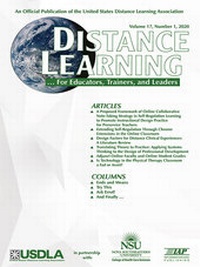
Distance Learning
Volume 17 #1
1st Edition
Published on 7. January 2020
69 pages
978-1-64802-170-1 (ISBN)
Description

Distance Learning is for leaders, practitioners, and decision makers in the fields of distance learning, e-learning, telecommunications, and related areas. It is a professional journal with applicable information for those involved with providing instruction to all kinds of learners, of all ages, using telecommunications technologies of all types. Stories are written by practitioners for practitioners with the intent of providing usable information and ideas. Articles are accepted from authors--new and experienced--with interesting and important information about the effective practice of distance teaching and learning.
Distance Learning is published quarterly. Each issue includes eight to ten articles and three to four columns, including the highly regarded 'And Finally...' column covering recent important issues in the field and written by Distance Learning editor, Michael Simonson. Articles are written by practitioners from various countries and locations, nationally and internationally.
Distance Learning is published quarterly. Each issue includes eight to ten articles and three to four columns, including the highly regarded 'And Finally...' column covering recent important issues in the field and written by Distance Learning editor, Michael Simonson. Articles are written by practitioners from various countries and locations, nationally and internationally.
All prices
More details
Other editions
Additional editions
Michael Simonson
Distance Learning Vol 17 Issue 1
Book
08/2020
Information Age Publishing
€47.00
Shipment within 3-4 weeks
Content
- Front Cover
- Table of Contents
- 1
- A Proposed Framework of Online Collaborative Note-Taking Strategy in Self-Regulation Learning to Promote Instructional Design Practice for Preservice Teachers
- 13
- Extending Self-Regulation Through Chrome Extensions in the Online Classroom
- 19
- Design Factors for Distance Clinical Experiences: A Literature Review
- 27
- Translating Theory to Practice: Applying Systems Thinking to the Design of Professional Development
- 35
- Adjunct Online Faculty and Online Student Grades
- 45
- Is Technology in the Physical Therapy Classroom a Fad or Asset?
- A Proposed Framework of Online Collaborative Note-Taking Strategy in Self-Regulation Learning to Promote Instructional Design Practice for Preservice Teacher
- Suthanit Wetcho and Jaitip Na-Songkhla
- In the 21st century, teachers need to continuously develop their knowledge and skills to work creatively on new ideas. The International Society for Technology in Education (2008) standards outlined the teacher's model, which has emphasized the imp...
- Introduction
- Research Design
- Table 1. The Elements and Outcomes From the Early Stages of Design-Based Research
- Defining Change of Problems and Assumptions
- Additional Findings
- Ideate Stage
- Preservice Teacher Instructional Design Practice
- Self-Regulated Learning
- Collaborative Note-Taking Strategy
- Table 3. Synthesis of the Right Tools for Collaborative Note-Taking
- Table 4. A Proposed Learning Design Blueprint
- -
- -
- -
- -
- Table 4. (Continued)
- -
- -
- -
- -
- -
- A Proposed Framework
- Future Design Direction
- Further Research Work
- References
- Extending Self-Regulation Through Chrome Extensions in the Online Classroom
- Amy Winger
- Online higher education has become more popular and available than at any other time
- however, persistence rates lag behind traditional education rates. To address this problem, self-regulation can be used as a strategy to improve student performance...
- Metacognition and Self-regulation Strategies
- Cognition and Self-Regulation Strategies
- Emotions and Self-regulation Strategies
- Challenges
- Conclusion
- References
- The Most Comprehensive Resource for Online Learning
- Design Factors for Distance Clinical Experiences
- A Literature Review
- George Nickles
- Residential university programs with required clinical experience will face obstacles if the format of the program moves to a distance method of delivery. The supervision of the students will need to take place entirely via digital technology. The li...
- Introduction
- Viability of Distance Clinical Experiences
- Ethical Considerations
- Ethics and Technology
- Supervisory Relationship
- Technology
- Supervisor Role
- Conclusions
- References
- Translating Theory to Practice
- Applying Systems Thinking to the Design of Professional Development
- Tracey A. Regenold and Sheila E. Murphy
- Introduction
- Systems Principles and the Instructional Design of Professional Development
- Theory to Practice
- Systems Principles and Instructional Design Practices
- The Law of Consequent Production
- Complementarity
- Holism
- Conclusion
- References
- Get Your Copy Today-Information Age Publishing
- Adjunct Online Faculty and Online Student Grades
- Wendy Kaaki
- Current research indicates that online student grades have dropped at for-profit online institutions, where adjunct online faculty made up for 80-90% of online faculty. Evidence of low online student grades in an era of increased use of adjunct onl...
- Introduction
- Literature Review
- Purpose
- 1. What is the relationship between online student grades and self- reported technological knowledge (TK), pedagogical knowledge (PK), and content knowledge (CK) of adjunct online instructors?
- 2. What is the relationship between the online student grades and self- reported pedagogical content knowledge (PCK), technological content knowledge (TCK), and technological pedagogical knowledge (TPK) of adjunct online instructors?
- 3. What is the relationship between self- reported pedagogical content knowledge (PCK), technological content knowledge (TCK), and technological pedagogical knowledge (TPK), and self-reported TPACK (Technological Pedagogical Content Knowledge) of adj...
- 4. To what extent, if any, is self-reported TPACK (Technological Pedagogical Content Knowledge) of adjunct online instructors related to online student grades?
- Methodology /Design
- Setting/Population/Sampling
- Instrument
- Validity and Reliability
- Results and Discussion
- Table 1. Age of Adjunct Online Faculty
- 18-29
- 1
- 30-44
- 38
- 45-59
- 30
- 60+
- 12
- Total
- 81
- Table 2. Race of Adjunct Online Faculty
- 59
- 73.8
- 5
- 6.3
- 5
- 6.3
- 1
- 1.3
- 10
- 12.5
- 1
- 81
- Table 3. Online Teaching Experience of Adjunct Online Faculty
- 7
- 26
- 27
- 21
- 81
- Table 4. Professional Development
- 81
- 1
- 4
- 2.4
- 1.1
- 81
- 1
- 4
- 2.4
- 1.1
- 81
- 1
- 4
- 2.4
- 1.1
- Table 5. Descriptive Statistics
- 81
- 14.5
- 100
- 68.1
- 17.5
- 81
- 1
- 5
- 3.9
- 0.88
- 81
- 1
- 5
- 4.37
- 0.91
- 81
- 1.71
- 5
- 4.12
- 0.91
- 81
- 1
- 5
- 4.15
- 0.92
- 81
- 1
- 5
- 3.95
- 1.19
- 81
- 1.33
- 5
- 3.71
- 1.01
- 81
- 2
- 5
- 4.04
- 0.88
- Recommendations for Practice
- Conclusion
- References
- Appendix A
- Is Technology in the Physical Therapy Classroom a Fad or an Asset?
- Matthew Casale
- References
- Ends and Means: Fostering Blended and Online Students' Well-Being
- Natalie B. Milman and Beth Tuckwiller
- How Can Online Instructors Cultivate Student Well-Being?
- References
- Try This: When Online Faculty Supervisors and Faculty Get Broken- And the Fixes!
- Errol Craig Sull and Kathy Embry
- Supervisor
- Faculty Member
- Ask Errol!
- Errol Craig Sull
- Using School Distance Learning Programs in the Corporate World
- How Best to Handle Students Turning in Assignments After a Course Has Ended
- Quarterly Review of Distance Education, Subscribe Today! www.infoagepub.com
- And Finally ... A Baker's Dozen
- Ideas for Creating an Online Course
- Michael Simonson
- 1. Finalize the syllabus: The syllabus is the key document for any course, but especially for an online course-make sure the syllabus is complete.
- 2. Organize the course: The unit-module-topic approach is best-do not organize content by time, such as weeks.
- 3. Organize a course into two or three main units, and each unit into three or four modules. Topics are key ideas in a module. (Most textbooks are very nicely organized and can provide the beginnings of structure to a course that uses the textbook.)
- 4. Building Blocks-Modules are building blocks for a course. Typically, a module is a division of content that requires about 8 hours of work by a student (reading, watching, listening, writing, studying, or discussing, for example).
- 5. Welcomes-the course should have a welcome from the instructor, and each module should have an introductory welcome (written, audio, or video).
- 6. Schedule-a detailed semester/term schedule should be prepared and sent to students Content-Add key topics to each module. Content can be textbook readings, single-concept videos, .pdf files, YouTubes, or other information that explains the mod...
- 7. Discussions-develop some way for students to interact about key topics presented in a module. Course management systems have easy-to-use discussion areas, but if no system is available email can be used.
- 8. Monday Morning Memos-Each Monday send an email or other correspondence to students that summarizes the previous week and introduces the upcoming week.
- 9. Partners-assign students to partners, but not teams. A partner supports, but teams may not.
- 10. Artifacts-Artifacts of student learning are papers, comments made to discussion questions, quizzes, audio explanations, or video demonstrations, for example. Each module should have some artifact expected from students.
- 11. Synchronous (or not)-"Live" classes using videoconferencing or conference telephone calls are okay, especially at first, but scheduling is a critical problem. If synchronous sessions are used make recordings of sessions available online (Yo...
- 12. Location, Location, Location-Online class content and organizational structure is typically placed in a course management system, such as Canvas or Blackboard. If no course management system is available, organize some other way such as by usin...
- 13. Be available-be regularly available either online, over the telephone, or via Zoom office hours.
- Back Cover

