

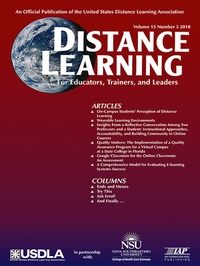
Distance Learning
Volume 15 #3
1st Edition
Published on 11. January 2018
93 pages
978-1-64113-534-4 (ISBN)
Description

Distance Learning is for leaders, practitioners, and decision makers in the fields of distance learning, e-learning, telecommunications, and related areas. It is a professional journal with applicable information for those involved with providing instruction to all kinds of learners, of all ages, using telecommunications technologies of all types. Stories are written by practitioners for practitioners with the intent of providing usable information and ideas. Articles are accepted from authors--new and experienced--with interesting and important information about the effective practice of distance teaching and learning.Distance Learning is published quarterly. Each issue includes eight to ten articles and three to four columns, including the highly regarded "e;And Finally..."e; column covering recent important issues in the field and written by Distance Learning editor, Michael Simonson. Articles are written by practitioners from various countries and locations, nationally and internationally.
All prices
More details
Other editions
Additional editions
Michael Simonson | Charles Schlosser
Distance Learning Vol 15 Issue 3
Book
01/2019
Information Age Publishing
€47.00
Shipment within 3-4 weeks
Content
- Front Cover
- Featured Articles
- 1
- On-Campus Students' Perception of Distance Learning
- 19
- Wearable Learning Environments
- 29
- Insights From a Reflective Conversation Among Two Professors and a Student: Instructional Approaches, Accountability, and Building Community in Online Courses
- 41
- Quality Matters: The Implementation of a Quality Assurance Program for a Virtual Campus at a State College in Florida
- 51
- Google Classroom for the Online Classroom: An Assessment
- 57
- A Comprehensive Model for Evaluating E-learning Systems Success
- Columns
- Your Advertisement or Announcement Could Be Here
- USDLA 76 Canal Street, Suite 301 Boston, MA 02114 617-399-1770
- On-Campus Students' Perception of Distance Learning
- Ezra Kiprono Maritim
- Introduction
- ODL Development in Education in Kenya
- Phase 1: Combined Correspondence and Print-Based Era (1960s-1970s)
- Phase 2: Combined Radio and Print Material era (Late 1960s-1980s)
- Phase 3: Combined print and e-learning era (1990s-to-date)
- ODL and E-Learning Challenges and Emerging Prospects
- E-Readiness Challenges
- ODL Policy and Quality Assurance Challenges
- Emerging E-Learning Prospects
- The Problem
- 1. "We do not want to migrate to e-learning because we want to interact with the lecturers and hence students are saying no to e-learning.
- 2. In the current trimester system, we complete our 4-year degree programs in 2 and half years."
- Methodology
- Subjects
- Procedure
- Results and Discussion
- Profile of the Subjects
- E-readiness
- ODL Awareness
- Use of Library E-Resources
- Counterchecking Quality of Lecture Notes
- Future Learning Preferences and Reflections
- Preferred Future Study Mode
- 1. Pure e-learning is inconvenient to some students, but blended mode is more convenient to all.
- 2. E-learning component is available anytime (24 hours).
- 3. Less expensive in terms of fees, accommodation and travel cost.
- 4. The two methods combined supplement one another:
- 5. E-learning makes learning enjoyable and gives up-to-date information.
- 6. Gives a chance to those involved elsewhere and wish to further their studies.
- 7. Good for those from some parts of the country without Internet connectivity.
- 8. E-learning is more efficient for postgraduate studies while the traditional learning is more convenient for undergraduate studies. That is, e-learning is for mature learners who know what they want.
- 9. Traditional mode alone is time consuming. Traditional mode alone is slow and wasteful.
- 10. E-learning enhances acquisition of technological skills.
- 11. Efficiency in time saving with respect to coverage of the content and on resources.
- 12. E-learning component is placeless and timeless/time-friendly learning.
- 13. Accountable with respect to tracking learners learning progress.
- 14. Enhances cultural integration and coexistence.
- 15. Reduces transitional barriers/borderless.
- 16. Boosts Egerton University's vision of being a world class university.
- 17. Global trend. The world is going digital.
- 18. Egerton is still behind in e-learning.
- 19. Strike-free. Time is wasted in the institution when lecturers are on strike.
- Recommendation to Others
- Enablers of Preferred Mode
- Institutional Factors
- Individual Factors
- Work-Related Factors
- ODL Attraction and Repulsive Factors
- Table 1. Level of Attraction to ODL
- 24 (20%
- 10 (8%)
- 14 (12%)
- 22 (19%)
- 10 (8%)
- 13 (11%)
- 19 (16%)
- 27 (23%)
- 14 (12%)
- 22 (19%)
- 15 (13%)
- 12 (10%)
- 9 (8%)
- 13 (11%)
- 16 (13%)
- 32 (27%
- 13 (11%)
- 10 (8%)
- 13 (11%)
- 26 (22%)
- Table 2. Levels of Repulsion to ODL
- 27 (23%)
- 10 (8%)
- 16 (13%)
- 19 (16%)
- 14 (12%)
- 19 (16%)
- 12 (10%)
- 25 (21%)
- 18 (15%)
- 12 (10%)
- 19 (16%)
- 13(11%)
- 18 (15%)
- 14 (12%)
- 17 (14%)
- 11 (9%)
- 22 (19%)
- 12 (10%)
- 12 (10%)
- 22 (19%)
- Limitations
- Conclusion
- References
- 1960-1970: Combined correspondence and print based era
- Late 1960s-1980s: Combined radio and print material era
- 1990s-Today: Combined print and e-learning era
- Wearable Learning Environments
- Byron Havard, Courtney Hyland, Megan Podsiad, and Nancy B. Hastings
- Introduction and Background
- Wearable Fitness Activity Tracking Devices
- Wearable Devices as Motivational Tools
- Wearables for Instructional Needs
- Wearables for Games and Other Uses
- Limitations
- Conclusion and Future Directions
- References
- Get Your Copy Today-www.infoagepub.com
- In online classes, troubleshooting and improving upon pedagogy sometimes includes more twists, turns, and puzzles than in face-to-face classes.
- Insights From a Reflective Conversation Among Two Professors and a Student
- Instructional Approaches, Accountability, and Building Community in Online Courses
- Autumn M. Dodge and Stefanie B. Copp, with Aja Stevens
- Introduction
- Our Collaborative Reflective Project
- Conversation Topic 1: Stefanie Discusses Choosing Instructional Methods
- Take-Away Thoughts
- Questions to Consider
- Conversation Topic 2: Autumn Discusses Accountability Beyond the Discussion Forum
- Take-Away Thoughts
- Questions to Consider
- Conversation Topic 3: Autumn Discusses the Importance of Building a Learning Community
- Take-Away Thoughts
- Questions to Consider
- Closing Thoughts
- References
- The virtual campus hopes that its rigorous course design combined with the skills and expertise of certified online faculty will ultimately improve student success and retention.
- Quality Matters
- The Implementation of a Quality Assurance Program for a Virtual Campus at a State College in Florida
- Rebekah Wright
- Introduction
- Overview of Indian River State College
- Accreditation
- Mission and Goals
- Indian River State College Virtual Campus
- Leadership
- Virtual Campus Courses and Degree Programs
- Technology Requirements for Online Learning
- Course Design Process
- Learning Management System
- Quality Matters
- The QM Rubric
- 1. course overview and introduction
- 2. learning objectives
- 3. assessment and measurement
- 4. instructional materials
- 5. course activities and learner interaction
- 6. course technology
- 7. learner support
- and
- 8. accessibility and usability (Lowenthal & Hodges, 2015, p. 86).
- QM Courses
- Best Practices for Online Teaching
- 1. Etiquette expectations-also known as netiquette. These are expectations that guide instructors in explaining how learners are to communicate in the course.
- 2. Response time and feedback-faculty at IRSC are encouraged to keep learners engaged by providing substantial feedback in a timely manner. The instructor is responsible for providing the learner with information regarding feedback and response tim...
- 3. Minimum technology requirements- faculty should clearly list the technology requirements that learners will be required to obtain and utilize throughout the course.
- 4. Minimum technical skills-students need a variety of technical skills to be successful in online courses. Some of these skills include properly using the LMS, downloading and installing software, using spreadsheets, word processing, and presentat...
- 5. Course grading-assessments are a critical indicator of student success. Instructors are encouraged to clearly describe the grading policies and how grades are calculated (Virtual Campus, 2010).
- Peer Review Process
- Faculty Development
- Virtual Campus Instructor Training (VCIT)
- Technology Training
- Student Retention and Success
- Conclusion
- References
- Get Your Copy Today-Information Age Publishing
- Teaching online requires course designers to implement a much more rigorous instructional design process than is required for face-to-face instruction.
- Google Classroom for the Online Classroom
- An Assessment
- Myra Cook Brown
- Introduction
- Getting Started
- Using Google Classroom to Create an Online Course
- The ABOUT Tab
- The STUDENTS Tab
- The STREAM Tab
- Delivery Platforms
- Future Directions for Inquiry
- Conclusion
- References
- The EESS model has 52 measures grouped under 7 constructs for measuring the success of e-learning systems.
- A Comprehensive Model for Evaluating E-Learning Systems Success
- Dimah Al-Fraihat, Mike Joy, and Jane Sinclair
- Introduction
- Evaluating the Success of E-learning Systems
- Technology Acceptance Model (TAM)
- The DeLone and McLean IS Success Model (D&M)
- User Satisfaction Models
- E-Learning Quality Models
- Methodology
- Conceptual Model
- Approach 1: DeLone and McLean model
- Table 1
- 1. Ease of use
- 2. Ease of access
- 3. User friendliness
- 4. Reliability
- 5. Security
- 6. Personalization
- Table 2
- 1. Interactivity
- 2. Learning styles
- 3. Assessment material
- Table 3
- 1. Well-organized content
- 2. Sufficient content
- 3. Clarity
- 4. Up-to-date content
- Table 4
- 1. Promptness
- 2. Responsiveness
- 3. Fairness
- 4. Knowledge
- Table 5
- 1. Individual achieving personal goals
- 2. Academic performance
- Table 6
- 1. Dependence on the system
- 2. Return to use the system
- 3. Suggest to others to use the system
- Table 7
- 1. Improve learning process
- 2. Save time
- 3. Systematically manage the learning process
- Approach 2: TAM
- Table 8
- 1. Interaction is clear and understandable
- 2. Interaction does not require a lot of mental effort
- 3. Ease in finding the information you want to
- 4. Overall, it is easy to use it
- Table 9
- 1. Using the model is of benefit to the student
- 2. The advantages outweigh the disadvantages
- 3. Overall the system is advantageous
- Table 10
- 1. Belief that use of the system is worthwhile
- 2. Tendency to use the system
- Table 11
- 1. Satisfaction with system performance
- 2. Users being pleased with system
- Approach 3: Satisfaction
- Table 12
- 1. Attitude toward e-learning
- 2. Computer anxiety
- 3. Self-efficacy
- 4. Experience with e-learning
- Table 13
- 1. Attitude toward e-learning
- 2. Responsiveness
- 3. Encouraging interaction between students
- 4. Teaching style
- 5. Control over technology
- 6. Course management
- 7. Communication ability
- Approach 4: Quality Models
- Table 14
- 1. Access to library materials
- 2. Support from technicians
- 3. Support from university
- 4. Infrastructure availability
- 5. Ethical-legal issues
- Proposed Model
- Conclusion and Future Research Direction
- References
- Teaching Online Postsecondary Students With a Disability, Chronic Health Condition, or Mental or Emotional Illness
- Resources for Instructors
- Natalie B. Milman
- Online Resources
- Print Resources
- References
- It is important to cultivate a learning community where all learners feel welcome, supported, and able to thrive.
- The Great Pitchman
- Selling Distance Learning to the Hesitant Student
- Errol Craig Sull
- Embrace the Course
- The More Familiar, The More Relaxed
- Great Support-and 24/7
- Revisit, Revisit, Revisit
- Improve Your Writing Ability- No Matter the Course
- Learn How to Eat Anxiety and Stress for Breakfast
- Discussion: A Big Plus for "the Real World"
- You Can Forget About the Evils of Nature
- Take it Wherever You Go
- Time Expands- But Do Manage It
- Quarterly Review of Distance Education, Subscribe Today! www.infoagepub.com
- Ask Errol!
- Errol Craig Sull
- Get Your Copy Today-Information Age Publishing
- Providing helpful websites at the bottom of assignments is appreciated by students.
- Let's Go Deeply Digital?
- Michael Simonson
- References
- In a deeply digital course, the teacher and student are surrounded by a virtual, digital curriculum world where all materials are available, any form of teaching is possible, alternative and unimagined student activities are expected, and assessment ...
- Back Cover

