

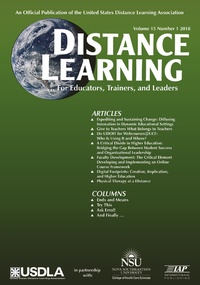
Distance Learning
Volume 15 #1
1st Edition
Published on 6. January 2018
73 pages
978-1-64113-342-5 (ISBN)
Description

Distance Learning is for leaders, practitioners, and decision makers in the fields of distance learning, e-learning, telecommunications, and related areas. It is a professional journal with applicable information for those involved with providing instruction to all kinds of learners, of all ages, using telecommunications technologies of all types. Stories are written by practitioners for practitioners with the intent of providing usable information and ideas. Articles are accepted from authors--new and experienced--with interesting and important information about the effective practice of distance teaching and learnin.
Distance Learning is published quarterly. Each issue includes eight to ten articles and three to four columns, including the highly regarded "And Finally..." column covering recent important issues in the field and written by Distance Learning editor, Michael Simonson. Articles are written by practitioners from various countries and locations, nationally and internationally.
Distance Learning is published quarterly. Each issue includes eight to ten articles and three to four columns, including the highly regarded "And Finally..." column covering recent important issues in the field and written by Distance Learning editor, Michael Simonson. Articles are written by practitioners from various countries and locations, nationally and internationally.
All prices
More details
Other editions
Additional editions

Michael Simonson | Charles Schlosser
Distance Learning Vol 15 Issue 1
Book
08/2018
Information Age Publishing
€47.00
Shipment within 3-4 weeks
Content
1 - Front Cover [Seite 1]
2 - Featured Articles [Seite 2]
2.1 - 1 [Seite 2]
2.2 - Expediting and Sustaining Change: Diffusing Innovation in Dynamic Educational Settings [Seite 2]
2.2.1 - 13 [Seite 2]
2.3 - Give to Teachers What Belongs to Teachers [Seite 2]
2.3.1 - 21 [Seite 2]
2.4 - Do UDOIT for Webcourses@UCF: Who Is Using It and Where? [Seite 2]
2.4.1 - 27 [Seite 2]
2.5 - A Critical Divide in Higher Education: Bridging the Gap Between Student Success and Organizational Leadership [Seite 2]
2.5.1 - 37 [Seite 2]
2.6 - Faculty Development: The Critical Element [Seite 2]
2.6.1 - 41 [Seite 2]
2.7 - Developing and Implementing an Online Course Framework [Seite 2]
2.7.1 - 51 [Seite 2]
2.8 - Digital Footprints: Creation, Implication, and Higher Education [Seite 2]
2.8.1 - 55 [Seite 2]
2.9 - Physical Therapy at a Distance [Seite 2]
3 - Columns [Seite 2]
3.1 - International schools in Asia are growing faster than any other market in the world, claiming 54% of international schools worldwide. [Seite 16]
4 - Expediting and Sustaining Change [Seite 6]
4.1 - Diffusing Innovation in Dynamic Educational Settings [Seite 6]
4.1.1 - Jeff Dungan and Jessica Hale [Seite 6]
4.1.1.1 - Introduction [Seite 6]
4.1.1.2 - School Leadership's Role in Diffusing Innovations [Seite 7]
4.1.1.3 - Change Leaders and Opinion Leadership [Seite 8]
4.1.1.3.1 - Change Leaders [Seite 8]
4.1.1.3.2 - Opinion Leadership [Seite 9]
4.1.1.4 - School Practices That Promote Innovation [Seite 10]
4.1.1.4.1 - Characteristics That Foster Innovation in a School [Seite 11]
4.1.1.4.2 - Stages of Innovation Diffusion [Seite 11]
4.1.1.5 - Recommendations for Creating Innovative School Cultures [Seite 12]
4.1.1.6 - Conclusion [Seite 14]
4.1.1.7 - References [Seite 14]
4.2 - Get Your Copy Today-Information Age Publishing [Seite 17]
5 - Give to Teachers What Belongs to Teachers [Seite 18]
5.1 - Joana Fernandez and Senta Sellers [Seite 18]
5.1.1 - The NSU Alvin Sherman Library [Seite 18]
5.1.2 - Broward County and Public Cardholders [Seite 19]
5.1.3 - A Library Education Collection to Support the Fischler College of Education [Seite 19]
5.1.4 - The Education Collection and Academic Services [Seite 20]
5.1.5 - Public Access to Library Resources [Seite 20]
5.1.6 - Increase Usage of the Education Resources by the Public [Seite 21]
5.1.7 - Education LibGuide and Teacher Resources Website [Seite 21]
5.1.8 - Resources of Particular Interest [Seite 21]
5.1.8.1 - Lynda.com [Seite 22]
5.1.8.2 - Gale Science in Context and Credo Reference Center [Seite 22]
5.1.8.3 - The USC Shoah Foundation Visual History Archive [Seite 22]
5.1.9 - RILS Outreach to Public Teachers [Seite 23]
5.1.10 - What Is in the Future for This Project? [Seite 23]
5.1.11 - References [Seite 24]
6 - Do UDOIT for Webcourses@UCF [Seite 26]
6.1 - Who Is Using It and Where? [Seite 26]
6.1.1 - Karen Tinsley-Kim [Seite 26]
6.1.1.1 - UCF Online Background [Seite 26]
6.1.1.2 - Does This Equal Online Access? [Seite 26]
6.1.1.3 - Part of the Answer: UDOIT [Seite 28]
6.1.1.4 - What's Happening in the United States and Abroad? [Seite 29]
6.1.1.5 - What's Happening at UCF? [Seite 29]
6.1.1.6 - What's the Plan Moving Forward? [Seite 30]
6.1.1.7 - References [Seite 31]
7 - A Critical Divide in Higher Education [Seite 32]
7.1 - Bridging the Gap Between Student Success and Organizational Leadership [Seite 32]
7.1.1 - Kathyleen Gamble Wyatt [Seite 32]
7.1.1.1 - Introduction [Seite 32]
7.1.1.2 - Background and Justification [Seite 32]
7.1.1.2.1 - Deficiencies in the Evidence [Seite 33]
7.1.1.3 - Methodology [Seite 33]
7.1.1.4 - Research Findings [Seite 34]
7.1.1.4.1 - Context of Findings [Seite 34]
7.1.1.5 - Implications [Seite 36]
7.1.1.6 - Future Direction of Research [Seite 36]
7.1.1.7 - Limitations [Seite 37]
7.1.1.8 - Conclusions [Seite 38]
7.1.1.9 - References [Seite 38]
7.2 - Get Your Copy Today-Information Age Publishing [Seite 41]
7.2.1 - At the university of Mississippi . the key to faculty development is clear: Instructional design is the critical element of faculty development. [Seite 44]
8 - Faculty Development [Seite 42]
8.1 - The Critical Element [Seite 42]
8.1.1 - Deborah Seepersaud [Seite 42]
8.1.1.1 - Introduction [Seite 42]
8.1.1.1.1 - 1. faculty development for online instruction, [Seite 42]
8.1.1.1.2 - 2. online course and program support, and [Seite 42]
8.1.1.1.3 - 3. grants and awards. [Seite 42]
8.1.1.2 - Academic Outreach and Faculty Development [Seite 43]
8.1.1.3 - Academic Outreach Support [Seite 43]
8.1.1.4 - Grants [Seite 43]
8.1.1.5 - Reference [Seite 44]
8.1.1.5.1 - Technology Integration Learning Community (TILC)-an online professional learning community where members teach each other about the latest and greatest technological tools and share ideas for integration into the curriculum. [Seite 55]
9 - Developing and Implementing an Online Course Framework [Seite 46]
9.1 - Jennifer Reeves, Jason Karp, Gabriela Mendez, Elda Veloso, Maureen McDermott, Jia Borror, and Berta Capo [Seite 46]
9.1.1 - Introduction [Seite 46]
9.1.2 - The ASSURE Model: Technology Integration in Classroom Instruction [Seite 47]
9.1.2.1 - 1. Analyze learners: Online learners seeking a graduate degree [Seite 48]
9.1.2.2 - 2. State course objectives: Integrate technology and transform our courses (Note: The TOCF focuses on general objectives that can be applied to any course. When applying the TCOF to a course, instructors would state the specific course learning objec... [Seite 48]
9.1.2.3 - 3. Select strategies and resources: [Seite 48]
9.1.2.4 - 4. Utilize resources: 21st century tools [Seite 48]
9.1.2.5 - 5. Require learner participation: Discussions, synchronous chats, blogs, videos, peer review, asynchronous activities [Seite 48]
9.1.2.6 - 6. Evaluate and revise: assessments, videos, student surveys [Seite 48]
9.1.3 - Online Course Framework [Seite 48]
9.1.4 - Course Overview [Seite 48]
9.1.4.1 - Communication [Seite 50]
9.1.4.2 - Activities: Collaboration and Interaction [Seite 50]
9.1.4.3 - Content Presentation [Seite 52]
9.1.4.4 - Assessment [Seite 53]
9.1.5 - Important Considerations [Seite 54]
9.1.6 - Summary [Seite 54]
9.1.7 - References [Seite 54]
10 - Digital Footprints [Seite 56]
10.1 - Creation, Implication, and Higher Education [Seite 56]
10.1.1 - Maureen McDermott [Seite 56]
10.1.1.1 - Introduction [Seite 56]
10.1.1.2 - Digital Footprints: Passive Versus Active [Seite 56]
10.1.1.3 - Implications for Online Learning Environments [Seite 57]
10.1.1.4 - Generating Active Digital Footprints to Gain/Maintain Employment [Seite 58]
10.1.1.5 - Conclusion [Seite 59]
10.1.1.6 - References [Seite 59]
10.1.1.6.1 - "I chose the hybrid program . because of its comprehensive curriculum, and flexibility. For 3 weeks, the program consists of watching lectures and practicing skills at home. Then for 1 week, we are on campus taking exams and having patient experi... [Seite 61]
11 - Physical Therapy at a Distance [Seite 60]
11.1 - The Student Experience [Seite 60]
11.1.1 - Eunice Luyegu [Seite 60]
11.1.1.1 - Introduction [Seite 60]
12 - Tips for Success [Seite 62]
12.1 - The Online Instructor's (Short) Guide to Making Assignment Descriptions More Transparent [Seite 62]
12.1.1 - Natalie B. Milman [Seite 62]
12.1.1.1 - What Is a Transparent Assignment Description? [Seite 63]
12.1.1.1.1 - Online Assignments Checklist [Seite 63]
12.1.1.2 - References [Seite 64]
13 - "I Get By With a Little Help From . My Supervisor" [Seite 66]
13.1 - The Art of Giving and Incorporating Classroom Feedback [Seite 66]
13.1.1 - Errol Craig Sull and Kathy Embry [Seite 66]
13.1.1.1 - How to Give Teaching Feedback [Seite 67]
13.1.1.1.1 - Feedback, Critique, and Coaching are Opportunities to Communicate With Faculty [Seite 67]
13.1.1.1.2 - Faculty Want to Hear They Are Doing a Great Job at all Times [Seite 67]
13.1.1.1.3 - Don't Forget to Tell Faculty They Are Doing a Great Job! [Seite 68]
13.1.1.2 - How to Use Teaching Feedback [Seite 68]
13.1.1.2.1 - Rule #1: Always Incorporate Feedback! [Seite 68]
13.1.1.2.2 - Be Sure to Ask for Clarification and/or Explanation of What You Don't Understand [Seite 69]
13.1.1.2.3 - Look at Less-Than-Stellar Feedback as an Opportunity to Improve-Not as an Arrow to the Heart! [Seite 69]
13.1.1.2.4 - Make Certain you Have Up-to- Date Performance Guidelines [Seite 69]
13.1.1.2.5 - Always Go Beyond Performance Guidelines Expectations [Seite 69]
13.1.1.2.6 - When You Need to Go Outside of Performance Guidelines, First Explain the Reason to Your Supervisor [Seite 70]
14 - Ask Errol! [Seite 72]
14.1 - Errol Craig Sull [Seite 72]
14.1.1 - Quarterly Review of Distance Education, Subscribe Today! www.infoagepub.com [Seite 75]
15 - Engagement [Seite 77]
15.1 - Michael Simonson [Seite 77]
15.1.1 - Engagement of a learner is defined as emotional and intellectual involvement or commitment-the participation in learning activities via interaction with others in meaningful ways. [Seite 76]
16 - Back Cover [Seite 78]
2 - Featured Articles [Seite 2]
2.1 - 1 [Seite 2]
2.2 - Expediting and Sustaining Change: Diffusing Innovation in Dynamic Educational Settings [Seite 2]
2.2.1 - 13 [Seite 2]
2.3 - Give to Teachers What Belongs to Teachers [Seite 2]
2.3.1 - 21 [Seite 2]
2.4 - Do UDOIT for Webcourses@UCF: Who Is Using It and Where? [Seite 2]
2.4.1 - 27 [Seite 2]
2.5 - A Critical Divide in Higher Education: Bridging the Gap Between Student Success and Organizational Leadership [Seite 2]
2.5.1 - 37 [Seite 2]
2.6 - Faculty Development: The Critical Element [Seite 2]
2.6.1 - 41 [Seite 2]
2.7 - Developing and Implementing an Online Course Framework [Seite 2]
2.7.1 - 51 [Seite 2]
2.8 - Digital Footprints: Creation, Implication, and Higher Education [Seite 2]
2.8.1 - 55 [Seite 2]
2.9 - Physical Therapy at a Distance [Seite 2]
3 - Columns [Seite 2]
3.1 - International schools in Asia are growing faster than any other market in the world, claiming 54% of international schools worldwide. [Seite 16]
4 - Expediting and Sustaining Change [Seite 6]
4.1 - Diffusing Innovation in Dynamic Educational Settings [Seite 6]
4.1.1 - Jeff Dungan and Jessica Hale [Seite 6]
4.1.1.1 - Introduction [Seite 6]
4.1.1.2 - School Leadership's Role in Diffusing Innovations [Seite 7]
4.1.1.3 - Change Leaders and Opinion Leadership [Seite 8]
4.1.1.3.1 - Change Leaders [Seite 8]
4.1.1.3.2 - Opinion Leadership [Seite 9]
4.1.1.4 - School Practices That Promote Innovation [Seite 10]
4.1.1.4.1 - Characteristics That Foster Innovation in a School [Seite 11]
4.1.1.4.2 - Stages of Innovation Diffusion [Seite 11]
4.1.1.5 - Recommendations for Creating Innovative School Cultures [Seite 12]
4.1.1.6 - Conclusion [Seite 14]
4.1.1.7 - References [Seite 14]
4.2 - Get Your Copy Today-Information Age Publishing [Seite 17]
5 - Give to Teachers What Belongs to Teachers [Seite 18]
5.1 - Joana Fernandez and Senta Sellers [Seite 18]
5.1.1 - The NSU Alvin Sherman Library [Seite 18]
5.1.2 - Broward County and Public Cardholders [Seite 19]
5.1.3 - A Library Education Collection to Support the Fischler College of Education [Seite 19]
5.1.4 - The Education Collection and Academic Services [Seite 20]
5.1.5 - Public Access to Library Resources [Seite 20]
5.1.6 - Increase Usage of the Education Resources by the Public [Seite 21]
5.1.7 - Education LibGuide and Teacher Resources Website [Seite 21]
5.1.8 - Resources of Particular Interest [Seite 21]
5.1.8.1 - Lynda.com [Seite 22]
5.1.8.2 - Gale Science in Context and Credo Reference Center [Seite 22]
5.1.8.3 - The USC Shoah Foundation Visual History Archive [Seite 22]
5.1.9 - RILS Outreach to Public Teachers [Seite 23]
5.1.10 - What Is in the Future for This Project? [Seite 23]
5.1.11 - References [Seite 24]
6 - Do UDOIT for Webcourses@UCF [Seite 26]
6.1 - Who Is Using It and Where? [Seite 26]
6.1.1 - Karen Tinsley-Kim [Seite 26]
6.1.1.1 - UCF Online Background [Seite 26]
6.1.1.2 - Does This Equal Online Access? [Seite 26]
6.1.1.3 - Part of the Answer: UDOIT [Seite 28]
6.1.1.4 - What's Happening in the United States and Abroad? [Seite 29]
6.1.1.5 - What's Happening at UCF? [Seite 29]
6.1.1.6 - What's the Plan Moving Forward? [Seite 30]
6.1.1.7 - References [Seite 31]
7 - A Critical Divide in Higher Education [Seite 32]
7.1 - Bridging the Gap Between Student Success and Organizational Leadership [Seite 32]
7.1.1 - Kathyleen Gamble Wyatt [Seite 32]
7.1.1.1 - Introduction [Seite 32]
7.1.1.2 - Background and Justification [Seite 32]
7.1.1.2.1 - Deficiencies in the Evidence [Seite 33]
7.1.1.3 - Methodology [Seite 33]
7.1.1.4 - Research Findings [Seite 34]
7.1.1.4.1 - Context of Findings [Seite 34]
7.1.1.5 - Implications [Seite 36]
7.1.1.6 - Future Direction of Research [Seite 36]
7.1.1.7 - Limitations [Seite 37]
7.1.1.8 - Conclusions [Seite 38]
7.1.1.9 - References [Seite 38]
7.2 - Get Your Copy Today-Information Age Publishing [Seite 41]
7.2.1 - At the university of Mississippi . the key to faculty development is clear: Instructional design is the critical element of faculty development. [Seite 44]
8 - Faculty Development [Seite 42]
8.1 - The Critical Element [Seite 42]
8.1.1 - Deborah Seepersaud [Seite 42]
8.1.1.1 - Introduction [Seite 42]
8.1.1.1.1 - 1. faculty development for online instruction, [Seite 42]
8.1.1.1.2 - 2. online course and program support, and [Seite 42]
8.1.1.1.3 - 3. grants and awards. [Seite 42]
8.1.1.2 - Academic Outreach and Faculty Development [Seite 43]
8.1.1.3 - Academic Outreach Support [Seite 43]
8.1.1.4 - Grants [Seite 43]
8.1.1.5 - Reference [Seite 44]
8.1.1.5.1 - Technology Integration Learning Community (TILC)-an online professional learning community where members teach each other about the latest and greatest technological tools and share ideas for integration into the curriculum. [Seite 55]
9 - Developing and Implementing an Online Course Framework [Seite 46]
9.1 - Jennifer Reeves, Jason Karp, Gabriela Mendez, Elda Veloso, Maureen McDermott, Jia Borror, and Berta Capo [Seite 46]
9.1.1 - Introduction [Seite 46]
9.1.2 - The ASSURE Model: Technology Integration in Classroom Instruction [Seite 47]
9.1.2.1 - 1. Analyze learners: Online learners seeking a graduate degree [Seite 48]
9.1.2.2 - 2. State course objectives: Integrate technology and transform our courses (Note: The TOCF focuses on general objectives that can be applied to any course. When applying the TCOF to a course, instructors would state the specific course learning objec... [Seite 48]
9.1.2.3 - 3. Select strategies and resources: [Seite 48]
9.1.2.4 - 4. Utilize resources: 21st century tools [Seite 48]
9.1.2.5 - 5. Require learner participation: Discussions, synchronous chats, blogs, videos, peer review, asynchronous activities [Seite 48]
9.1.2.6 - 6. Evaluate and revise: assessments, videos, student surveys [Seite 48]
9.1.3 - Online Course Framework [Seite 48]
9.1.4 - Course Overview [Seite 48]
9.1.4.1 - Communication [Seite 50]
9.1.4.2 - Activities: Collaboration and Interaction [Seite 50]
9.1.4.3 - Content Presentation [Seite 52]
9.1.4.4 - Assessment [Seite 53]
9.1.5 - Important Considerations [Seite 54]
9.1.6 - Summary [Seite 54]
9.1.7 - References [Seite 54]
10 - Digital Footprints [Seite 56]
10.1 - Creation, Implication, and Higher Education [Seite 56]
10.1.1 - Maureen McDermott [Seite 56]
10.1.1.1 - Introduction [Seite 56]
10.1.1.2 - Digital Footprints: Passive Versus Active [Seite 56]
10.1.1.3 - Implications for Online Learning Environments [Seite 57]
10.1.1.4 - Generating Active Digital Footprints to Gain/Maintain Employment [Seite 58]
10.1.1.5 - Conclusion [Seite 59]
10.1.1.6 - References [Seite 59]
10.1.1.6.1 - "I chose the hybrid program . because of its comprehensive curriculum, and flexibility. For 3 weeks, the program consists of watching lectures and practicing skills at home. Then for 1 week, we are on campus taking exams and having patient experi... [Seite 61]
11 - Physical Therapy at a Distance [Seite 60]
11.1 - The Student Experience [Seite 60]
11.1.1 - Eunice Luyegu [Seite 60]
11.1.1.1 - Introduction [Seite 60]
12 - Tips for Success [Seite 62]
12.1 - The Online Instructor's (Short) Guide to Making Assignment Descriptions More Transparent [Seite 62]
12.1.1 - Natalie B. Milman [Seite 62]
12.1.1.1 - What Is a Transparent Assignment Description? [Seite 63]
12.1.1.1.1 - Online Assignments Checklist [Seite 63]
12.1.1.2 - References [Seite 64]
13 - "I Get By With a Little Help From . My Supervisor" [Seite 66]
13.1 - The Art of Giving and Incorporating Classroom Feedback [Seite 66]
13.1.1 - Errol Craig Sull and Kathy Embry [Seite 66]
13.1.1.1 - How to Give Teaching Feedback [Seite 67]
13.1.1.1.1 - Feedback, Critique, and Coaching are Opportunities to Communicate With Faculty [Seite 67]
13.1.1.1.2 - Faculty Want to Hear They Are Doing a Great Job at all Times [Seite 67]
13.1.1.1.3 - Don't Forget to Tell Faculty They Are Doing a Great Job! [Seite 68]
13.1.1.2 - How to Use Teaching Feedback [Seite 68]
13.1.1.2.1 - Rule #1: Always Incorporate Feedback! [Seite 68]
13.1.1.2.2 - Be Sure to Ask for Clarification and/or Explanation of What You Don't Understand [Seite 69]
13.1.1.2.3 - Look at Less-Than-Stellar Feedback as an Opportunity to Improve-Not as an Arrow to the Heart! [Seite 69]
13.1.1.2.4 - Make Certain you Have Up-to- Date Performance Guidelines [Seite 69]
13.1.1.2.5 - Always Go Beyond Performance Guidelines Expectations [Seite 69]
13.1.1.2.6 - When You Need to Go Outside of Performance Guidelines, First Explain the Reason to Your Supervisor [Seite 70]
14 - Ask Errol! [Seite 72]
14.1 - Errol Craig Sull [Seite 72]
14.1.1 - Quarterly Review of Distance Education, Subscribe Today! www.infoagepub.com [Seite 75]
15 - Engagement [Seite 77]
15.1 - Michael Simonson [Seite 77]
15.1.1 - Engagement of a learner is defined as emotional and intellectual involvement or commitment-the participation in learning activities via interaction with others in meaningful ways. [Seite 76]
16 - Back Cover [Seite 78]

