

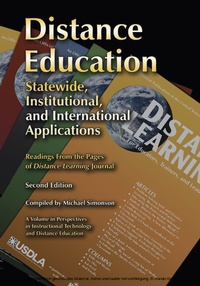
Distance Education
Statewide, Institutional, and International Applications of Distance Education, 2nd Edition
1st Edition
Published on 9. January 2016
265 pages
978-1-68123-643-8 (ISBN)
Description

Distance Learning journal is a premiere outlet for articles featuring practical applications of distance education in states, institutions, and countries. Distance Education: Statewide, Institutional, and International Applications of Distance Education, 2nd Edition is a collection of readings from Distance Learning journal written by practitioners for practitioners.
All prices
More details
Other editions
New editions

Lee Ayers Schlosser | Michael Simonson
Distance Education 3rd Edition
Definition and Glossary of Terms
E-Book
07/2009
1st Edition
Information Age Publishing
from
€62.33
Available for download
Additional editions

Michael Simonson
Distance Education
Statewide, Institutional, and International Applications of Distance Education
Book
09/2016
2nd Edition
Information Age Publishing
€120.90
Shipment within 3-4 weeks
Michael Simonson
Distance Education
Statewide, Institutional, and International Applications of Distance Education
Book
09/2016
2nd Edition
Information Age Publishing
€68.40
Shipment within 3-4 weeks
Content
1 - Front Cover [Seite 1]
2 - Perspectives in Instructional Technology and Distance Education [Seite 3]
3 - Distance Education [Seite 4]
4 - Statewide, Institutional, and International Applications: Readings From the Pages of Distance Learning Journal [Seite 4]
5 - Second Edition [Seite 4]
5.1 - Compiled by [Seite 4]
5.2 - Michael Simonson [Seite 4]
5.3 - Editor of Distance Learning Journal Department Chair Instructional Design and Technology Fischler School of Education Nova Southeastern University [Seite 4]
6 - CONTENTS [Seite 6]
7 - Distance Education [Seite 2]
8 - Statewide, Institutional, and International Applications: Readings From the Pages of Distance Learning Journal [Seite 2]
9 - Second Edition [Seite 2]
10 - Introduction [Seite 10]
10.1 - Michael Simonson [Seite 10]
11 - Part I [Seite 12]
11.1 - State-Based and Statewide Approaches to Distance Education [Seite 12]
12 - Florida Virtual School [Seite 14]
12.1 - Blended Learning [Seite 14]
12.1.1 - Dana Baugh [Seite 14]
12.1.1.1 - Introduction [Seite 14]
12.1.1.2 - Florida Virtual School Today [Seite 14]
12.1.1.3 - Funding [Seite 15]
12.1.1.4 - Leadership [Seite 15]
12.1.1.5 - Innovation Led by Legislation [Seite 15]
12.1.1.6 - Blended Learning [Seite 16]
12.1.1.7 - How FLVS Conducts Blended Learning [Seite 17]
12.1.1.8 - Florida Virtual School Virtual Learning Lab Pilot [Seite 17]
12.1.1.9 - VLL Versus Blended Learning Community [Seite 18]
12.1.1.10 - The Future [Seite 18]
12.1.1.11 - References [Seite 18]
13 - ACCESS Distance Learning [Seite 20]
13.1 - A Teacher's Perspective [Seite 20]
13.1.1 - M. Danyelle Hillman [Seite 20]
13.1.1.1 - Introduction [Seite 20]
13.1.1.2 - Background [Seite 20]
13.1.1.3 - Benefits of ACCESS [Seite 21]
13.1.1.4 - Three Roles of the Professional and ACCESS Distance Learning [Seite 21]
13.1.1.4.1 - Counselor's Role [Seite 21]
13.1.1.4.2 - Facilitator's Role [Seite 22]
13.1.1.4.3 - Teacher's Role [Seite 22]
13.1.1.5 - Instructional Strategy [Seite 23]
13.1.1.5.1 - Classroom Strategies That Work [Seite 23]
13.1.1.5.2 - Implementing Discussion Questions in ACCESS Distance Learning [Seite 23]
13.1.1.5.3 - Web-Enhanced and Blended Courses [Seite 24]
13.1.1.5.4 - Time Commitment [Seite 24]
13.1.1.5.5 - Communication [Seite 24]
13.1.1.6 - Conclusion [Seite 24]
13.1.1.7 - References [Seite 25]
14 - NorthStar Academy [Seite 26]
14.1 - An Online International School [Seite 26]
14.1.1 - Kevin Arndt [Seite 26]
14.1.1.1 - Introduction [Seite 26]
14.1.1.2 - NorthStar Academy [Seite 27]
14.1.1.3 - NorthStar's Flexibility [Seite 28]
14.1.1.4 - Student Experience [Seite 29]
14.1.1.5 - Technology and Course Design [Seite 29]
14.1.1.6 - Future [Seite 30]
14.1.1.7 - References [Seite 30]
15 - North Carolina Virtual Public School [Seite 32]
15.1 - Preparing Students Today for Lives Tomorrow [Seite 32]
15.1.1 - Holly Marshburn [Seite 32]
15.1.1.1 - Introduction [Seite 32]
15.1.1.2 - Background [Seite 32]
15.1.1.2.1 - Mission and Vision Statements [Seite 34]
15.1.1.2.2 - Three Instructional Pillars [Seite 34]
15.1.1.2.3 - Funding [Seite 35]
15.1.1.3 - Courses [Seite 35]
15.1.1.3.1 - Success 101 [Seite 35]
15.1.1.4 - Course Design [Seite 36]
15.1.1.5 - Teachers [Seite 36]
15.1.1.5.1 - Teacher-in-Training Program [Seite 37]
15.1.1.6 - Students [Seite 37]
15.1.1.6.1 - Peer Tutoring Program [Seite 37]
15.1.1.7 - Parental Involvement [Seite 38]
15.1.1.8 - New Hanover County Schools [Seite 38]
15.1.1.8.1 - Benefits [Seite 38]
15.1.1.9 - Virtual Academy Coordinators [Seite 39]
15.1.1.10 - Conclusion [Seite 39]
15.1.1.11 - References [Seite 39]
16 - Texas Virtual School Network [Seite 42]
16.1 - Deep in the Heart of Distance Education [Seite 42]
16.1.1 - Rolando R. Garza [Seite 42]
16.1.1.1 - Introduction and History [Seite 42]
16.1.1.2 - Provider Requirements [Seite 43]
16.1.1.3 - Students Getting Started [Seite 44]
16.1.1.4 - TxVSN Standards [Seite 44]
16.1.1.5 - Online Teaching Professional Development [Seite 45]
16.1.1.6 - Conclusion [Seite 46]
16.1.1.7 - References [Seite 46]
16.1.1.7.1 - Table 1. TxVSN Approved Professional Development [Seite 46]
17 - The South Carolina Virtual School Program [Seite 48]
17.1 - Opportunities for South Carolina's Students [Seite 48]
17.1.1 - Robin M. Clinton [Seite 48]
17.1.1.1 - Introduction [Seite 48]
17.1.1.2 - South Carolina Virtual School Program [Seite 49]
17.1.1.2.1 - Leadership [Seite 49]
17.1.1.2.2 - Teachers [Seite 49]
17.1.1.2.3 - Teacher Training [Seite 49]
17.1.1.2.4 - Course Offerings [Seite 50]
17.1.1.2.5 - Technology [Seite 50]
17.1.1.2.6 - Students [Seite 51]
17.1.1.2.7 - How Is SCVSP Performing? [Seite 51]
17.1.1.2.8 - The Future of the SCVSP [Seite 53]
17.1.1.3 - Conclusion [Seite 53]
17.1.1.4 - References [Seite 54]
18 - Learning at Georgia Virtual School [Seite 56]
18.1 - Courtney L. Teague [Seite 56]
18.1.1 - Introduction [Seite 56]
18.1.2 - Georgia Virtual School [Seite 56]
18.1.2.1 - Background [Seite 57]
18.1.2.1.1 - GaVS Strategic Plan [Seite 57]
18.1.2.1.2 - Enrollment in GaVS [Seite 57]
18.1.2.1.3 - GaVS Learners' Needs [Seite 57]
18.1.3 - GaVS Courses [Seite 59]
18.1.3.1 - Course Development [Seite 59]
18.1.3.1.1 - GaVS Course Recovery Program [Seite 59]
18.1.3.1.2 - GaVS Accreditation and Evaluation [Seite 59]
18.1.3.1.2.1 - 1. The course provides online learners with engaging learning experiences that promote their mastery of content and are aligned with state content standards or nationally accepted content. [Seite 60]
18.1.3.1.2.2 - 2. The course uses learning activities that engage learners in active learning [Seite 60]
18.1.3.1.2.3 - 3. The course uses multiple strategies and activities to assess learner readiness for and progress in course content and provides learners with feedback on their progress. [Seite 60]
18.1.3.1.2.4 - 4. The course takes full advantage of a variety of technology tools, has a user- friendly interface and meets accessibility standards for interoperability and access for learners with special needs. [Seite 60]
18.1.3.1.2.5 - 5. The course is evaluated regularly for effectiveness, using a variety of assessment strategies, and the findings are used as a basis for improvement. The course is kept up to date, both in content and in the application of new research on course de... [Seite 60]
18.1.3.1.3 - GaVS End of Course Policy [Seite 60]
18.1.4 - GaVS Teacher [Seite 60]
18.1.4.1 - Teacher Certification [Seite 60]
18.1.4.2 - GaVS Adjunct Teacher Salary [Seite 61]
18.1.5 - Leadership [Seite 61]
18.1.6 - Instructional Technology [Seite 61]
18.1.7 - Diffusion of Innovation [Seite 62]
18.1.8 - Conclusion [Seite 62]
18.1.9 - References [Seite 62]
18.1.9.1 - Online learning has become an important part of the progression of K-12 education. It is no longer considered novel but considered as a recognized method of course delivery. Georgia has recognized the importance and has passed legislative bills to en... [Seite 63]
19 - Broward Virtual School [Seite 64]
19.1 - Nova Lishon-Savarino [Seite 64]
19.1.1 - Overview [Seite 64]
19.1.2 - Mission [Seite 64]
19.1.3 - Accreditation [Seite 64]
19.1.4 - Educators [Seite 64]
19.1.5 - Administration [Seite 65]
19.1.6 - Students [Seite 65]
19.1.7 - Cost [Seite 66]
19.1.8 - Attendance [Seite 66]
19.1.9 - Communication Delivery [Seite 66]
19.1.10 - Student Activities [Seite 66]
19.1.11 - Partnerships With Organizations [Seite 67]
19.1.12 - Technology Requirements [Seite 67]
19.1.13 - Technology Utilized [Seite 67]
19.1.14 - Technology Supplements and Support [Seite 68]
19.1.15 - Videoconferencing [Seite 68]
19.1.16 - Statistics [Seite 68]
19.1.17 - Awards and Recognition [Seite 69]
19.1.18 - Goals [Seite 70]
19.1.19 - Conclusion [Seite 70]
19.1.20 - References [Seite 70]
19.1.20.1 - Table 1. Video Conference Course Lesson Plans [Seite 69]
19.1.21 - 5 [Seite 69]
19.1.22 - 0 [Seite 69]
19.1.23 - 2 [Seite 69]
19.1.24 - 26 [Seite 69]
19.1.25 - 151 [Seite 69]
19.1.26 - 4 [Seite 69]
19.1.27 - 0 [Seite 69]
19.1.28 - 3 [Seite 69]
19.1.29 - 28 [Seite 69]
19.1.30 - 148 [Seite 69]
19.1.31 - 4 [Seite 69]
19.1.32 - 0 [Seite 69]
19.1.33 - 20 [Seite 69]
19.1.34 - 23 [Seite 69]
19.1.35 - 137 [Seite 69]
19.1.36 - 4 [Seite 69]
19.1.37 - 0 [Seite 69]
19.1.38 - 5 [Seite 69]
19.1.39 - 34 [Seite 69]
19.1.40 - 141 [Seite 69]
19.1.40.1 - Table 2. Instructor of Video Conference Course [Seite 69]
19.1.41 - 6 [Seite 69]
19.1.42 - 0 [Seite 69]
19.1.43 - 0 [Seite 69]
19.1.44 - 21 [Seite 69]
19.1.45 - 156 [Seite 69]
19.1.46 - 6 [Seite 69]
19.1.47 - 0 [Seite 69]
19.1.48 - 0 [Seite 69]
19.1.49 - 22 [Seite 69]
19.1.50 - 155 [Seite 69]
19.1.51 - 6 [Seite 69]
19.1.52 - 1 [Seite 69]
19.1.53 - 1 [Seite 69]
19.1.54 - 26 [Seite 69]
19.1.55 - 149 [Seite 69]
19.1.56 - 6 [Seite 69]
19.1.57 - 0 [Seite 69]
19.1.58 - 2 [Seite 69]
19.1.59 - 35 [Seite 69]
19.1.60 - 138 [Seite 69]
19.1.61 - 5 [Seite 69]
19.1.62 - 1 [Seite 69]
19.1.63 - 2 [Seite 69]
19.1.64 - 28 [Seite 69]
19.1.65 - 146 [Seite 69]
19.1.66 - 5 [Seite 69]
19.1.67 - 3 [Seite 69]
19.1.68 - 4 [Seite 69]
19.1.69 - 33 [Seite 69]
19.1.70 - 137 [Seite 69]
20 - Georgia Schools [Seite 72]
20.1 - Virtually Here [Seite 72]
20.1.1 - Lynn M. Hawkins [Seite 72]
20.1.1.1 - Introduction [Seite 72]
20.1.1.2 - Georgia's Virtual Certification [Seite 72]
20.1.1.3 - Georgia Virtual Learning for Public Schools [Seite 73]
20.1.1.3.1 - History [Seite 73]
20.1.1.3.2 - Georgia Virtual School (GaVS) [Seite 73]
20.1.1.3.3 - GaVS Accreditation and Certification [Seite 73]
20.1.1.3.4 - GaVS Times and Tuition [Seite 73]
20.1.1.3.5 - Credit Recovery [Seite 74]
20.1.1.3.6 - Coursework/Schedule [Seite 74]
20.1.1.3.7 - Grading [Seite 74]
20.1.1.3.8 - Cost [Seite 74]
20.1.1.4 - ExPreSS [Seite 74]
20.1.1.5 - Georgia Virtual Charter Schools [Seite 74]
20.1.1.5.1 - Georgia Charter Schools [Seite 74]
20.1.1.5.2 - Georgia Connections Academy Charter School [Seite 75]
20.1.1.5.3 - Georgia Cyber Academy [Seite 75]
20.1.1.5.4 - Provost Academy [Seite 75]
20.1.1.5.5 - Georgia's Amendment 1 [Seite 75]
20.1.1.5.6 - The Change [Seite 75]
20.1.1.5.7 - Support [Seite 76]
20.1.1.5.8 - Historical Significance [Seite 76]
20.1.1.6 - Why E-learning in Georgia [Seite 76]
20.1.1.7 - Conclusion [Seite 76]
20.1.1.8 - References [Seite 76]
21 - Meeting the Shifting Perspective [Seite 78]
21.1 - The Iowa Communications Network [Seite 78]
21.1.1 - John Gillispie, Joseph Cassis, Tami Fujinaka, and Gail McMahon [Seite 78]
21.1.1.1 - Time Shift [Seite 80]
21.1.1.2 - Place Shift [Seite 81]
21.1.1.3 - Mental Shift [Seite 85]
21.1.1.4 - Shifting Gears [Seite 87]
22 - Designing the "Perfect" Online Program [Seite 90]
22.1 - Michael Simonson [Seite 90]
22.1.1 - 1. First, an academic technology/distance education plan is needed. This plan includes the following components: [Seite 91]
22.1.2 - 2. Next, a process for diffusion and implementation of distance education is needed. This process includes these components: [Seite 91]
22.1.3 - References [Seite 91]
22.1.3.1 - And Finally . [Seite 90]
23 - Part II [Seite 92]
23.1 - Institution-Based Applications of Distance Education [Seite 92]
24 - Michigan Virtual University [Seite 94]
24.1 - Providing Online Learning Opportunities [Seite 94]
24.1.1 - Sophia Lafayette [Seite 94]
24.1.1.1 - Introduction [Seite 94]
24.1.1.2 - The Origins of Michigan Virtual University [Seite 94]
24.1.1.2.1 - Historical Context [Seite 94]
24.1.1.2.2 - Creation of Michigan Virtual University [Seite 95]
24.1.1.3 - Organizational Structure of Michigan Virtual University [Seite 96]
24.1.1.3.1 - Michigan Virtual School, a Division of Michigan Virtual University [Seite 96]
24.1.1.3.2 - Michigan LearnPort, a Division of Michigan Virtual University [Seite 97]
24.1.1.3.3 - Michigan Virtual Learning Research Institute, a Division of Michigan Virtual University [Seite 98]
24.1.1.3.3.1 - 1. Michigan students accounted for 319,630 virtual enrollments in the 2013- 14 school year, an increase of over 134,577 virtual enrollments from the prior year. Only 5% of those enrollments were delivered by MVS. [Seite 99]
24.1.1.3.3.2 - 2. Although almost 90% of enrollments were by secondary students (Grades 7- 12), elementary level students had the highest year-over-year percentage growth. [Seite 99]
24.1.1.3.3.3 - 3. Fifty-seven percent of virtual enrollments from virtual students ended with a completion status of "completed/passed." Those same virtual students, however, passed their non- virtual courses 71% of the time. In contrast, non-virtual learners p... [Seite 99]
24.1.1.3.3.4 - 4. Of the virtual learners taking courses, those taking courses through MVS had a passed/completed rate of 72%, while cyber schools had a rate of 54%, and local districts rate was 57%. [Seite 99]
24.1.1.3.3.5 - 5. Students who tend to have lower levels of academic success are being directed to take virtual courses, primarily in core content areas. [Seite 99]
24.1.1.4 - The Future of Michigan Virtual University [Seite 100]
24.1.1.5 - References [Seite 100]
24.1.1.5.1 - Table 1. Leadership Structure of Michigan Virtual University [Seite 96]
24.1.1.5.2 - Table 2. Michigan Virtual School 2013-2014 Course Enrollments by Subject Area [Seite 97]
24.1.1.6 - 21.4% [Seite 97]
24.1.1.7 - 4,522 [Seite 97]
24.1.1.8 - 16.1% [Seite 97]
24.1.1.9 - 3,396 [Seite 97]
24.1.1.10 - 14.7% [Seite 97]
24.1.1.11 - 3,101 [Seite 97]
24.1.1.12 - 11.7% [Seite 97]
24.1.1.13 - 2,473 [Seite 97]
24.1.1.14 - 7.8% [Seite 97]
24.1.1.15 - 1,653 [Seite 97]
24.1.1.15.1 - Table 3. Michigan Virtual University Goals [Seite 100]
25 - Navy College Program for Afloat College Education [Seite 102]
25.1 - Christopher Bergeron [Seite 102]
25.1.1 - Introduction [Seite 102]
25.1.2 - Navy College Program Distance Learning Partnership [Seite 103]
25.1.3 - Navy College Program for Afloat College Education [Seite 103]
25.1.4 - Distance Degrees Offered Via NCPACE [Seite 104]
25.1.4.1 - 42 Associate's Degrees [Seite 104]
25.1.4.2 - 24 Bachelor's Degrees [Seite 105]
25.1.4.3 - 6 Master's Degrees [Seite 105]
25.1.5 - References [Seite 105]
26 - UMassOnline [Seite 106]
26.1 - Online Education at the University of Massachusetts [Seite 106]
26.1.1 - Eileen B. Perez [Seite 106]
26.1.1.1 - Introduction [Seite 106]
26.1.1.2 - Distance Education Models [Seite 106]
26.1.1.3 - University of Massachusetts History [Seite 106]
26.1.1.4 - Online Learning at the University of Massachusetts [Seite 108]
26.1.1.4.1 - Reporting Structure [Seite 108]
26.1.1.4.2 - UMassOnline Organizational Structure and Funding [Seite 108]
26.1.1.4.3 - Online Learning Funding [Seite 109]
26.1.1.4.4 - UMassOnline Enrollment, Programs, and Degree Offerings [Seite 109]
26.1.1.5 - Online Education at the University of Massachusetts Reviewed [Seite 109]
26.1.1.5.1 - Online Learning and the Five Campuses [Seite 110]
26.1.1.5.2 - UMassOnline [Seite 111]
26.1.1.5.3 - UMassOnline and the Five Campuses [Seite 112]
26.1.1.5.4 - Recommendations of the Reviewers [Seite 112]
26.1.1.6 - Conclusion [Seite 112]
26.1.1.7 - References [Seite 112]
26.1.1.7.1 - Table 1. Annual Budget [Seite 109]
26.1.1.8 - 2007 [Seite 109]
26.1.1.9 - 2008 [Seite 109]
26.1.1.10 - 2009 [Seite 109]
26.1.1.11 - 2010 [Seite 109]
26.1.1.12 - 2011 [Seite 109]
26.1.1.13 - Not available* [Seite 109]
26.1.1.13.1 - Table 2. Programs by Campus [Seite 110]
26.1.1.14 - 3 [Seite 110]
26.1.1.15 - 0 [Seite 110]
26.1.1.16 - 1 [Seite 110]
26.1.1.17 - 0 [Seite 110]
26.1.1.18 - 0 [Seite 110]
26.1.1.19 - 5 [Seite 110]
26.1.1.20 - 13 [Seite 110]
26.1.1.21 - 10 [Seite 110]
26.1.1.22 - 23 [Seite 110]
26.1.1.23 - 1 [Seite 110]
26.1.1.24 - 12 [Seite 110]
26.1.1.25 - 2 [Seite 110]
26.1.1.26 - 3 [Seite 110]
26.1.1.27 - 5 [Seite 110]
26.1.1.28 - 0 [Seite 110]
26.1.1.29 - 5 [Seite 110]
26.1.1.30 - 10 [Seite 110]
26.1.1.31 - 1 [Seite 110]
26.1.1.32 - 9 [Seite 110]
26.1.1.33 - 0 [Seite 110]
26.1.1.34 - 1 [Seite 110]
26.1.1.35 - 1 [Seite 110]
26.1.1.36 - 0 [Seite 110]
26.1.1.37 - 0 [Seite 110]
26.1.1.38 - 0 [Seite 110]
26.1.1.39 - 1 [Seite 110]
26.1.1.40 - 5 [Seite 110]
26.1.1.41 - 0 [Seite 110]
26.1.1.42 - 0 [Seite 110]
26.1.1.43 - 0 [Seite 110]
26.1.1.44 - 0 [Seite 110]
26.1.1.45 - 0 [Seite 110]
26.1.1.46 - 0 [Seite 110]
26.1.1.47 - 0 [Seite 110]
26.1.1.48 - 1 [Seite 110]
26.1.1.49 - 27 [Seite 110]
26.1.1.50 - 31 [Seite 110]
26.1.1.51 - 15 [Seite 110]
26.1.1.52 - 37 [Seite 110]
26.1.1.53 - 2 [Seite 110]
26.1.1.53.1 - In the last 12 years, the new organization UMassOnline succeeded in increasing online enrollment, program and course offerings, and created a brand that capitalized on the strengths of the University of Massachusetts system. [Seite 113]
27 - Tribal Colleges and Universities [Seite 114]
27.1 - Rebuilding Culture and Education Through Distance Education [Seite 114]
27.1.1 - Ayasia Hampton [Seite 114]
27.1.1.1 - Introduction [Seite 114]
27.1.1.2 - Brief History of American Indian Education [Seite 114]
27.1.1.3 - TCU, Culture, and Distance Education [Seite 115]
27.1.1.3.1 - The Importance of Culture [Seite 116]
27.1.1.3.2 - A Glance at Distance Education at Work [Seite 116]
27.1.1.4 - Broadband Connecting and Transforming American Indians [Seite 117]
27.1.1.4.1 - The Digital Divide and the Broadband Technologies Opportunities Program (BTOP) [Seite 118]
27.1.1.4.2 - The College of Menominee Nation (CMN) [Seite 118]
27.1.1.4.3 - ZeroDivide Tribal [Seite 118]
27.1.1.5 - Conclusion [Seite 119]
27.1.1.6 - References [Seite 119]
27.1.1.6.1 - Distance education bridges the instructional gap between teacher and student when various technologies are used for teaching and learning. Historically, education has changed based on new technologies [Seite 120]
28 - Maximizing HR Professionals' Leadership Role in e-Learning for Organizational Effectiveness [Seite 122]
28.1 - Jane Waweru [Seite 122]
28.1.1 - Introduction [Seite 122]
28.1.2 - Perceptions of Innovation Attributes [Seite 122]
28.1.3 - Implications of Limited e-Learning [Seite 123]
28.1.4 - Focus Group Qualitative Data [Seite 124]
28.1.4.1 - Reasons for Use or Nonuse of e-Learning [Seite 125]
28.1.4.1.1 - 1. Professional/personal development. Most HR professionals stated they participated in e-learning for their own professional or personal development. On professional development, participants indicated they utilized e-learning resources to recertify... [Seite 125]
28.1.4.1.2 - 2. Convenience. Participants generally perceived that e-learning provides easy access to learning. Consequently, distance from a training site or even time of day was not an obstacle when training was done through e-learning. One participant stated s... [Seite 125]
28.1.4.1.3 - 3. Compliance. Participants stated they were able to educate employees on mandated courses such as code of ethics and harassment policies among others through e-learning. [Seite 125]
28.1.4.1.4 - 4. Facilitate/instruct/intervention. Several participants indicated they had been exposed to e-learning as facilitators or instructors or utilized e-learning as an intervention. [Seite 125]
28.1.4.1.5 - 5. Customized training. Participants stated that e-learning provided the ability to provide customized training to employees with special needs. A HR professional stated that "different learners require unique needs which may not be met through e-l... [Seite 125]
28.1.4.2 - Potential Barriers [Seite 125]
28.1.4.2.1 - 1. Lack of face-to-face interaction. Participants stated that a lack of face-to-face interaction or engagement does create a barrier to e-learning. A participant was of the view that online interaction "can be strange." The participant added by s... [Seite 125]
28.1.4.2.2 - 2. Accessibility and usability. Some participants were of the view that technical challenges can create a barrier to e- learning. Participants stated that, sometimes, e-learning may not be easy to use because of "terrible technology." An HR profe... [Seite 126]
28.1.4.2.3 - 3. Cost. Participants stated that cost of e- learning can be a barrier to e-learning because finances are needed to support the software, people, developers, and designers of the innovation. Some believed that due to hard economic challenges, complia... [Seite 126]
28.1.4.2.4 - 4. Effectiveness. Participants believed that the inability to measure the effectiveness of e-learning was a barrier to learning. [Seite 126]
28.1.4.2.5 - 5. Lack of time. HR professionals stated they were sometimes busy and may not have had time for e-learning on the job. One participant stated that not having enough time at work made e- learning "a bother at work." Others felt that interruptions ... [Seite 126]
28.1.5 - Interpretation of the Focus Group Results on the Use or Nonuse of e-Learning [Seite 126]
28.1.6 - Interpretation of Results for the Barriers of e-Learning [Seite 126]
28.1.7 - Implications for Practice [Seite 127]
28.1.7.1 - Publication of the Research [Seite 127]
28.1.7.2 - Offering Workshops [Seite 127]
28.1.7.3 - Offering Technical Support [Seite 128]
28.1.7.4 - Enhancing Organizational Synergy [Seite 128]
28.1.7.5 - Enhancing Communication Within the Organization [Seite 129]
28.1.8 - Implications for Future Research [Seite 129]
28.1.8.1 - Conducting Studies in Specific Companies [Seite 129]
28.1.8.2 - Research on Specific HR Management Functions [Seite 129]
28.1.9 - Summary [Seite 130]
28.1.10 - References [Seite 130]
28.1.10.1 - Table 1. e-Learning Opportunities for HR Professionals [Seite 124]
29 - The Global Campus [Seite 132]
29.1 - Examining the Initiative From the Perspective of Diffusion Theory [Seite 132]
29.1.1 - Kevin E. Johnson [Seite 132]
29.1.1.1 - Innovation [Seite 133]
29.1.1.1.1 - 1. Relative Advantage: one's perception of how advantageous the innovation in terms of economics, social prestige factors, convenience, and satisfaction (Rogers, 2003). For a majority of the Global Campus adopters, the advantages of The Global Camp... [Seite 133]
29.1.1.1.2 - 2. Compatibility: determines how compatible the individual perceives the innovation to the adopting society (Rogers, 2003). In the initial stages, The Global Campus was to be a for-profit arm of the university that relied solely on the idea of hiring... [Seite 134]
29.1.1.1.3 - 3. Complexity: "The degree to which an innovation is perceived as difficult to understand and use (Rogers, 2003, p. 15). The starting of a new campus is always complex in nature. However, most people understand the nature of developing policies, pr... [Seite 134]
29.1.1.1.4 - 4. Trialability: the degree to which an individual is able to practice the innovation before making a decision (Rogers, 2003). The Global Campus worked hard to meet with other successful programs such as University of Massachusetts, University of Pho... [Seite 134]
29.1.1.1.5 - 5. Observability: the degree to which the results of an innovation are visible to others. Global Campus administration provided faculty and college administrators with economic projections specific to enrollment and university income (Rogers, 2003). ... [Seite 134]
29.1.1.2 - Communication and Communication Channels [Seite 134]
29.1.1.3 - Time [Seite 135]
29.1.1.4 - Social System [Seite 135]
29.1.1.5 - References [Seite 136]
29.1.1.5.1 - "The University of Illinois Global Campus is a rather new initiative with the mission to become a national leader in online education, focused on innovation, quality, superior instruction, service, and accessibility." [Seite 136]
30 - Online Learning Opportunities for K-12 Students in Florida's Nassau County [Seite 138]
30.1 - Kari Burgess-Watkins [Seite 138]
30.1.1 - Introduction [Seite 138]
30.1.2 - Mission Statement [Seite 139]
30.1.3 - Goals and Objectives [Seite 139]
30.1.4 - FLVS FT for Grades K-8 [Seite 139]
30.1.5 - FLVS Franchise for Grades 6-12 [Seite 140]
30.1.6 - Home Education Students [Seite 140]
30.1.7 - Private School Students [Seite 140]
30.1.8 - Hospital Homebound [Seite 140]
30.1.9 - Coenrolled Students [Seite 140]
30.1.10 - Full-Time Diploma-Seeking Students [Seite 141]
30.1.11 - Self-Evaluation Online Learning Quiz [Seite 141]
30.1.11.1 - Technical Competencies and Access [Seite 141]
30.1.11.2 - Learning Styles [Seite 141]
30.1.12 - Courses [Seite 141]
30.1.13 - Instruction [Seite 142]
30.1.14 - Coursework [Seite 142]
30.1.15 - Grace Period [Seite 142]
30.1.16 - Assessments [Seite 142]
30.1.17 - Academic Integrity [Seite 143]
30.1.18 - Teacher Responsibilities [Seite 143]
30.1.19 - Parental Involvement [Seite 143]
30.1.20 - References [Seite 144]
31 - Responding to Change [Seite 146]
31.1 - Online Education at the College of Central Florida [Seite 146]
31.1.1 - Connie J. Tice [Seite 146]
31.1.1.1 - Historical Perspective [Seite 146]
31.1.1.2 - Responding to Change [Seite 147]
31.1.1.3 - Evolution of a Program [Seite 147]
31.1.1.4 - Future Goals [Seite 149]
31.1.1.5 - The Future [Seite 149]
31.1.1.6 - References [Seite 149]
31.1.1.6.1 - Table 1. E-learning Enrollment [Seite 148]
31.1.1.7 - 1998-1999 [Seite 148]
31.1.1.8 - 54 [Seite 148]
31.1.1.9 - ,712 [Seite 148]
31.1.1.10 - 0 [Seite 148]
31.1.1.11 - , 0 [Seite 148]
31.1.1.12 - 1999-2000 [Seite 148]
31.1.1.13 - 71 [Seite 148]
31.1.1.14 - 1,065 [Seite 148]
31.1.1.15 - 0 [Seite 148]
31.1.1.16 - , 0 [Seite 148]
31.1.1.17 - 2000-2001 [Seite 148]
31.1.1.18 - 65 [Seite 148]
31.1.1.19 - 1,094 [Seite 148]
31.1.1.20 - 0 [Seite 148]
31.1.1.21 - , 0 [Seite 148]
31.1.1.22 - 2001-2002 [Seite 148]
31.1.1.23 - 78 [Seite 148]
31.1.1.24 - 1,373 [Seite 148]
31.1.1.25 - 0 [Seite 148]
31.1.1.26 - , 0 [Seite 148]
31.1.1.27 - 2002-2003 [Seite 148]
31.1.1.28 - 82 [Seite 148]
31.1.1.29 - 1,724 [Seite 148]
31.1.1.30 - 0 [Seite 148]
31.1.1.31 - , 0 [Seite 148]
31.1.1.32 - 2003-2004 [Seite 148]
31.1.1.33 - 103 [Seite 148]
31.1.1.34 - 2,460 [Seite 148]
31.1.1.35 - 3 [Seite 148]
31.1.1.36 - , 54 [Seite 148]
31.1.1.37 - 2004-2005 [Seite 148]
31.1.1.38 - 135 [Seite 148]
31.1.1.39 - 3,120 [Seite 148]
31.1.1.40 - 10 [Seite 148]
31.1.1.41 - , 213 [Seite 148]
31.1.1.42 - 2005-2006 [Seite 148]
31.1.1.43 - 173 [Seite 148]
31.1.1.44 - 3,812 [Seite 148]
31.1.1.45 - 20 [Seite 148]
31.1.1.46 - , 251 [Seite 148]
31.1.1.47 - 2006-2007 [Seite 148]
31.1.1.48 - 206 [Seite 148]
31.1.1.49 - 4,451 [Seite 148]
31.1.1.50 - 32 [Seite 148]
31.1.1.51 - ,509 [Seite 148]
31.1.1.52 - 2007-2008 [Seite 148]
31.1.1.53 - 240 [Seite 148]
31.1.1.54 - 5,288 [Seite 148]
31.1.1.55 - 54 [Seite 148]
31.1.1.56 - , 841 [Seite 148]
31.1.1.57 - 2008-2009 [Seite 148]
31.1.1.58 - 299 [Seite 148]
31.1.1.59 - 6,886 [Seite 148]
31.1.1.60 - 83 [Seite 148]
31.1.1.61 - 1,509 [Seite 148]
31.1.1.61.1 - Community colleges and their faculty have been known for their ability to respond to both change and the needs of their students and community. [Seite 149]
32 - A Closer Look at Distance Learning in the Kansas City, Missouri School District [Seite 151]
32.1 - Shelley Brown Cooper [Seite 151]
32.1.1 - Introduction [Seite 151]
32.1.2 - Background of KCMSD School District [Seite 151]
32.1.3 - Transformation Plan [Seite 152]
32.1.4 - Distance Education [Seite 153]
32.1.5 - Players [Seite 155]
32.1.6 - Definition of Terms [Seite 155]
32.1.7 - Building the DLLs (Costs/ Equipment + Facilities) [Seite 156]
32.1.8 - Policies and Procedures [Seite 156]
32.1.9 - Training Facilitators [Seite 156]
32.1.10 - Scheduling [Seite 156]
32.1.11 - Teachers [Seite 157]
32.1.12 - Successes [Seite 157]
32.1.13 - Challenges and Concerns [Seite 157]
32.1.14 - State Technology Plan [Seite 157]
32.1.15 - Future Plans and Expectations [Seite 157]
32.1.16 - Evaluation [Seite 157]
32.1.17 - References [Seite 158]
33 - Reaching Beyond the Conventional Classroom [Seite 160]
33.1 - NASA's Digital Learning Network [Seite 160]
33.1.1 - Damon Talley and Gamaliel "Dan" Cherry [Seite 160]
33.1.1.1 - The Digital Learning Network [Seite 160]
33.1.1.2 - America's Spaceport: John F. Kennedy Space Center [Seite 161]
33.1.1.3 - Interest in Science [Seite 162]
33.1.1.4 - Interpretations of Inquiry-Based Instruction [Seite 164]
33.1.1.5 - The Learning Cycle [Seite 164]
33.1.1.6 - 5E-Instructional Model [Seite 165]
33.1.1.7 - Pulling it all Together [Seite 165]
33.1.1.8 - References [Seite 165]
33.1.1.8.1 - Table 1. Summary of the BSCS 5E Instructional Model and Teacher Roles [Seite 165]
33.1.1.8.1.1 - "Despite evidence that point to using an inquiry-based approach to teach science, the amount of research examining instructional strategies used via video- conferencing suggests room for a closer look." [Seite 166]
34 - The Virtual Campus at the International Academy of Design & Technology-Online [Seite 168]
34.1 - Andrea Vassar [Seite 168]
34.1.1 - Introduction [Seite 168]
34.1.2 - Key Features of the Virtual Campus [Seite 169]
34.1.2.1 - The Classroom [Seite 169]
34.1.2.2 - Online Library [Seite 172]
34.1.2.3 - Learning Center [Seite 174]
34.1.2.4 - Virtual Commons [Seite 174]
34.1.2.5 - Technical Support [Seite 176]
34.1.3 - Advantages and Limitations of the Virtual Campus [Seite 176]
34.1.3.1 - Flexible Delivery Model [Seite 177]
34.1.3.2 - Student-Centered Learning [Seite 177]
34.1.3.3 - Interactive Experiences [Seite 177]
34.1.3.4 - Industry-Current Technology [Seite 178]
34.1.3.5 - Creative Community [Seite 178]
34.1.3.6 - Bandwidth Limitations [Seite 178]
34.1.3.7 - Course Development [Seite 178]
34.1.4 - Summary [Seite 178]
34.1.5 - References [Seite 179]
34.1.5.1 - In the words of an IADT-Online graphic design instructor, the virtual campus is an exciting, interactive experience for the students. [Seite 179]
35 - U.S. Army and U.S. Navy Staff Officer Distance Education Programs [Seite 180]
35.1 - Lawrence L. Gruszecki [Seite 180]
35.1.1 - References [Seite 186]
35.1.1.1 - "The online distance education program of today's military, particularly the Army and Navy, appear to be as contemporary as leading online schools." [Seite 186]
36 - MOOC Madness [Seite 188]
36.1 - Michael Simonson [Seite 188]
36.2 - "Though this be madness, yet there is method in't" [Seite 188]
36.3 - -Hamlet, Act II, Scene ii, line 211, Shakespeare [Seite 188]
36.3.1 - References [Seite 189]
36.3.1.1 - And Finally . [Seite 188]
37 - Part III [Seite 190]
37.1 - International Applications of Distance Education [Seite 190]
38 - The University of the West Indies Open Campus [Seite 192]
38.1 - A Beacon for Distance Education in the Caribbean [Seite 192]
38.1.1 - Beverly S. Crooks-Johnson [Seite 192]
38.1.1.1 - Introduction [Seite 192]
38.1.1.2 - Historical Overview: UWI's Humble Beginnings [Seite 192]
38.1.1.3 - UWI at Present [Seite 193]
38.1.1.4 - Distance Education: No New Phenomenon at UWI [Seite 193]
38.1.1.5 - The Emergence of the UWIOC [Seite 194]
38.1.1.6 - UWIOC's Distance Education Telecommunication Infrastructure [Seite 195]
38.1.1.7 - UWIOC's Programs and Student Enrollment [Seite 196]
38.1.1.8 - UWIOC and Quality Assurance [Seite 197]
38.1.1.9 - References [Seite 198]
38.1.1.9.1 - Table 1. UWI's Three Main Campuses and 12 Participating Countries [Seite 193]
38.1.1.9.2 - Table 2. Total Enrollment for Online/Blended Programs 2011-2012 [Seite 196]
38.1.1.9.3 - Table 3. Enrollment in Open Campus Continuing Education Programs 2008-2012 [Seite 196]
39 - Online Education in the Bahamas [Seite 200]
39.1 - What Is its Position? [Seite 200]
39.1.1 - Kendra Spencer [Seite 200]
39.1.1.1 - References [Seite 203]
40 - The Evolution of ODL System in Nigeria [Seite 204]
40.1 - The Place of Nigerian Students of Conventional University Age Bracket [Seite 204]
40.1.1 - Janet O. Odeyemi [Seite 204]
40.1.1.1 - Introduction [Seite 204]
40.1.1.2 - Overview of Higher Education in Nigeria [Seite 205]
40.1.1.3 - Challenges of Higher Education [Seite 206]
40.1.1.4 - Open Learning: The Way Forward [Seite 207]
40.1.1.5 - NOUN: Vision, Quality, and the Nigerian Youths of University-Age Bracket [Seite 208]
40.1.1.6 - Conclusion [Seite 210]
40.1.1.7 - References [Seite 210]
40.1.1.7.1 - Table 1. Enrollment in Nigerian Universities (2006/2007) [Seite 207]
40.1.1.7.2 - Table 2. Enrollment of Nigerian Students, By Level [Seite 207]
40.1.1.8 - 20,000,000 [Seite 207]
40.1.1.9 - 27,000,000 [Seite 207]
40.1.1.10 - 2,000,000 [Seite 207]
40.1.1.11 - 95 + 4IUC [Seite 207]
40.1.1.12 - 6,000,000 [Seite 207]
41 - Delivering an Online MBA Program for Future Business Leaders in Ukraine [Seite 212]
41.1 - A Success Story [Seite 212]
41.1.1 - Carol A. Gravel and Lilia Dubko [Seite 212]
41.1.1.1 - Introduction [Seite 212]
41.1.1.2 - Program Results [Seite 213]
41.1.1.3 - Instructional Design Elements [Seite 213]
41.1.1.3.1 - 1. Project-Based Approach: Several the classes took the form of a project. While working on a project, students develop a variety of skills. The project approach provides a meaning and a context to the learning process. Projects explore topics that e... [Seite 213]
41.1.1.3.2 - 2. Flexibility: Because this program was for working adults, the program provided opportunity to for a flexible but effective classroom schedule, while at the same time ensuring that the key elements of the standard curriculum. There are learning obj... [Seite 213]
41.1.1.3.3 - 3. Technology as a Tool: While technology is one of the key elements of the curriculum, technology was also a powerful enabling tool, which supported critical thinking and other developmental skills. The use of an online learning environment created ... [Seite 214]
41.1.1.4 - A Student's Perception [Seite 214]
41.1.1.5 - Program Outcomes and Success [Seite 215]
41.1.1.5.1 - 1. Education through a variety of applied graduate-level assignments and projects. [Seite 215]
41.1.1.5.2 - 2. Enhanced business skills for both current and future business professionals. [Seite 215]
42 - Instructional Technology and Distance Education in Nigeria [Seite 216]
42.1 - Historical Background and a Critical Appraisal [Seite 216]
42.1.1 - Titilola Obilade [Seite 216]
42.1.1.1 - Introduction [Seite 216]
42.1.1.2 - Challenges [Seite 217]
42.1.1.3 - Conclusion [Seite 219]
42.1.1.4 - References [Seite 219]
43 - Distance Learning in Belize [Seite 222]
43.1 - A Benefit for Youths and Adults [Seite 222]
43.1.1 - Yvonne Palma [Seite 222]
43.1.1.1 - Demographics of Belize [Seite 222]
43.1.1.2 - Profile of the Belizean Student [Seite 222]
43.1.1.3 - Distance Education: A Possible Solution? [Seite 223]
43.1.1.4 - Technical and Vocational Education and Training [Seite 224]
43.1.1.4.1 - Distance Learning in Technical and Vocational Education [Seite 225]
43.1.1.4.2 - A Coordinated Effort [Seite 226]
43.1.1.5 - Benefit to Youths and Adults [Seite 226]
43.1.1.6 - References [Seite 227]
44 - Challenges in [Seite 228]
45 - Higher Education Distance Learning in the Democratic Republic of Congo [Seite 228]
45.1 - Banza Nsomwe-a-nfunkwa [Seite 228]
45.1.1 - Introduction [Seite 228]
45.1.2 - Need for Distance Learning [Seite 229]
45.1.3 - Challenges to Distance Learning in the Higher Education Sector [Seite 229]
45.1.4 - Strategies [Seite 229]
45.1.4.1 - 1. Information about distance learning should be provided to the people of the Democratic Republic of Congo. [Seite 229]
45.1.4.2 - 2. If distance learning in the Democratic Republic of Congo is to succeed, it is an obligation to prepare distance educators. [Seite 229]
45.1.4.3 - 3. Organize conferences, seminars, discussions and reflection on the topic of distance learning and its impact on the Congolese people's well-being. [Seite 229]
45.1.4.4 - 4. Organizing training on the management of distance learning by the Congolese people. [Seite 229]
45.1.4.5 - 5. Organizing workshops on the design and development of distance learning courses. [Seite 229]
45.1.4.6 - 6. Help new distance educators learn about methods of teaching [Seite 229]
45.1.4.7 - 7. A huge campaign to encourage the people of the Democratic Republic of Congo to study at a distance. [Seite 229]
45.1.4.8 - 8. Organizing training on the evaluation system before, during, and after the lesson. [Seite 230]
45.1.4.9 - 9. Prepare counseling and support services for distance learners. [Seite 230]
45.1.5 - Conclusion [Seite 230]
45.1.6 - Reference [Seite 230]
45.1.6.1 - Barriers to Distance Education in the Republic of Congo [Seite 230]
45.1.6.2 - 1. Limited technologies [Seite 230]
45.1.6.3 - 2. Exorbitant costs for technologies [Seite 230]
45.1.6.4 - 3. Unstable electricity [Seite 230]
45.1.6.5 - 4. New technologies have not replaced old technologies [Seite 230]
46 - Distance Education and the Well-Being of the Rural Poor [Seite 232]
46.1 - Case Study of the Kabongo Region in the Democratic Republic of Congo [Seite 232]
46.1.1 - Banza Nsomwe-a-nfunkwa [Seite 232]
46.1.1.1 - Introduction [Seite 233]
46.1.1.2 - Cassava Problems and Solutions [Seite 234]
46.1.1.2.1 - Network of Cassava Problems, Causes, and Effects [Seite 234]
46.1.1.2.2 - Network of Methods and Solutions [Seite 234]
46.1.1.3 - Curriculum for Rural Distant learners [Seite 235]
46.1.1.3.1 - Plan [Seite 236]
46.1.1.4 - Implement [Seite 239]
46.1.1.5 - Evaluation [Seite 239]
46.1.1.6 - Radio Broadcasting [Seite 240]
46.1.1.6.1 - Time of Delivery [Seite 241]
46.1.1.7 - Management and Broadcast [Seite 241]
46.1.1.7.1 - Timetable [Seite 242]
46.1.1.8 - Suggestion [Seite 242]
46.1.1.9 - Conclusion [Seite 242]
46.1.1.10 - References [Seite 243]
46.1.1.10.1 - Table 1 Broadcast Timetable [Seite 242]
46.1.1.11 - LI [Seite 242]
46.1.1.12 - LI [Seite 242]
46.1.1.13 - LI [Seite 242]
46.1.1.14 - LI [Seite 242]
46.1.1.15 - LI [Seite 242]
46.1.1.16 - LI [Seite 242]
46.1.1.17 - LI [Seite 242]
46.1.1.18 - ADV [Seite 242]
46.1.1.19 - ADV [Seite 242]
46.1.1.20 - ADV [Seite 242]
46.1.1.21 - ADV [Seite 242]
46.1.1.22 - ADV [Seite 242]
46.1.1.23 - ADV [Seite 242]
46.1.1.24 - RELIG [Seite 242]
46.1.1.25 - NI [Seite 242]
46.1.1.26 - NI [Seite 242]
46.1.1.27 - NI [Seite 242]
46.1.1.28 - NI [Seite 242]
46.1.1.29 - NI [Seite 242]
46.1.1.30 - NI [Seite 242]
46.1.1.31 - NI [Seite 242]
46.1.1.32 - M [Seite 242]
46.1.1.33 - M [Seite 242]
46.1.1.34 - M [Seite 242]
46.1.1.35 - M [Seite 242]
46.1.1.36 - M [Seite 242]
46.1.1.37 - M [Seite 242]
46.1.1.38 - M [Seite 242]
46.1.1.39 - RA [Seite 242]
46.1.1.40 - RA [Seite 242]
46.1.1.41 - RA [Seite 242]
46.1.1.42 - RA [Seite 242]
46.1.1.43 - RA [Seite 242]
46.1.1.44 - RA [Seite 242]
46.1.1.45 - KB [Seite 242]
46.1.1.46 - KH [Seite 242]
46.1.1.47 - KB [Seite 242]
46.1.1.48 - KH [Seite 242]
46.1.1.49 - K [Seite 242]
46.1.1.50 - KH [Seite 242]
46.1.1.51 - KB [Seite 242]
46.1.1.52 - K [Seite 242]
47 - Distance Learning and Bilingual Educational CD-ROMs in Rural Areas of the Democratic Republic of Congo [Seite 244]
47.1 - Banza Nsomwe-a-nfunkwa [Seite 244]
47.1.1 - CD-ROM Presentation [Seite 245]
47.1.2 - Learning Design [Seite 246]
47.1.3 - Choice of Language [Seite 246]
47.1.4 - Flexibility of Using Voice [Seite 246]
47.1.5 - Difficulties and Obstacles [Seite 249]
47.1.6 - Suggestions [Seite 249]
47.1.7 - Conclusion [Seite 250]
47.1.8 - References [Seite 250]
47.1.8.1 - In rural areas of the Democratic Republic of Congo, people are facing different kinds of problems connected to the lack of education and training on a daily level. [Seite 250]
48 - Education Leaders Perspectives [Seite 252]
48.1 - Pros and Cons of Distance Education in a Small Caribbean Island [Seite 252]
48.1.1 - Noverene Taylor [Seite 252]
48.1.1.1 - Introduction [Seite 252]
48.1.1.2 - The Turks and Caicos Islands [Seite 252]
48.1.1.3 - Defining Distance Education [Seite 253]
48.1.1.4 - Online Distance Education [Seite 254]
48.1.1.5 - Distance Education Versus Traditional Instruction [Seite 254]
48.1.1.6 - Advantages of Distance Education in the Turks and Caicos Islands [Seite 254]
48.1.1.7 - Disadvantages of Distance Education in the Turks and Caicos Islands [Seite 257]
48.1.1.8 - Summary and Conclusion [Seite 259]
48.1.1.9 - References [Seite 260]
49 - Educational Colonialism [Seite 262]
49.1 - Michael Simonson [Seite 262]
49.1.1 - References [Seite 263]
49.1.1.1 - And Finally . [Seite 262]
50 - Back Cover [Seite 264]
2 - Perspectives in Instructional Technology and Distance Education [Seite 3]
3 - Distance Education [Seite 4]
4 - Statewide, Institutional, and International Applications: Readings From the Pages of Distance Learning Journal [Seite 4]
5 - Second Edition [Seite 4]
5.1 - Compiled by [Seite 4]
5.2 - Michael Simonson [Seite 4]
5.3 - Editor of Distance Learning Journal Department Chair Instructional Design and Technology Fischler School of Education Nova Southeastern University [Seite 4]
6 - CONTENTS [Seite 6]
7 - Distance Education [Seite 2]
8 - Statewide, Institutional, and International Applications: Readings From the Pages of Distance Learning Journal [Seite 2]
9 - Second Edition [Seite 2]
10 - Introduction [Seite 10]
10.1 - Michael Simonson [Seite 10]
11 - Part I [Seite 12]
11.1 - State-Based and Statewide Approaches to Distance Education [Seite 12]
12 - Florida Virtual School [Seite 14]
12.1 - Blended Learning [Seite 14]
12.1.1 - Dana Baugh [Seite 14]
12.1.1.1 - Introduction [Seite 14]
12.1.1.2 - Florida Virtual School Today [Seite 14]
12.1.1.3 - Funding [Seite 15]
12.1.1.4 - Leadership [Seite 15]
12.1.1.5 - Innovation Led by Legislation [Seite 15]
12.1.1.6 - Blended Learning [Seite 16]
12.1.1.7 - How FLVS Conducts Blended Learning [Seite 17]
12.1.1.8 - Florida Virtual School Virtual Learning Lab Pilot [Seite 17]
12.1.1.9 - VLL Versus Blended Learning Community [Seite 18]
12.1.1.10 - The Future [Seite 18]
12.1.1.11 - References [Seite 18]
13 - ACCESS Distance Learning [Seite 20]
13.1 - A Teacher's Perspective [Seite 20]
13.1.1 - M. Danyelle Hillman [Seite 20]
13.1.1.1 - Introduction [Seite 20]
13.1.1.2 - Background [Seite 20]
13.1.1.3 - Benefits of ACCESS [Seite 21]
13.1.1.4 - Three Roles of the Professional and ACCESS Distance Learning [Seite 21]
13.1.1.4.1 - Counselor's Role [Seite 21]
13.1.1.4.2 - Facilitator's Role [Seite 22]
13.1.1.4.3 - Teacher's Role [Seite 22]
13.1.1.5 - Instructional Strategy [Seite 23]
13.1.1.5.1 - Classroom Strategies That Work [Seite 23]
13.1.1.5.2 - Implementing Discussion Questions in ACCESS Distance Learning [Seite 23]
13.1.1.5.3 - Web-Enhanced and Blended Courses [Seite 24]
13.1.1.5.4 - Time Commitment [Seite 24]
13.1.1.5.5 - Communication [Seite 24]
13.1.1.6 - Conclusion [Seite 24]
13.1.1.7 - References [Seite 25]
14 - NorthStar Academy [Seite 26]
14.1 - An Online International School [Seite 26]
14.1.1 - Kevin Arndt [Seite 26]
14.1.1.1 - Introduction [Seite 26]
14.1.1.2 - NorthStar Academy [Seite 27]
14.1.1.3 - NorthStar's Flexibility [Seite 28]
14.1.1.4 - Student Experience [Seite 29]
14.1.1.5 - Technology and Course Design [Seite 29]
14.1.1.6 - Future [Seite 30]
14.1.1.7 - References [Seite 30]
15 - North Carolina Virtual Public School [Seite 32]
15.1 - Preparing Students Today for Lives Tomorrow [Seite 32]
15.1.1 - Holly Marshburn [Seite 32]
15.1.1.1 - Introduction [Seite 32]
15.1.1.2 - Background [Seite 32]
15.1.1.2.1 - Mission and Vision Statements [Seite 34]
15.1.1.2.2 - Three Instructional Pillars [Seite 34]
15.1.1.2.3 - Funding [Seite 35]
15.1.1.3 - Courses [Seite 35]
15.1.1.3.1 - Success 101 [Seite 35]
15.1.1.4 - Course Design [Seite 36]
15.1.1.5 - Teachers [Seite 36]
15.1.1.5.1 - Teacher-in-Training Program [Seite 37]
15.1.1.6 - Students [Seite 37]
15.1.1.6.1 - Peer Tutoring Program [Seite 37]
15.1.1.7 - Parental Involvement [Seite 38]
15.1.1.8 - New Hanover County Schools [Seite 38]
15.1.1.8.1 - Benefits [Seite 38]
15.1.1.9 - Virtual Academy Coordinators [Seite 39]
15.1.1.10 - Conclusion [Seite 39]
15.1.1.11 - References [Seite 39]
16 - Texas Virtual School Network [Seite 42]
16.1 - Deep in the Heart of Distance Education [Seite 42]
16.1.1 - Rolando R. Garza [Seite 42]
16.1.1.1 - Introduction and History [Seite 42]
16.1.1.2 - Provider Requirements [Seite 43]
16.1.1.3 - Students Getting Started [Seite 44]
16.1.1.4 - TxVSN Standards [Seite 44]
16.1.1.5 - Online Teaching Professional Development [Seite 45]
16.1.1.6 - Conclusion [Seite 46]
16.1.1.7 - References [Seite 46]
16.1.1.7.1 - Table 1. TxVSN Approved Professional Development [Seite 46]
17 - The South Carolina Virtual School Program [Seite 48]
17.1 - Opportunities for South Carolina's Students [Seite 48]
17.1.1 - Robin M. Clinton [Seite 48]
17.1.1.1 - Introduction [Seite 48]
17.1.1.2 - South Carolina Virtual School Program [Seite 49]
17.1.1.2.1 - Leadership [Seite 49]
17.1.1.2.2 - Teachers [Seite 49]
17.1.1.2.3 - Teacher Training [Seite 49]
17.1.1.2.4 - Course Offerings [Seite 50]
17.1.1.2.5 - Technology [Seite 50]
17.1.1.2.6 - Students [Seite 51]
17.1.1.2.7 - How Is SCVSP Performing? [Seite 51]
17.1.1.2.8 - The Future of the SCVSP [Seite 53]
17.1.1.3 - Conclusion [Seite 53]
17.1.1.4 - References [Seite 54]
18 - Learning at Georgia Virtual School [Seite 56]
18.1 - Courtney L. Teague [Seite 56]
18.1.1 - Introduction [Seite 56]
18.1.2 - Georgia Virtual School [Seite 56]
18.1.2.1 - Background [Seite 57]
18.1.2.1.1 - GaVS Strategic Plan [Seite 57]
18.1.2.1.2 - Enrollment in GaVS [Seite 57]
18.1.2.1.3 - GaVS Learners' Needs [Seite 57]
18.1.3 - GaVS Courses [Seite 59]
18.1.3.1 - Course Development [Seite 59]
18.1.3.1.1 - GaVS Course Recovery Program [Seite 59]
18.1.3.1.2 - GaVS Accreditation and Evaluation [Seite 59]
18.1.3.1.2.1 - 1. The course provides online learners with engaging learning experiences that promote their mastery of content and are aligned with state content standards or nationally accepted content. [Seite 60]
18.1.3.1.2.2 - 2. The course uses learning activities that engage learners in active learning [Seite 60]
18.1.3.1.2.3 - 3. The course uses multiple strategies and activities to assess learner readiness for and progress in course content and provides learners with feedback on their progress. [Seite 60]
18.1.3.1.2.4 - 4. The course takes full advantage of a variety of technology tools, has a user- friendly interface and meets accessibility standards for interoperability and access for learners with special needs. [Seite 60]
18.1.3.1.2.5 - 5. The course is evaluated regularly for effectiveness, using a variety of assessment strategies, and the findings are used as a basis for improvement. The course is kept up to date, both in content and in the application of new research on course de... [Seite 60]
18.1.3.1.3 - GaVS End of Course Policy [Seite 60]
18.1.4 - GaVS Teacher [Seite 60]
18.1.4.1 - Teacher Certification [Seite 60]
18.1.4.2 - GaVS Adjunct Teacher Salary [Seite 61]
18.1.5 - Leadership [Seite 61]
18.1.6 - Instructional Technology [Seite 61]
18.1.7 - Diffusion of Innovation [Seite 62]
18.1.8 - Conclusion [Seite 62]
18.1.9 - References [Seite 62]
18.1.9.1 - Online learning has become an important part of the progression of K-12 education. It is no longer considered novel but considered as a recognized method of course delivery. Georgia has recognized the importance and has passed legislative bills to en... [Seite 63]
19 - Broward Virtual School [Seite 64]
19.1 - Nova Lishon-Savarino [Seite 64]
19.1.1 - Overview [Seite 64]
19.1.2 - Mission [Seite 64]
19.1.3 - Accreditation [Seite 64]
19.1.4 - Educators [Seite 64]
19.1.5 - Administration [Seite 65]
19.1.6 - Students [Seite 65]
19.1.7 - Cost [Seite 66]
19.1.8 - Attendance [Seite 66]
19.1.9 - Communication Delivery [Seite 66]
19.1.10 - Student Activities [Seite 66]
19.1.11 - Partnerships With Organizations [Seite 67]
19.1.12 - Technology Requirements [Seite 67]
19.1.13 - Technology Utilized [Seite 67]
19.1.14 - Technology Supplements and Support [Seite 68]
19.1.15 - Videoconferencing [Seite 68]
19.1.16 - Statistics [Seite 68]
19.1.17 - Awards and Recognition [Seite 69]
19.1.18 - Goals [Seite 70]
19.1.19 - Conclusion [Seite 70]
19.1.20 - References [Seite 70]
19.1.20.1 - Table 1. Video Conference Course Lesson Plans [Seite 69]
19.1.21 - 5 [Seite 69]
19.1.22 - 0 [Seite 69]
19.1.23 - 2 [Seite 69]
19.1.24 - 26 [Seite 69]
19.1.25 - 151 [Seite 69]
19.1.26 - 4 [Seite 69]
19.1.27 - 0 [Seite 69]
19.1.28 - 3 [Seite 69]
19.1.29 - 28 [Seite 69]
19.1.30 - 148 [Seite 69]
19.1.31 - 4 [Seite 69]
19.1.32 - 0 [Seite 69]
19.1.33 - 20 [Seite 69]
19.1.34 - 23 [Seite 69]
19.1.35 - 137 [Seite 69]
19.1.36 - 4 [Seite 69]
19.1.37 - 0 [Seite 69]
19.1.38 - 5 [Seite 69]
19.1.39 - 34 [Seite 69]
19.1.40 - 141 [Seite 69]
19.1.40.1 - Table 2. Instructor of Video Conference Course [Seite 69]
19.1.41 - 6 [Seite 69]
19.1.42 - 0 [Seite 69]
19.1.43 - 0 [Seite 69]
19.1.44 - 21 [Seite 69]
19.1.45 - 156 [Seite 69]
19.1.46 - 6 [Seite 69]
19.1.47 - 0 [Seite 69]
19.1.48 - 0 [Seite 69]
19.1.49 - 22 [Seite 69]
19.1.50 - 155 [Seite 69]
19.1.51 - 6 [Seite 69]
19.1.52 - 1 [Seite 69]
19.1.53 - 1 [Seite 69]
19.1.54 - 26 [Seite 69]
19.1.55 - 149 [Seite 69]
19.1.56 - 6 [Seite 69]
19.1.57 - 0 [Seite 69]
19.1.58 - 2 [Seite 69]
19.1.59 - 35 [Seite 69]
19.1.60 - 138 [Seite 69]
19.1.61 - 5 [Seite 69]
19.1.62 - 1 [Seite 69]
19.1.63 - 2 [Seite 69]
19.1.64 - 28 [Seite 69]
19.1.65 - 146 [Seite 69]
19.1.66 - 5 [Seite 69]
19.1.67 - 3 [Seite 69]
19.1.68 - 4 [Seite 69]
19.1.69 - 33 [Seite 69]
19.1.70 - 137 [Seite 69]
20 - Georgia Schools [Seite 72]
20.1 - Virtually Here [Seite 72]
20.1.1 - Lynn M. Hawkins [Seite 72]
20.1.1.1 - Introduction [Seite 72]
20.1.1.2 - Georgia's Virtual Certification [Seite 72]
20.1.1.3 - Georgia Virtual Learning for Public Schools [Seite 73]
20.1.1.3.1 - History [Seite 73]
20.1.1.3.2 - Georgia Virtual School (GaVS) [Seite 73]
20.1.1.3.3 - GaVS Accreditation and Certification [Seite 73]
20.1.1.3.4 - GaVS Times and Tuition [Seite 73]
20.1.1.3.5 - Credit Recovery [Seite 74]
20.1.1.3.6 - Coursework/Schedule [Seite 74]
20.1.1.3.7 - Grading [Seite 74]
20.1.1.3.8 - Cost [Seite 74]
20.1.1.4 - ExPreSS [Seite 74]
20.1.1.5 - Georgia Virtual Charter Schools [Seite 74]
20.1.1.5.1 - Georgia Charter Schools [Seite 74]
20.1.1.5.2 - Georgia Connections Academy Charter School [Seite 75]
20.1.1.5.3 - Georgia Cyber Academy [Seite 75]
20.1.1.5.4 - Provost Academy [Seite 75]
20.1.1.5.5 - Georgia's Amendment 1 [Seite 75]
20.1.1.5.6 - The Change [Seite 75]
20.1.1.5.7 - Support [Seite 76]
20.1.1.5.8 - Historical Significance [Seite 76]
20.1.1.6 - Why E-learning in Georgia [Seite 76]
20.1.1.7 - Conclusion [Seite 76]
20.1.1.8 - References [Seite 76]
21 - Meeting the Shifting Perspective [Seite 78]
21.1 - The Iowa Communications Network [Seite 78]
21.1.1 - John Gillispie, Joseph Cassis, Tami Fujinaka, and Gail McMahon [Seite 78]
21.1.1.1 - Time Shift [Seite 80]
21.1.1.2 - Place Shift [Seite 81]
21.1.1.3 - Mental Shift [Seite 85]
21.1.1.4 - Shifting Gears [Seite 87]
22 - Designing the "Perfect" Online Program [Seite 90]
22.1 - Michael Simonson [Seite 90]
22.1.1 - 1. First, an academic technology/distance education plan is needed. This plan includes the following components: [Seite 91]
22.1.2 - 2. Next, a process for diffusion and implementation of distance education is needed. This process includes these components: [Seite 91]
22.1.3 - References [Seite 91]
22.1.3.1 - And Finally . [Seite 90]
23 - Part II [Seite 92]
23.1 - Institution-Based Applications of Distance Education [Seite 92]
24 - Michigan Virtual University [Seite 94]
24.1 - Providing Online Learning Opportunities [Seite 94]
24.1.1 - Sophia Lafayette [Seite 94]
24.1.1.1 - Introduction [Seite 94]
24.1.1.2 - The Origins of Michigan Virtual University [Seite 94]
24.1.1.2.1 - Historical Context [Seite 94]
24.1.1.2.2 - Creation of Michigan Virtual University [Seite 95]
24.1.1.3 - Organizational Structure of Michigan Virtual University [Seite 96]
24.1.1.3.1 - Michigan Virtual School, a Division of Michigan Virtual University [Seite 96]
24.1.1.3.2 - Michigan LearnPort, a Division of Michigan Virtual University [Seite 97]
24.1.1.3.3 - Michigan Virtual Learning Research Institute, a Division of Michigan Virtual University [Seite 98]
24.1.1.3.3.1 - 1. Michigan students accounted for 319,630 virtual enrollments in the 2013- 14 school year, an increase of over 134,577 virtual enrollments from the prior year. Only 5% of those enrollments were delivered by MVS. [Seite 99]
24.1.1.3.3.2 - 2. Although almost 90% of enrollments were by secondary students (Grades 7- 12), elementary level students had the highest year-over-year percentage growth. [Seite 99]
24.1.1.3.3.3 - 3. Fifty-seven percent of virtual enrollments from virtual students ended with a completion status of "completed/passed." Those same virtual students, however, passed their non- virtual courses 71% of the time. In contrast, non-virtual learners p... [Seite 99]
24.1.1.3.3.4 - 4. Of the virtual learners taking courses, those taking courses through MVS had a passed/completed rate of 72%, while cyber schools had a rate of 54%, and local districts rate was 57%. [Seite 99]
24.1.1.3.3.5 - 5. Students who tend to have lower levels of academic success are being directed to take virtual courses, primarily in core content areas. [Seite 99]
24.1.1.4 - The Future of Michigan Virtual University [Seite 100]
24.1.1.5 - References [Seite 100]
24.1.1.5.1 - Table 1. Leadership Structure of Michigan Virtual University [Seite 96]
24.1.1.5.2 - Table 2. Michigan Virtual School 2013-2014 Course Enrollments by Subject Area [Seite 97]
24.1.1.6 - 21.4% [Seite 97]
24.1.1.7 - 4,522 [Seite 97]
24.1.1.8 - 16.1% [Seite 97]
24.1.1.9 - 3,396 [Seite 97]
24.1.1.10 - 14.7% [Seite 97]
24.1.1.11 - 3,101 [Seite 97]
24.1.1.12 - 11.7% [Seite 97]
24.1.1.13 - 2,473 [Seite 97]
24.1.1.14 - 7.8% [Seite 97]
24.1.1.15 - 1,653 [Seite 97]
24.1.1.15.1 - Table 3. Michigan Virtual University Goals [Seite 100]
25 - Navy College Program for Afloat College Education [Seite 102]
25.1 - Christopher Bergeron [Seite 102]
25.1.1 - Introduction [Seite 102]
25.1.2 - Navy College Program Distance Learning Partnership [Seite 103]
25.1.3 - Navy College Program for Afloat College Education [Seite 103]
25.1.4 - Distance Degrees Offered Via NCPACE [Seite 104]
25.1.4.1 - 42 Associate's Degrees [Seite 104]
25.1.4.2 - 24 Bachelor's Degrees [Seite 105]
25.1.4.3 - 6 Master's Degrees [Seite 105]
25.1.5 - References [Seite 105]
26 - UMassOnline [Seite 106]
26.1 - Online Education at the University of Massachusetts [Seite 106]
26.1.1 - Eileen B. Perez [Seite 106]
26.1.1.1 - Introduction [Seite 106]
26.1.1.2 - Distance Education Models [Seite 106]
26.1.1.3 - University of Massachusetts History [Seite 106]
26.1.1.4 - Online Learning at the University of Massachusetts [Seite 108]
26.1.1.4.1 - Reporting Structure [Seite 108]
26.1.1.4.2 - UMassOnline Organizational Structure and Funding [Seite 108]
26.1.1.4.3 - Online Learning Funding [Seite 109]
26.1.1.4.4 - UMassOnline Enrollment, Programs, and Degree Offerings [Seite 109]
26.1.1.5 - Online Education at the University of Massachusetts Reviewed [Seite 109]
26.1.1.5.1 - Online Learning and the Five Campuses [Seite 110]
26.1.1.5.2 - UMassOnline [Seite 111]
26.1.1.5.3 - UMassOnline and the Five Campuses [Seite 112]
26.1.1.5.4 - Recommendations of the Reviewers [Seite 112]
26.1.1.6 - Conclusion [Seite 112]
26.1.1.7 - References [Seite 112]
26.1.1.7.1 - Table 1. Annual Budget [Seite 109]
26.1.1.8 - 2007 [Seite 109]
26.1.1.9 - 2008 [Seite 109]
26.1.1.10 - 2009 [Seite 109]
26.1.1.11 - 2010 [Seite 109]
26.1.1.12 - 2011 [Seite 109]
26.1.1.13 - Not available* [Seite 109]
26.1.1.13.1 - Table 2. Programs by Campus [Seite 110]
26.1.1.14 - 3 [Seite 110]
26.1.1.15 - 0 [Seite 110]
26.1.1.16 - 1 [Seite 110]
26.1.1.17 - 0 [Seite 110]
26.1.1.18 - 0 [Seite 110]
26.1.1.19 - 5 [Seite 110]
26.1.1.20 - 13 [Seite 110]
26.1.1.21 - 10 [Seite 110]
26.1.1.22 - 23 [Seite 110]
26.1.1.23 - 1 [Seite 110]
26.1.1.24 - 12 [Seite 110]
26.1.1.25 - 2 [Seite 110]
26.1.1.26 - 3 [Seite 110]
26.1.1.27 - 5 [Seite 110]
26.1.1.28 - 0 [Seite 110]
26.1.1.29 - 5 [Seite 110]
26.1.1.30 - 10 [Seite 110]
26.1.1.31 - 1 [Seite 110]
26.1.1.32 - 9 [Seite 110]
26.1.1.33 - 0 [Seite 110]
26.1.1.34 - 1 [Seite 110]
26.1.1.35 - 1 [Seite 110]
26.1.1.36 - 0 [Seite 110]
26.1.1.37 - 0 [Seite 110]
26.1.1.38 - 0 [Seite 110]
26.1.1.39 - 1 [Seite 110]
26.1.1.40 - 5 [Seite 110]
26.1.1.41 - 0 [Seite 110]
26.1.1.42 - 0 [Seite 110]
26.1.1.43 - 0 [Seite 110]
26.1.1.44 - 0 [Seite 110]
26.1.1.45 - 0 [Seite 110]
26.1.1.46 - 0 [Seite 110]
26.1.1.47 - 0 [Seite 110]
26.1.1.48 - 1 [Seite 110]
26.1.1.49 - 27 [Seite 110]
26.1.1.50 - 31 [Seite 110]
26.1.1.51 - 15 [Seite 110]
26.1.1.52 - 37 [Seite 110]
26.1.1.53 - 2 [Seite 110]
26.1.1.53.1 - In the last 12 years, the new organization UMassOnline succeeded in increasing online enrollment, program and course offerings, and created a brand that capitalized on the strengths of the University of Massachusetts system. [Seite 113]
27 - Tribal Colleges and Universities [Seite 114]
27.1 - Rebuilding Culture and Education Through Distance Education [Seite 114]
27.1.1 - Ayasia Hampton [Seite 114]
27.1.1.1 - Introduction [Seite 114]
27.1.1.2 - Brief History of American Indian Education [Seite 114]
27.1.1.3 - TCU, Culture, and Distance Education [Seite 115]
27.1.1.3.1 - The Importance of Culture [Seite 116]
27.1.1.3.2 - A Glance at Distance Education at Work [Seite 116]
27.1.1.4 - Broadband Connecting and Transforming American Indians [Seite 117]
27.1.1.4.1 - The Digital Divide and the Broadband Technologies Opportunities Program (BTOP) [Seite 118]
27.1.1.4.2 - The College of Menominee Nation (CMN) [Seite 118]
27.1.1.4.3 - ZeroDivide Tribal [Seite 118]
27.1.1.5 - Conclusion [Seite 119]
27.1.1.6 - References [Seite 119]
27.1.1.6.1 - Distance education bridges the instructional gap between teacher and student when various technologies are used for teaching and learning. Historically, education has changed based on new technologies [Seite 120]
28 - Maximizing HR Professionals' Leadership Role in e-Learning for Organizational Effectiveness [Seite 122]
28.1 - Jane Waweru [Seite 122]
28.1.1 - Introduction [Seite 122]
28.1.2 - Perceptions of Innovation Attributes [Seite 122]
28.1.3 - Implications of Limited e-Learning [Seite 123]
28.1.4 - Focus Group Qualitative Data [Seite 124]
28.1.4.1 - Reasons for Use or Nonuse of e-Learning [Seite 125]
28.1.4.1.1 - 1. Professional/personal development. Most HR professionals stated they participated in e-learning for their own professional or personal development. On professional development, participants indicated they utilized e-learning resources to recertify... [Seite 125]
28.1.4.1.2 - 2. Convenience. Participants generally perceived that e-learning provides easy access to learning. Consequently, distance from a training site or even time of day was not an obstacle when training was done through e-learning. One participant stated s... [Seite 125]
28.1.4.1.3 - 3. Compliance. Participants stated they were able to educate employees on mandated courses such as code of ethics and harassment policies among others through e-learning. [Seite 125]
28.1.4.1.4 - 4. Facilitate/instruct/intervention. Several participants indicated they had been exposed to e-learning as facilitators or instructors or utilized e-learning as an intervention. [Seite 125]
28.1.4.1.5 - 5. Customized training. Participants stated that e-learning provided the ability to provide customized training to employees with special needs. A HR professional stated that "different learners require unique needs which may not be met through e-l... [Seite 125]
28.1.4.2 - Potential Barriers [Seite 125]
28.1.4.2.1 - 1. Lack of face-to-face interaction. Participants stated that a lack of face-to-face interaction or engagement does create a barrier to e-learning. A participant was of the view that online interaction "can be strange." The participant added by s... [Seite 125]
28.1.4.2.2 - 2. Accessibility and usability. Some participants were of the view that technical challenges can create a barrier to e- learning. Participants stated that, sometimes, e-learning may not be easy to use because of "terrible technology." An HR profe... [Seite 126]
28.1.4.2.3 - 3. Cost. Participants stated that cost of e- learning can be a barrier to e-learning because finances are needed to support the software, people, developers, and designers of the innovation. Some believed that due to hard economic challenges, complia... [Seite 126]
28.1.4.2.4 - 4. Effectiveness. Participants believed that the inability to measure the effectiveness of e-learning was a barrier to learning. [Seite 126]
28.1.4.2.5 - 5. Lack of time. HR professionals stated they were sometimes busy and may not have had time for e-learning on the job. One participant stated that not having enough time at work made e- learning "a bother at work." Others felt that interruptions ... [Seite 126]
28.1.5 - Interpretation of the Focus Group Results on the Use or Nonuse of e-Learning [Seite 126]
28.1.6 - Interpretation of Results for the Barriers of e-Learning [Seite 126]
28.1.7 - Implications for Practice [Seite 127]
28.1.7.1 - Publication of the Research [Seite 127]
28.1.7.2 - Offering Workshops [Seite 127]
28.1.7.3 - Offering Technical Support [Seite 128]
28.1.7.4 - Enhancing Organizational Synergy [Seite 128]
28.1.7.5 - Enhancing Communication Within the Organization [Seite 129]
28.1.8 - Implications for Future Research [Seite 129]
28.1.8.1 - Conducting Studies in Specific Companies [Seite 129]
28.1.8.2 - Research on Specific HR Management Functions [Seite 129]
28.1.9 - Summary [Seite 130]
28.1.10 - References [Seite 130]
28.1.10.1 - Table 1. e-Learning Opportunities for HR Professionals [Seite 124]
29 - The Global Campus [Seite 132]
29.1 - Examining the Initiative From the Perspective of Diffusion Theory [Seite 132]
29.1.1 - Kevin E. Johnson [Seite 132]
29.1.1.1 - Innovation [Seite 133]
29.1.1.1.1 - 1. Relative Advantage: one's perception of how advantageous the innovation in terms of economics, social prestige factors, convenience, and satisfaction (Rogers, 2003). For a majority of the Global Campus adopters, the advantages of The Global Camp... [Seite 133]
29.1.1.1.2 - 2. Compatibility: determines how compatible the individual perceives the innovation to the adopting society (Rogers, 2003). In the initial stages, The Global Campus was to be a for-profit arm of the university that relied solely on the idea of hiring... [Seite 134]
29.1.1.1.3 - 3. Complexity: "The degree to which an innovation is perceived as difficult to understand and use (Rogers, 2003, p. 15). The starting of a new campus is always complex in nature. However, most people understand the nature of developing policies, pr... [Seite 134]
29.1.1.1.4 - 4. Trialability: the degree to which an individual is able to practice the innovation before making a decision (Rogers, 2003). The Global Campus worked hard to meet with other successful programs such as University of Massachusetts, University of Pho... [Seite 134]
29.1.1.1.5 - 5. Observability: the degree to which the results of an innovation are visible to others. Global Campus administration provided faculty and college administrators with economic projections specific to enrollment and university income (Rogers, 2003). ... [Seite 134]
29.1.1.2 - Communication and Communication Channels [Seite 134]
29.1.1.3 - Time [Seite 135]
29.1.1.4 - Social System [Seite 135]
29.1.1.5 - References [Seite 136]
29.1.1.5.1 - "The University of Illinois Global Campus is a rather new initiative with the mission to become a national leader in online education, focused on innovation, quality, superior instruction, service, and accessibility." [Seite 136]
30 - Online Learning Opportunities for K-12 Students in Florida's Nassau County [Seite 138]
30.1 - Kari Burgess-Watkins [Seite 138]
30.1.1 - Introduction [Seite 138]
30.1.2 - Mission Statement [Seite 139]
30.1.3 - Goals and Objectives [Seite 139]
30.1.4 - FLVS FT for Grades K-8 [Seite 139]
30.1.5 - FLVS Franchise for Grades 6-12 [Seite 140]
30.1.6 - Home Education Students [Seite 140]
30.1.7 - Private School Students [Seite 140]
30.1.8 - Hospital Homebound [Seite 140]
30.1.9 - Coenrolled Students [Seite 140]
30.1.10 - Full-Time Diploma-Seeking Students [Seite 141]
30.1.11 - Self-Evaluation Online Learning Quiz [Seite 141]
30.1.11.1 - Technical Competencies and Access [Seite 141]
30.1.11.2 - Learning Styles [Seite 141]
30.1.12 - Courses [Seite 141]
30.1.13 - Instruction [Seite 142]
30.1.14 - Coursework [Seite 142]
30.1.15 - Grace Period [Seite 142]
30.1.16 - Assessments [Seite 142]
30.1.17 - Academic Integrity [Seite 143]
30.1.18 - Teacher Responsibilities [Seite 143]
30.1.19 - Parental Involvement [Seite 143]
30.1.20 - References [Seite 144]
31 - Responding to Change [Seite 146]
31.1 - Online Education at the College of Central Florida [Seite 146]
31.1.1 - Connie J. Tice [Seite 146]
31.1.1.1 - Historical Perspective [Seite 146]
31.1.1.2 - Responding to Change [Seite 147]
31.1.1.3 - Evolution of a Program [Seite 147]
31.1.1.4 - Future Goals [Seite 149]
31.1.1.5 - The Future [Seite 149]
31.1.1.6 - References [Seite 149]
31.1.1.6.1 - Table 1. E-learning Enrollment [Seite 148]
31.1.1.7 - 1998-1999 [Seite 148]
31.1.1.8 - 54 [Seite 148]
31.1.1.9 - ,712 [Seite 148]
31.1.1.10 - 0 [Seite 148]
31.1.1.11 - , 0 [Seite 148]
31.1.1.12 - 1999-2000 [Seite 148]
31.1.1.13 - 71 [Seite 148]
31.1.1.14 - 1,065 [Seite 148]
31.1.1.15 - 0 [Seite 148]
31.1.1.16 - , 0 [Seite 148]
31.1.1.17 - 2000-2001 [Seite 148]
31.1.1.18 - 65 [Seite 148]
31.1.1.19 - 1,094 [Seite 148]
31.1.1.20 - 0 [Seite 148]
31.1.1.21 - , 0 [Seite 148]
31.1.1.22 - 2001-2002 [Seite 148]
31.1.1.23 - 78 [Seite 148]
31.1.1.24 - 1,373 [Seite 148]
31.1.1.25 - 0 [Seite 148]
31.1.1.26 - , 0 [Seite 148]
31.1.1.27 - 2002-2003 [Seite 148]
31.1.1.28 - 82 [Seite 148]
31.1.1.29 - 1,724 [Seite 148]
31.1.1.30 - 0 [Seite 148]
31.1.1.31 - , 0 [Seite 148]
31.1.1.32 - 2003-2004 [Seite 148]
31.1.1.33 - 103 [Seite 148]
31.1.1.34 - 2,460 [Seite 148]
31.1.1.35 - 3 [Seite 148]
31.1.1.36 - , 54 [Seite 148]
31.1.1.37 - 2004-2005 [Seite 148]
31.1.1.38 - 135 [Seite 148]
31.1.1.39 - 3,120 [Seite 148]
31.1.1.40 - 10 [Seite 148]
31.1.1.41 - , 213 [Seite 148]
31.1.1.42 - 2005-2006 [Seite 148]
31.1.1.43 - 173 [Seite 148]
31.1.1.44 - 3,812 [Seite 148]
31.1.1.45 - 20 [Seite 148]
31.1.1.46 - , 251 [Seite 148]
31.1.1.47 - 2006-2007 [Seite 148]
31.1.1.48 - 206 [Seite 148]
31.1.1.49 - 4,451 [Seite 148]
31.1.1.50 - 32 [Seite 148]
31.1.1.51 - ,509 [Seite 148]
31.1.1.52 - 2007-2008 [Seite 148]
31.1.1.53 - 240 [Seite 148]
31.1.1.54 - 5,288 [Seite 148]
31.1.1.55 - 54 [Seite 148]
31.1.1.56 - , 841 [Seite 148]
31.1.1.57 - 2008-2009 [Seite 148]
31.1.1.58 - 299 [Seite 148]
31.1.1.59 - 6,886 [Seite 148]
31.1.1.60 - 83 [Seite 148]
31.1.1.61 - 1,509 [Seite 148]
31.1.1.61.1 - Community colleges and their faculty have been known for their ability to respond to both change and the needs of their students and community. [Seite 149]
32 - A Closer Look at Distance Learning in the Kansas City, Missouri School District [Seite 151]
32.1 - Shelley Brown Cooper [Seite 151]
32.1.1 - Introduction [Seite 151]
32.1.2 - Background of KCMSD School District [Seite 151]
32.1.3 - Transformation Plan [Seite 152]
32.1.4 - Distance Education [Seite 153]
32.1.5 - Players [Seite 155]
32.1.6 - Definition of Terms [Seite 155]
32.1.7 - Building the DLLs (Costs/ Equipment + Facilities) [Seite 156]
32.1.8 - Policies and Procedures [Seite 156]
32.1.9 - Training Facilitators [Seite 156]
32.1.10 - Scheduling [Seite 156]
32.1.11 - Teachers [Seite 157]
32.1.12 - Successes [Seite 157]
32.1.13 - Challenges and Concerns [Seite 157]
32.1.14 - State Technology Plan [Seite 157]
32.1.15 - Future Plans and Expectations [Seite 157]
32.1.16 - Evaluation [Seite 157]
32.1.17 - References [Seite 158]
33 - Reaching Beyond the Conventional Classroom [Seite 160]
33.1 - NASA's Digital Learning Network [Seite 160]
33.1.1 - Damon Talley and Gamaliel "Dan" Cherry [Seite 160]
33.1.1.1 - The Digital Learning Network [Seite 160]
33.1.1.2 - America's Spaceport: John F. Kennedy Space Center [Seite 161]
33.1.1.3 - Interest in Science [Seite 162]
33.1.1.4 - Interpretations of Inquiry-Based Instruction [Seite 164]
33.1.1.5 - The Learning Cycle [Seite 164]
33.1.1.6 - 5E-Instructional Model [Seite 165]
33.1.1.7 - Pulling it all Together [Seite 165]
33.1.1.8 - References [Seite 165]
33.1.1.8.1 - Table 1. Summary of the BSCS 5E Instructional Model and Teacher Roles [Seite 165]
33.1.1.8.1.1 - "Despite evidence that point to using an inquiry-based approach to teach science, the amount of research examining instructional strategies used via video- conferencing suggests room for a closer look." [Seite 166]
34 - The Virtual Campus at the International Academy of Design & Technology-Online [Seite 168]
34.1 - Andrea Vassar [Seite 168]
34.1.1 - Introduction [Seite 168]
34.1.2 - Key Features of the Virtual Campus [Seite 169]
34.1.2.1 - The Classroom [Seite 169]
34.1.2.2 - Online Library [Seite 172]
34.1.2.3 - Learning Center [Seite 174]
34.1.2.4 - Virtual Commons [Seite 174]
34.1.2.5 - Technical Support [Seite 176]
34.1.3 - Advantages and Limitations of the Virtual Campus [Seite 176]
34.1.3.1 - Flexible Delivery Model [Seite 177]
34.1.3.2 - Student-Centered Learning [Seite 177]
34.1.3.3 - Interactive Experiences [Seite 177]
34.1.3.4 - Industry-Current Technology [Seite 178]
34.1.3.5 - Creative Community [Seite 178]
34.1.3.6 - Bandwidth Limitations [Seite 178]
34.1.3.7 - Course Development [Seite 178]
34.1.4 - Summary [Seite 178]
34.1.5 - References [Seite 179]
34.1.5.1 - In the words of an IADT-Online graphic design instructor, the virtual campus is an exciting, interactive experience for the students. [Seite 179]
35 - U.S. Army and U.S. Navy Staff Officer Distance Education Programs [Seite 180]
35.1 - Lawrence L. Gruszecki [Seite 180]
35.1.1 - References [Seite 186]
35.1.1.1 - "The online distance education program of today's military, particularly the Army and Navy, appear to be as contemporary as leading online schools." [Seite 186]
36 - MOOC Madness [Seite 188]
36.1 - Michael Simonson [Seite 188]
36.2 - "Though this be madness, yet there is method in't" [Seite 188]
36.3 - -Hamlet, Act II, Scene ii, line 211, Shakespeare [Seite 188]
36.3.1 - References [Seite 189]
36.3.1.1 - And Finally . [Seite 188]
37 - Part III [Seite 190]
37.1 - International Applications of Distance Education [Seite 190]
38 - The University of the West Indies Open Campus [Seite 192]
38.1 - A Beacon for Distance Education in the Caribbean [Seite 192]
38.1.1 - Beverly S. Crooks-Johnson [Seite 192]
38.1.1.1 - Introduction [Seite 192]
38.1.1.2 - Historical Overview: UWI's Humble Beginnings [Seite 192]
38.1.1.3 - UWI at Present [Seite 193]
38.1.1.4 - Distance Education: No New Phenomenon at UWI [Seite 193]
38.1.1.5 - The Emergence of the UWIOC [Seite 194]
38.1.1.6 - UWIOC's Distance Education Telecommunication Infrastructure [Seite 195]
38.1.1.7 - UWIOC's Programs and Student Enrollment [Seite 196]
38.1.1.8 - UWIOC and Quality Assurance [Seite 197]
38.1.1.9 - References [Seite 198]
38.1.1.9.1 - Table 1. UWI's Three Main Campuses and 12 Participating Countries [Seite 193]
38.1.1.9.2 - Table 2. Total Enrollment for Online/Blended Programs 2011-2012 [Seite 196]
38.1.1.9.3 - Table 3. Enrollment in Open Campus Continuing Education Programs 2008-2012 [Seite 196]
39 - Online Education in the Bahamas [Seite 200]
39.1 - What Is its Position? [Seite 200]
39.1.1 - Kendra Spencer [Seite 200]
39.1.1.1 - References [Seite 203]
40 - The Evolution of ODL System in Nigeria [Seite 204]
40.1 - The Place of Nigerian Students of Conventional University Age Bracket [Seite 204]
40.1.1 - Janet O. Odeyemi [Seite 204]
40.1.1.1 - Introduction [Seite 204]
40.1.1.2 - Overview of Higher Education in Nigeria [Seite 205]
40.1.1.3 - Challenges of Higher Education [Seite 206]
40.1.1.4 - Open Learning: The Way Forward [Seite 207]
40.1.1.5 - NOUN: Vision, Quality, and the Nigerian Youths of University-Age Bracket [Seite 208]
40.1.1.6 - Conclusion [Seite 210]
40.1.1.7 - References [Seite 210]
40.1.1.7.1 - Table 1. Enrollment in Nigerian Universities (2006/2007) [Seite 207]
40.1.1.7.2 - Table 2. Enrollment of Nigerian Students, By Level [Seite 207]
40.1.1.8 - 20,000,000 [Seite 207]
40.1.1.9 - 27,000,000 [Seite 207]
40.1.1.10 - 2,000,000 [Seite 207]
40.1.1.11 - 95 + 4IUC [Seite 207]
40.1.1.12 - 6,000,000 [Seite 207]
41 - Delivering an Online MBA Program for Future Business Leaders in Ukraine [Seite 212]
41.1 - A Success Story [Seite 212]
41.1.1 - Carol A. Gravel and Lilia Dubko [Seite 212]
41.1.1.1 - Introduction [Seite 212]
41.1.1.2 - Program Results [Seite 213]
41.1.1.3 - Instructional Design Elements [Seite 213]
41.1.1.3.1 - 1. Project-Based Approach: Several the classes took the form of a project. While working on a project, students develop a variety of skills. The project approach provides a meaning and a context to the learning process. Projects explore topics that e... [Seite 213]
41.1.1.3.2 - 2. Flexibility: Because this program was for working adults, the program provided opportunity to for a flexible but effective classroom schedule, while at the same time ensuring that the key elements of the standard curriculum. There are learning obj... [Seite 213]
41.1.1.3.3 - 3. Technology as a Tool: While technology is one of the key elements of the curriculum, technology was also a powerful enabling tool, which supported critical thinking and other developmental skills. The use of an online learning environment created ... [Seite 214]
41.1.1.4 - A Student's Perception [Seite 214]
41.1.1.5 - Program Outcomes and Success [Seite 215]
41.1.1.5.1 - 1. Education through a variety of applied graduate-level assignments and projects. [Seite 215]
41.1.1.5.2 - 2. Enhanced business skills for both current and future business professionals. [Seite 215]
42 - Instructional Technology and Distance Education in Nigeria [Seite 216]
42.1 - Historical Background and a Critical Appraisal [Seite 216]
42.1.1 - Titilola Obilade [Seite 216]
42.1.1.1 - Introduction [Seite 216]
42.1.1.2 - Challenges [Seite 217]
42.1.1.3 - Conclusion [Seite 219]
42.1.1.4 - References [Seite 219]
43 - Distance Learning in Belize [Seite 222]
43.1 - A Benefit for Youths and Adults [Seite 222]
43.1.1 - Yvonne Palma [Seite 222]
43.1.1.1 - Demographics of Belize [Seite 222]
43.1.1.2 - Profile of the Belizean Student [Seite 222]
43.1.1.3 - Distance Education: A Possible Solution? [Seite 223]
43.1.1.4 - Technical and Vocational Education and Training [Seite 224]
43.1.1.4.1 - Distance Learning in Technical and Vocational Education [Seite 225]
43.1.1.4.2 - A Coordinated Effort [Seite 226]
43.1.1.5 - Benefit to Youths and Adults [Seite 226]
43.1.1.6 - References [Seite 227]
44 - Challenges in [Seite 228]
45 - Higher Education Distance Learning in the Democratic Republic of Congo [Seite 228]
45.1 - Banza Nsomwe-a-nfunkwa [Seite 228]
45.1.1 - Introduction [Seite 228]
45.1.2 - Need for Distance Learning [Seite 229]
45.1.3 - Challenges to Distance Learning in the Higher Education Sector [Seite 229]
45.1.4 - Strategies [Seite 229]
45.1.4.1 - 1. Information about distance learning should be provided to the people of the Democratic Republic of Congo. [Seite 229]
45.1.4.2 - 2. If distance learning in the Democratic Republic of Congo is to succeed, it is an obligation to prepare distance educators. [Seite 229]
45.1.4.3 - 3. Organize conferences, seminars, discussions and reflection on the topic of distance learning and its impact on the Congolese people's well-being. [Seite 229]
45.1.4.4 - 4. Organizing training on the management of distance learning by the Congolese people. [Seite 229]
45.1.4.5 - 5. Organizing workshops on the design and development of distance learning courses. [Seite 229]
45.1.4.6 - 6. Help new distance educators learn about methods of teaching [Seite 229]
45.1.4.7 - 7. A huge campaign to encourage the people of the Democratic Republic of Congo to study at a distance. [Seite 229]
45.1.4.8 - 8. Organizing training on the evaluation system before, during, and after the lesson. [Seite 230]
45.1.4.9 - 9. Prepare counseling and support services for distance learners. [Seite 230]
45.1.5 - Conclusion [Seite 230]
45.1.6 - Reference [Seite 230]
45.1.6.1 - Barriers to Distance Education in the Republic of Congo [Seite 230]
45.1.6.2 - 1. Limited technologies [Seite 230]
45.1.6.3 - 2. Exorbitant costs for technologies [Seite 230]
45.1.6.4 - 3. Unstable electricity [Seite 230]
45.1.6.5 - 4. New technologies have not replaced old technologies [Seite 230]
46 - Distance Education and the Well-Being of the Rural Poor [Seite 232]
46.1 - Case Study of the Kabongo Region in the Democratic Republic of Congo [Seite 232]
46.1.1 - Banza Nsomwe-a-nfunkwa [Seite 232]
46.1.1.1 - Introduction [Seite 233]
46.1.1.2 - Cassava Problems and Solutions [Seite 234]
46.1.1.2.1 - Network of Cassava Problems, Causes, and Effects [Seite 234]
46.1.1.2.2 - Network of Methods and Solutions [Seite 234]
46.1.1.3 - Curriculum for Rural Distant learners [Seite 235]
46.1.1.3.1 - Plan [Seite 236]
46.1.1.4 - Implement [Seite 239]
46.1.1.5 - Evaluation [Seite 239]
46.1.1.6 - Radio Broadcasting [Seite 240]
46.1.1.6.1 - Time of Delivery [Seite 241]
46.1.1.7 - Management and Broadcast [Seite 241]
46.1.1.7.1 - Timetable [Seite 242]
46.1.1.8 - Suggestion [Seite 242]
46.1.1.9 - Conclusion [Seite 242]
46.1.1.10 - References [Seite 243]
46.1.1.10.1 - Table 1 Broadcast Timetable [Seite 242]
46.1.1.11 - LI [Seite 242]
46.1.1.12 - LI [Seite 242]
46.1.1.13 - LI [Seite 242]
46.1.1.14 - LI [Seite 242]
46.1.1.15 - LI [Seite 242]
46.1.1.16 - LI [Seite 242]
46.1.1.17 - LI [Seite 242]
46.1.1.18 - ADV [Seite 242]
46.1.1.19 - ADV [Seite 242]
46.1.1.20 - ADV [Seite 242]
46.1.1.21 - ADV [Seite 242]
46.1.1.22 - ADV [Seite 242]
46.1.1.23 - ADV [Seite 242]
46.1.1.24 - RELIG [Seite 242]
46.1.1.25 - NI [Seite 242]
46.1.1.26 - NI [Seite 242]
46.1.1.27 - NI [Seite 242]
46.1.1.28 - NI [Seite 242]
46.1.1.29 - NI [Seite 242]
46.1.1.30 - NI [Seite 242]
46.1.1.31 - NI [Seite 242]
46.1.1.32 - M [Seite 242]
46.1.1.33 - M [Seite 242]
46.1.1.34 - M [Seite 242]
46.1.1.35 - M [Seite 242]
46.1.1.36 - M [Seite 242]
46.1.1.37 - M [Seite 242]
46.1.1.38 - M [Seite 242]
46.1.1.39 - RA [Seite 242]
46.1.1.40 - RA [Seite 242]
46.1.1.41 - RA [Seite 242]
46.1.1.42 - RA [Seite 242]
46.1.1.43 - RA [Seite 242]
46.1.1.44 - RA [Seite 242]
46.1.1.45 - KB [Seite 242]
46.1.1.46 - KH [Seite 242]
46.1.1.47 - KB [Seite 242]
46.1.1.48 - KH [Seite 242]
46.1.1.49 - K [Seite 242]
46.1.1.50 - KH [Seite 242]
46.1.1.51 - KB [Seite 242]
46.1.1.52 - K [Seite 242]
47 - Distance Learning and Bilingual Educational CD-ROMs in Rural Areas of the Democratic Republic of Congo [Seite 244]
47.1 - Banza Nsomwe-a-nfunkwa [Seite 244]
47.1.1 - CD-ROM Presentation [Seite 245]
47.1.2 - Learning Design [Seite 246]
47.1.3 - Choice of Language [Seite 246]
47.1.4 - Flexibility of Using Voice [Seite 246]
47.1.5 - Difficulties and Obstacles [Seite 249]
47.1.6 - Suggestions [Seite 249]
47.1.7 - Conclusion [Seite 250]
47.1.8 - References [Seite 250]
47.1.8.1 - In rural areas of the Democratic Republic of Congo, people are facing different kinds of problems connected to the lack of education and training on a daily level. [Seite 250]
48 - Education Leaders Perspectives [Seite 252]
48.1 - Pros and Cons of Distance Education in a Small Caribbean Island [Seite 252]
48.1.1 - Noverene Taylor [Seite 252]
48.1.1.1 - Introduction [Seite 252]
48.1.1.2 - The Turks and Caicos Islands [Seite 252]
48.1.1.3 - Defining Distance Education [Seite 253]
48.1.1.4 - Online Distance Education [Seite 254]
48.1.1.5 - Distance Education Versus Traditional Instruction [Seite 254]
48.1.1.6 - Advantages of Distance Education in the Turks and Caicos Islands [Seite 254]
48.1.1.7 - Disadvantages of Distance Education in the Turks and Caicos Islands [Seite 257]
48.1.1.8 - Summary and Conclusion [Seite 259]
48.1.1.9 - References [Seite 260]
49 - Educational Colonialism [Seite 262]
49.1 - Michael Simonson [Seite 262]
49.1.1 - References [Seite 263]
49.1.1.1 - And Finally . [Seite 262]
50 - Back Cover [Seite 264]

